























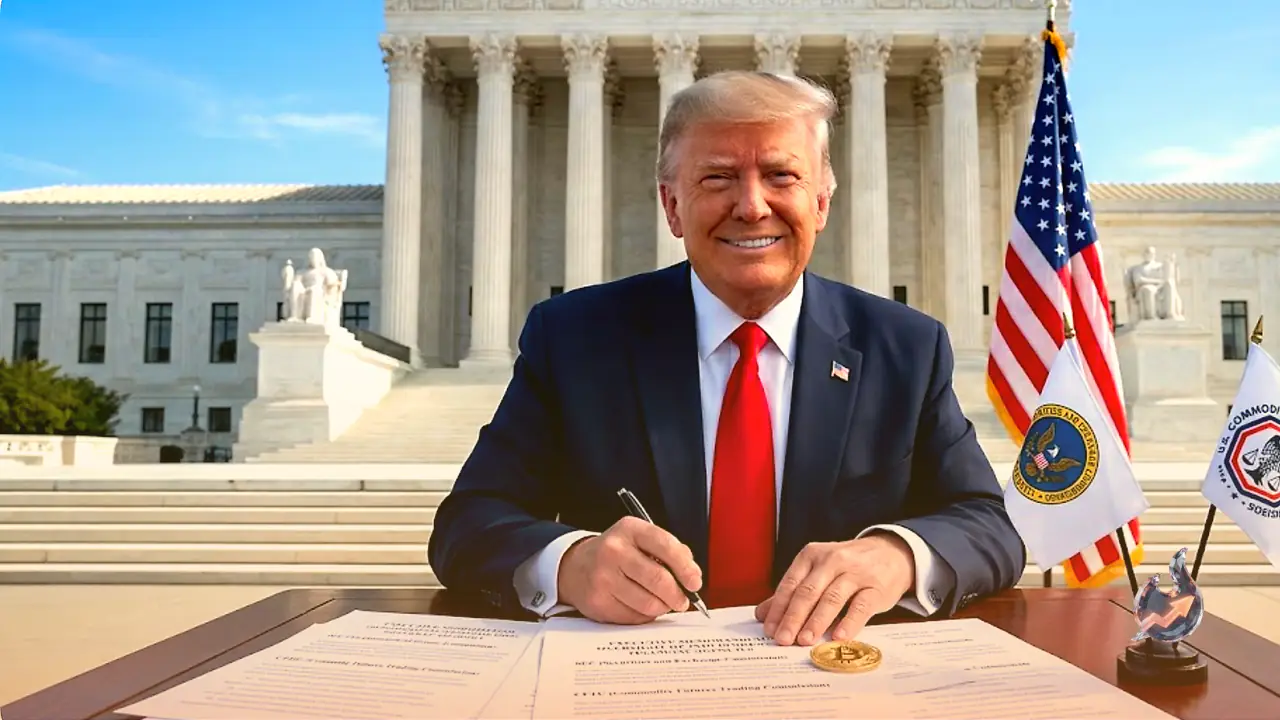

The U.S. Supreme Court on Monday struck down a near century-old limit on presidential power, scrapping the rule that allowed presidents to remove federal agency commissioners only under extraordinary circumstances. The ruling hands President Donald Trump far greater authority over several key regulatory areas, including crypto.
In a 6-3 decision, the court's conservative majority upheld Trump's right to dismiss Rebecca Slaughter, a Democratic FTC commissioner. The justices made clear that the president can now fire other agency commissioners at will, with the sole exception of Federal Reserve governors.
A Direct Crypto Connection
The case is closely tied to the crypto industry. Slaughter's husband serves as VP of policy at Paradigm, a heavyweight venture firm in the sector. That position allowed the couple to bankroll Slaughter's lawsuit all the way to the Supreme Court.
Trump v. Slaughter overturns a longstanding precedent set during the early years of the Franklin Delano Roosevelt administration. Under that arrangement, a president could remove an agency commissioner only in extreme cases of neglect of duty or malfeasance.
Trump celebrated the outcome on social media. "Today's historic Slaughter decision by the Supreme Court is the greatest increase in presidential power in the last 100 years," he wrote on Monday. "Such a monumental ruling at such an important time!"
New Leverage Over the SEC and CFTC
From now on, Trump, along with future presidents, will be able to remove commissioners at major regulators like the SEC and CFTC at any moment and for almost any reason. The shift grants the executive branch substantial new power over the direction of agencies that have long been treated as independent.
Trump has already shown his hand. He has refused to appoint Democrats to the SEC and CFTC, both of which are meant to include two minority-party commissioners. The SEC currently has three Republican commissioners and no Democrats, while the CFTC is left with a lone Republican chairman.
Clarity Act Standoff
The issue became a flashpoint in the yearlong fight to pass the Clarity Act, a bill that would formally legalize most crypto activity in the United States. Senate Democrats have repeatedly stressed that they will not back the legislation, which would hand the SEC and CFTC sweeping authority to regulate crypto markets, unless Trump commits to appointing Democrats to both agencies.
In December, Trump said he was "open" to the idea. Yet in the six months since, he has made no such appointments.
Monday's ruling deepens the tangle, since Trump could now theoretically appoint Democrats to federal agencies and then dismiss them at any time afterward.
The Pressure of an August Deadline
The decision lands as the Clarity Act faces a do-or-die push after more than a year of starts and stops. Most stakeholders agree the bill must pass by early August to have any shot at becoming law, given the looming November midterm elections.
Several hurdles beyond regulator independence still block the legislation. Chief among them is whether Trump will sign off on ethics language restricting his many lucrative crypto ventures. Senate Democrats have drawn that language as a red line. Earlier today, GOP Senate leadership signaled it intends to force a floor vote on the Clarity Act next month, whether Democrats are ready or not.