


















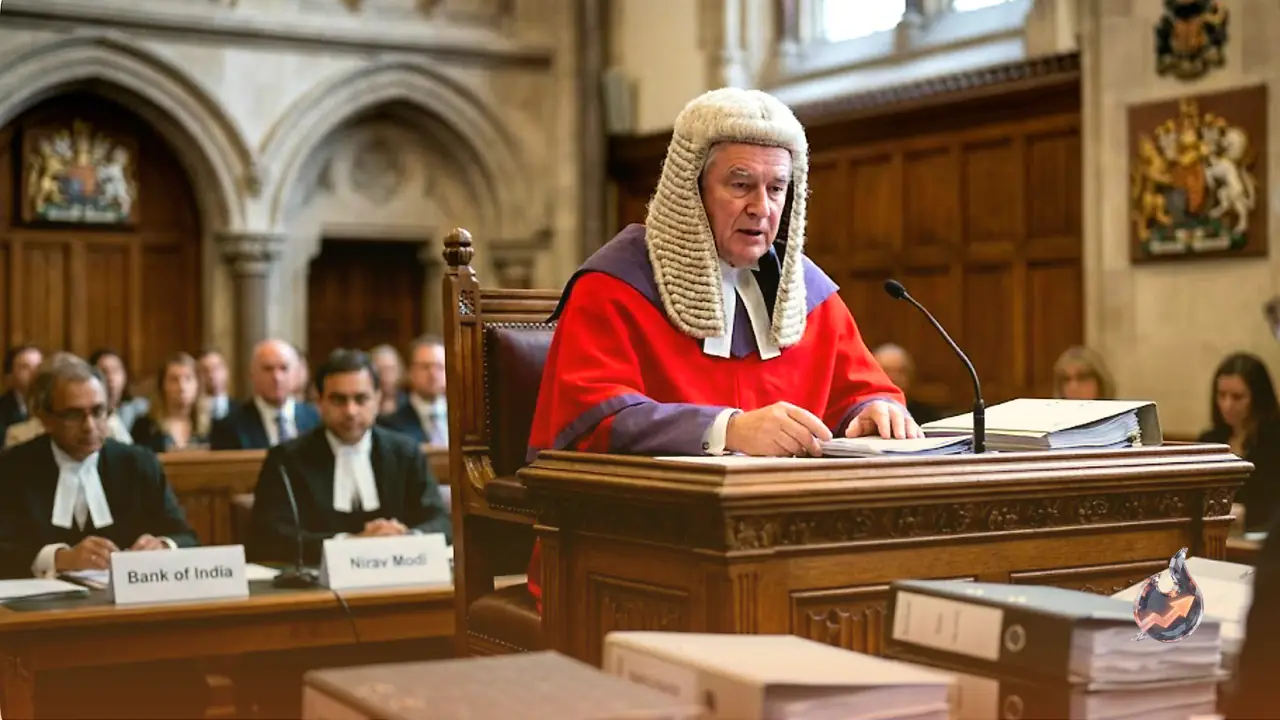

There is fresh trouble in London for fugitive diamond merchant Nirav Modi. On Tuesday, the London High Court ruled in favour of Bank of India, deciding the ₹100 crore case against Nirav Modi in the lender's favour. The court held that the public sector bank is owed $10.7 million by Nirav Modi, an amount that works out to a little more than ₹100 crore.
The verdict was delivered by Judge Simon Tinkler at the London Circuit Commercial Court. In his order, the judge stated that under the personal guarantee Nirav Modi had given to the bank, he is liable to repay the principal sum of $4.1 million, roughly ₹38.9 crore. Interest, calculated on the basis fixed by the bank, will be added on top of this. The judge also observed that Nirav Modi failed to put forward any defence showing why the bank was not entitled to the amount.
Nirav Modi's arguments fell flat
During the hearing, Nirav Modi's side argued that the guarantee was not legally enforceable. The claim was that he had never received any valid demand from the bank, and that there was no concrete adverse impact justifying the cancellation of the loan. The court, however, did not accept these arguments.
Nirav Modi is currently lodged in a London jail and is fighting a legal battle against extradition to India. This latest ruling has only added to his difficulties.
How the whole case began
The roots of this dispute go back to 2012. In July 2012, Bank of India had lent money to Firestar Diamond FZE, based in Dubai, which is one of Nirav Modi's companies. Later, on 3 August 2013, Nirav Modi provided his personal guarantee for this loan.
In early 2018, as the alleged fraud involving Nirav Modi and Punjab National Bank came to light, Bank of India decided to recall the loan it had extended. In March and April 2018, the bank sent demand notices to both Firestar and Nirav Modi, but received no response.
Following this, Bank of India obtained a summary judgment on 8 March 2024 for the $4.1 million principal amount and the interest on it. The bank also sent Nirav Modi another demand letter in October 2025. The London High Court's ruling now strengthens the bank's path to recovering the outstanding amount.