




















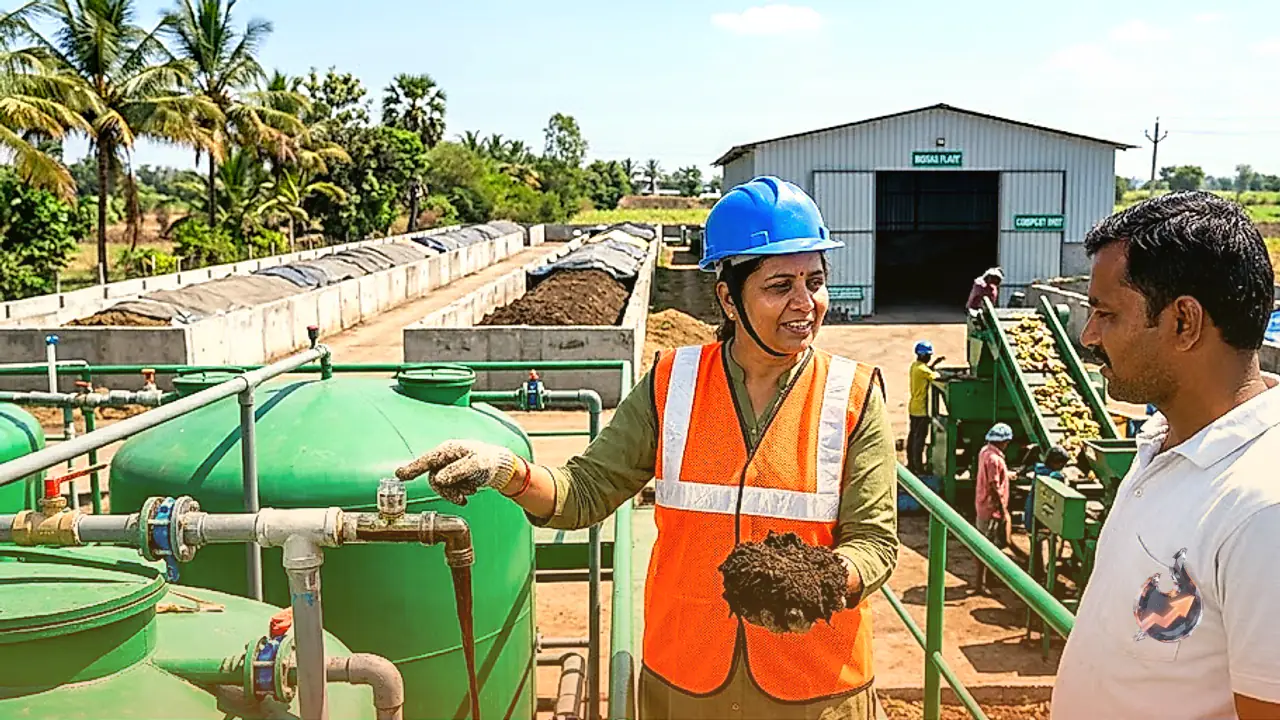

Everyday organic wet waste originating from households and commercial markets is no longer viewed merely as refuse destined for dumpsites. Instead, it has transformed into a highly lucrative business opportunity for modern green entrepreneurs. By utilizing advanced scientific processing techniques, organic waste can be processed into compressed bio-gas (CBG) and nutrient-rich organic compost. Setting up these processing plants serves a dual purpose: it ensures scientific waste disposal, preserves environmental hygiene, and yields substantial commercial returns. To encourage investment in this sector, both central and state governments in India are providing multi-tiered financial support, subsidies, and policy backing at every stage of plant setup and operations.
Comprehensive Multi-Ministry Policy Framework
India has established a robust institutional mechanism to facilitate the commercial conversion of organic waste into renewable energy and manure. According to Priyanka Singh, Senior Programme Lead at the Council on Energy, Environment and Water (CEEW), organic waste management operates under a diverse multi-agency structure. CEEW research highlights that approximately 16 central ministries and government entities currently collaborate to govern and promote this sector. This extensive national effort is operationalized through 9 major programs, 3 core policy guidelines, and 7 designated government schemes.
Key national flagship programs, including Swachh Bharat Mission-Urban (SBM-U), the National Bioenergy Programme, and the GOBARdhan (Galvanizing Organic Bio-Agro Resources Dhan) scheme, have fundamentally reframed public policy on waste. Rather than approaching waste strictly as a disposal challenge, these frameworks position organic refuse as a valuable economic resource capable of driving clean energy production and generating sustainable revenue streams for private enterprises.
Central Subsidies: CFA, SATAT, and GOBARdhan Schemes
Entrepreneurs looking to establish wet waste processing facilities can tap into direct financial grants offered by the central government. The Ministry of New and Renewable Energy (MNRE) provides Central Financial Assistance (CFA), which offers upfront capital subsidies for erecting biogas plants. This financial support directly reduces the initial out-of-pocket capital expenditure required by project developers, making large-scale greenfield projects financially viable.
Furthermore, for entrepreneurs focusing on producing organic fertilizers and compost, targeted support is available through schemes like SATAT (Sustainable Alternative Towards Affordable Transportation), GOBARdhan, and Market Development Assistance (MDA). While some of these initiatives do not distribute direct cash disbursements to plant owners, they create a highly favorable market ecosystem. By structuring off-take agreements, linking compost production with commercial fertilizer distributors, and establishing price stability mechanisms, these policies eliminate entry barriers and guarantee demand for processed organic waste products.
Financial Reliefs, Tax Waivers, and Infrastructure Incentives
To deepen private sector participation and ensure institutional credit flow, the government has integrated waste-to-energy projects into broader financial and banking mechanisms. Biogas and waste management infrastructure units qualify for Priority Sector Lending (PSL), enabling developers to secure commercial bank loans at lower interest rates and streamlined approval processes. Additionally, projects can leverage credit guarantee facilities and interest subvention benefits provided under the Agriculture Infrastructure Fund (AIF).
Significant fiscal incentives are also extended during operational phases. Compressed bio-gas (CBG) blended into city gas networks or compressed natural gas (CNG) supplies enjoys explicit exemptions from central excise duty. To solve logistical challenges, the government supports direct pipeline infrastructure integration for bio-gas injection. Developers importing high-efficiency processing machinery also receive concessional customs duty certificates, lowering technological import costs substantially.
State-Level Capital Grants and Project Viability
Beyond central government incentives, individual state governments provide complementary capital and administrative support for setting up CBG and waste processing plants. States such as Maharashtra, Gujarat, and Uttar Pradesh have published specialized state CBG policies. These state-level provisions build directly on top of central subsidies like MNRE CFA and SATAT, providing additional capital grants, waivers on land use conversion fees, stamp duty exemptions, and concessions on local taxes.
The synthesis of central and state subsidies drastically reduces the total capital expenditure (CapEx) burden for prospective plant owners. By lowering initial deployment costs, these combined policy benefits shorten the payback period and enhance the overall internal rate of return (IRR) for investors. Through this coordinated financial ecosystem, organic waste management in India has evolved into a commercially sustainable, highly attractive enterprise.