



















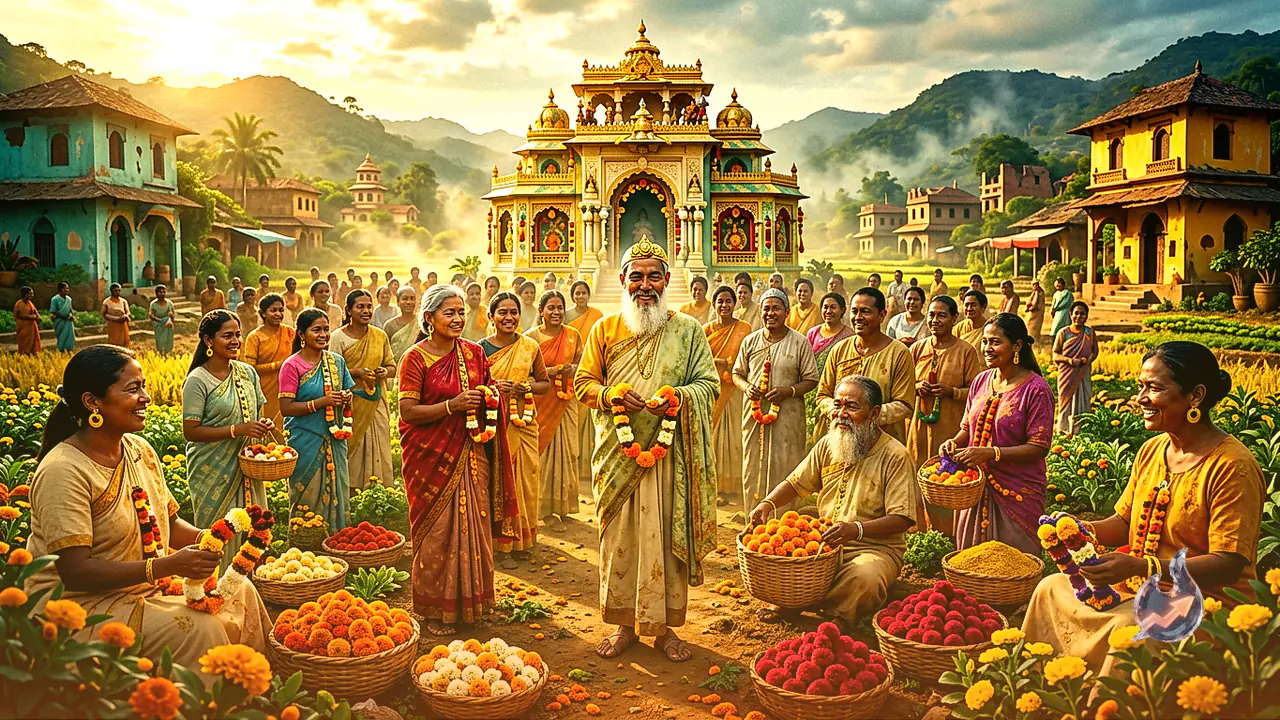

The annual Shravani Mela in Deoghar, Jharkhand, is widely celebrated as one of the largest religious gatherings in Eastern India, drawing millions of devotees to offer sacred prayers at the revered Baba Baidyanath Dham and nearby Basukinath Dham. Beyond its deep spiritual resonance, this grand month-long pilgrimage has gradually emerged as a powerful engine of economic transformation for surrounding rural communities. As vast waves of pilgrims purchase fresh blooms and hand-crafted garlands every morning to offer to Lord Shiva, agricultural households in the region are turning away from low-yielding traditional crops and moving rapidly toward commercial floriculture.
Shift From Traditional Grains to High-Value Floriculture
In the agricultural belt of Deoghar, particularly within the Mohanpur block, villages such as Kaniya Pokhar, Malhara, and Jariya are witnessing a dramatic shift in their countryside landscape. Fields that were once dominated strictly by staple food grains and seasonal rain-fed crops are now covered with vibrant flower plantations. Recognizing the surging commercial opportunity, local agricultural families are no longer limiting themselves to simply harvesting raw flowers and selling them wholesale. Instead, they have adopted an integrated value-addition approach where household members collaborate to craft intricate garlands directly at home.
This dual-channel operational strategy effectively creates two distinct revenue streams from a single plot of land. While a portion of the raw floral harvest is sold directly to market vendors, the remaining flowers are transformed into ready-to-use ceremonial garlands, fetching significantly higher profit margins. The entire domestic unit participates in this end-to-end effort. Women and elderly family members play a vital role in stringing the garlands, turning routine household routine into a productive domestic enterprise. By combining farm production with home-based processing, rural households are successfully building localized employment opportunities right at their doorstep.
Direct Access to Mela Markets Eliminates Transport Costs
During the peak weeks of the Shravani Mela, consumer demand for fresh flowers and garlands multiplies exponentially compared to standard off-season trading days. Devotees arriving from distant corners of the nation line up near temple complexes from the early hours of dawn to buy ceremonial items. Pop-up market stalls and dedicated flower vendors set up shop well before sunrise, experiencing brisk sales momentum throughout the morning and afternoon hours.
For smallholder farmers, this overwhelming concentration of buyers near the pilgrimage hubs delivers a massive economic advantage by solving long-standing supply chain challenges. Because the immediate temple precincts and surrounding urban bazaars can absorb virtually all locally produced flowers, growers no longer need to transport their yield to distant regional agricultural markets. This geographic proximity eliminates heavy freight and transit expenses while preserving the fresh quality of delicate blooms. Furthermore, selling directly to nearby markets drastically reduces post-harvest handling time and protects growers from unpredictable intermediary markups.
Family-Centric Business Model and Strategic Planning
Because the timing of the Shravan pilgrimage is fixed on the traditional calendar, farming communities in Deoghar systematically align their planting schedules months ahead of time. Growers carefully time their sowing and field maintenance so that their floral crops reach full bloom precisely when pilgrim turnout reaches its peak. This strategic calendar planning ensures a reliable, high-volume harvest exactly when prices and market demand reach their annual highs.
The entire operation relies on shared household labor, making floriculture an inclusive economic activity for the entire family unit. Explaining how local agricultural workers organize their efforts, farmer Pramod Pujhar noted, "Farmers prepare well in advance for the surge in flower demand during Shravani Mela, giving the whole family an extra earning opportunity." From field cultivation and pest management to delicate harvesting and morning garland creation, the workload is distributed across generations. This collaborative structure reduces reliance on hired external labor and ensures that financial returns remain entirely within the household budget.
Year-Round Demand Lays Foundation for Cottage Industry
While the Shravani Mela generates a significant seasonal windfall, the economic viability of flower cultivation extends far beyond the duration of the festival. Daily ritual practices, ongoing temple visits, and regional celebrations across Deoghar maintain a steady baseline demand for fresh flowers throughout the year. As a result, local growers are not forced to rely solely on the mela season for their livelihood, but can maintain regular cash flow month after month.
Agricultural observers point out that with targeted institutional support, floriculture in Deoghar could easily transition from an informal supplementary activity into a structured micro-industry for rural Jharkhand. Providing smallholders with modern cultivation techniques, improved seed varieties, cold-storage options, and organized direct-to-consumer sales infrastructure would further enhance profit margins. As holy chants resonate across Baba Baidyanath's sacred city, the blooming fields surrounding Deoghar are proving that religious tourism can cultivate lasting economic resilience for local farming families.