














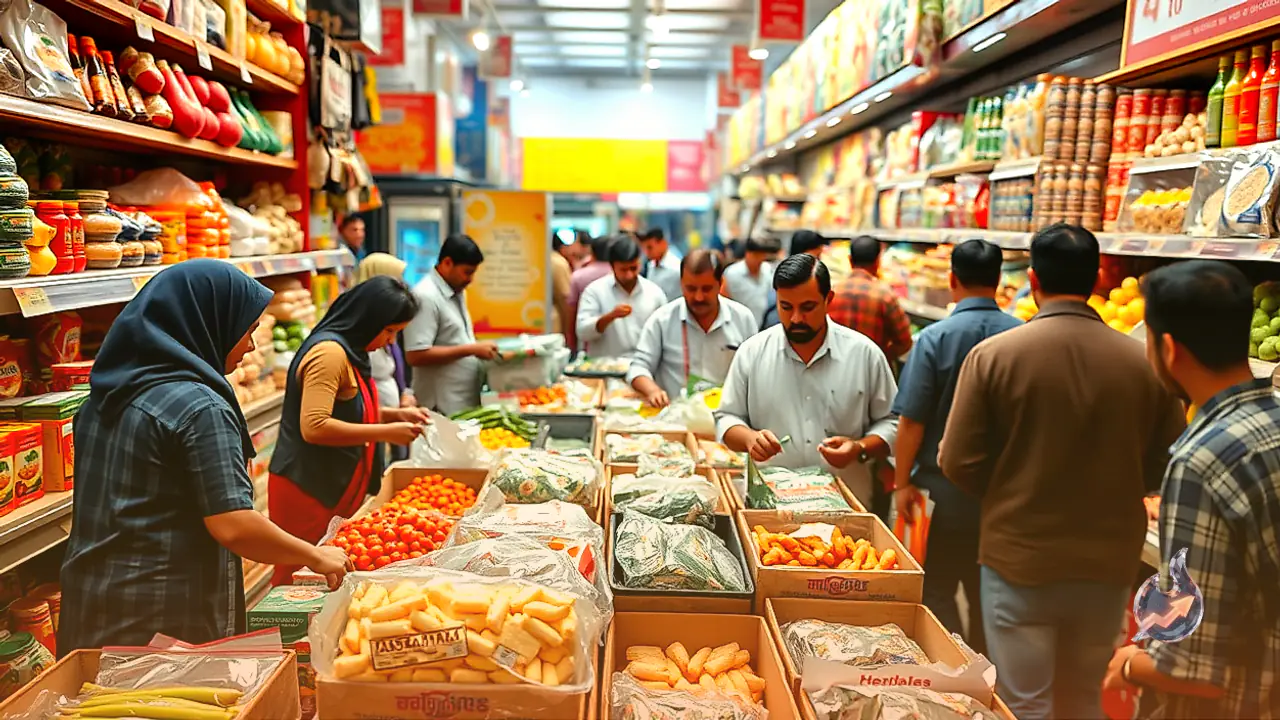

Household budgets across India came under severe strain during September as escalating prices of kitchen staples pushed headline retail inflation to 5.54 percent. Fresh numbers released by the government on Monday reveal a noticeable acceleration from August, when the Consumer Price Index based rate stood at 4.83 percent. The sharp upward trajectory comes against the backdrop of broader international tensions, notably lingering friction in West Asia and associated geopolitical disruptions that continue to influence global commodity markets.
Food Inflation Spikes Beyond Central Bank Baseline Target
Under the revised index series introduced in January, the September figure represents the highest level recorded so far. Driving this climb was the Consumer Food Price Index, which advanced from 5.97 percent in August to 7.74 percent in September. This acceleration carried the headline rate well above the Reserve Bank of India medium-term target of 4 percent, though it still stays within the statutory tolerance band of 2 to 6 percent. Responding to persistent price pressures, the central bank had already raised the benchmark repo rate by 0.25 percentage points last week to 5.50 percent.
Onion and Garlic See Massive Price Spikes
Among essential vegetables, onions experienced an extraordinary surge that placed severe pressure on everyday consumers. Inflation for onions leaped from 48.78 percent in August to a staggering 108.09 percent in September. Garlic followed a similar upward curve, moving from 43.60 percent to 54.62 percent. Lemon prices also jumped substantially, rising from 15.15 percent the previous month to 36.41 percent. In contrast, certain staples offered limited relief to shoppers. Potato prices declined by 11.50 percent year-on-year, while tomatoes saw an 8.62 percent reduction. Silver jewellery inflation remained elevated at 87.80 percent, though it moderated somewhat compared to August's mark of 106.81 percent.
Rural Inflation Breaches Upper Tolerance Threshold
The latest price shock hit rural households significantly harder than urban centres. Retail inflation across rural parts of the country jumped from 5.24 percent in August to 6.08 percent in September, crossing the upper comfort threshold of 6 percent. By comparison, urban areas experienced a milder rise, with inflation ticking up from 4.31 percent to 4.88 percent over the same period.
Tracking Month-by-Month Inflation Through 2026
The progression of retail inflation across 2026 reflects an uninterrupted upward trend throughout the year
- January: Inflation began the year at a subdued 2.75 percent.
- February: The index ticked upward to 3.21 percent.
- March: Price gains continued steadily at 3.40 percent.
- April: The rate advanced slightly to 3.48 percent.
- May: The index climbed further to 3.93 percent.
- June: Inflation surpassed the baseline target, hitting 4.38 percent.
- July: The rate consolidated at 4.45 percent.
- August: Upward momentum carried the figure to 4.82 percent.
- September: Accelerated food costs drove the figure to a high of 5.54 percent.
Service Sectors and Household Utilities Also Edge Higher
Price rises were not restricted to agricultural produce. The category covering personal care, social protection, and other miscellaneous goods and services posted an inflation rate of 13.75 percent in September. Accommodation and food services at hotels and restaurants recorded an increase of 9.36 percent. Transport registered a 5.01 percent inflation rate, driven primarily by a 7.46 percent rise in the cost of operating personal vehicles. Education services climbed 3.94 percent, housing and utilities rose 2.74 percent, and healthcare inflation stood at 1.40 percent.