






















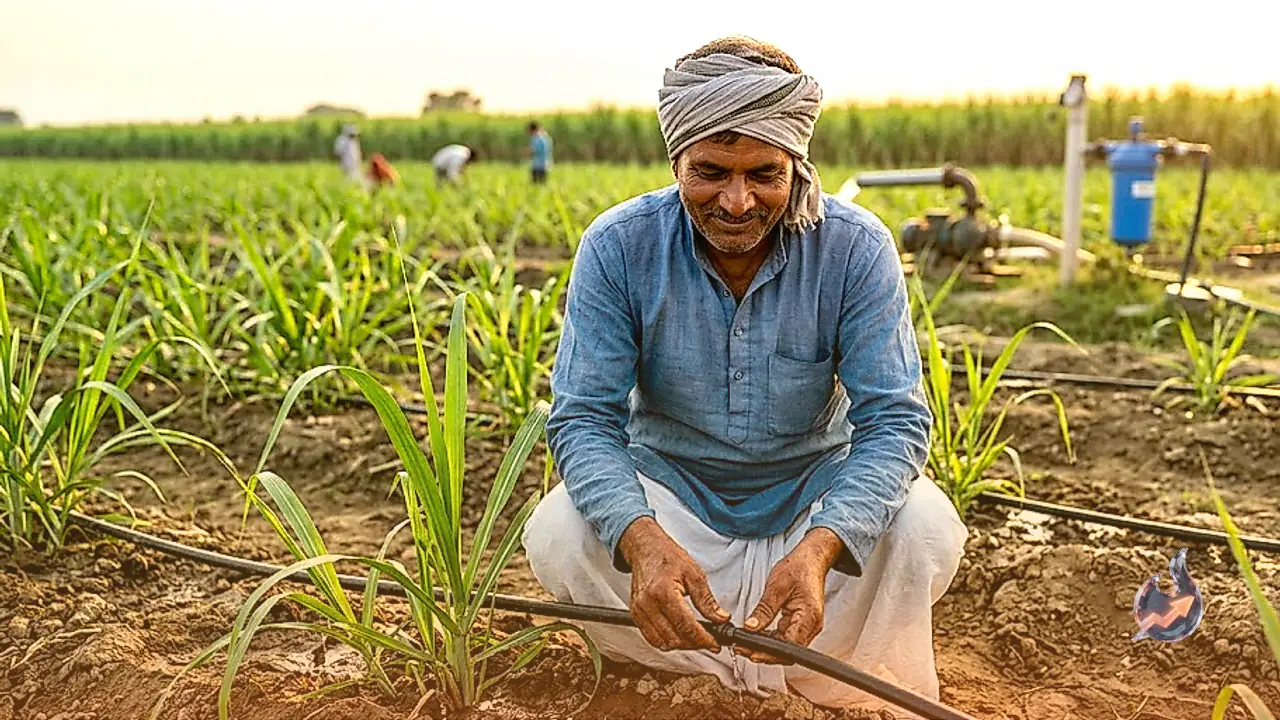

Amid rising water demands and modern agricultural challenges in Gonda, drip irrigation is proving to be immensely useful for farmers seeking efficient crop management. This technique allows for proper field irrigation while consuming minimal water resources. A major highlight for growers is the financial assistance provided by the government to install this infrastructure, where eligible farmers can receive subsidies of up to ninety percent under the scheme.
How The Drip Method Delivers Water Directly To Roots
Explaining the mechanics of this modern approach, Gunjan Shukla, a CRP at the Water Institute, notes that drip irrigation is an advanced process where water is delivered drop by drop directly to plant roots via specialized pipes and tiny emitters. This ensures that the field receives precisely the required moisture without any runoff or wastage. The technique is also widely known as the trickle method.
Extremely Useful For Vegetables And Fruit Crops
Gunjan Shukla points out that this method is especially suitable for growing vegetables, fruit-bearing plants, sugarcane, bananas, papayas, tomatoes, green chilies, and various other crops. Drip emitters are installed along the distribution pipes based on the specific spacing between plants, ensuring that every single plant receives targeted moisture.
Saving Up To Fifty Percent Water
The biggest advantage of drip irrigation is a direct saving of forty to fifty percent in water usage. In conventional irrigation, water spreads across large sections of the field, whereas the drip technique deposits moisture precisely near the plant root zone, fulfilling crop needs with much smaller water volumes.
Enhanced Crop Growth And Root Protection
When plants receive timely moisture tailored to their exact requirements, overall crop growth improves remarkably. Furthermore, the risk of water stagnation across the field is greatly reduced, which simultaneously minimizes any potential damage to plant root systems.
Efficient Application Of Water Soluble Fertilizers
Through the drip system network, water-soluble fertilizers can also be administered directly to the roots alongside irrigation water. This allows for a far more effective use of nutrients and cuts down the waste typically caused by scattering fertilizers across the open field.
Application Process And Government Subsidies
Highlighting government efforts to promote the practice, Gunjan Shukla explains that financial grants covering up to ninety percent of the cost are made available to farmers. Interested growers can visit their local district horticulture or agriculture department offices to check current eligibility criteria and subsidy details. To submit an application, farmers can visit their nearest CSC center carrying land records, a bank passbook, an Aadhaar card, and their farmer registry documents to complete the online filing process.