



















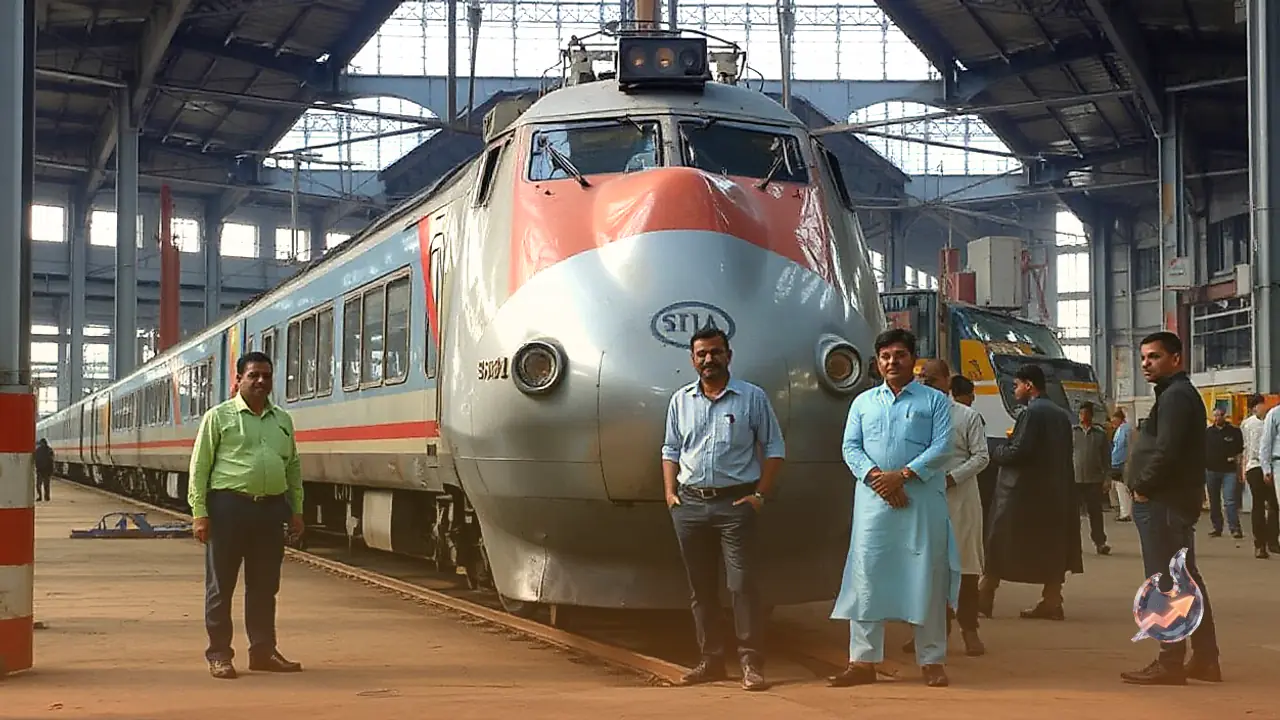

India's long-standing ambition of operating high-speed rail has moved from blueprints into tangible manufacturing reality. At the BEML manufacturing facility in Bengaluru, the car body shell of the nation's inaugural bullet train has been fully fabricated and entered critical structural evaluation. Railway Minister Ashwini Vaishnaw conducted an on-site inspection of the facility on November 1 to review assembly milestones, passenger amenities, and structural integrity protocols. Built with an eight-coach configuration, this advanced train set is engineered to achieve a design speed of 280 kmph alongside a targeted commercial operating speed of 250 kmph.
Squeeze Testing Evaluates Shell Strength and Stability
The integrated shell currently positioned inside the manufacturing plant serves as the structural foundation for the future train set. Fabricated by joining precision-cut sidewalls, roof structures, endwalls, and vital load-bearing segments, the shell forms a cohesive metallic shell. Specialized engineering teams are now running the final stages of the squeeze test on this primary frame.
When a passenger train moves at elevated velocities, the structural shell must endure intense pneumatic resistance, kinetic stresses, and rail-induced vibrations. Maintaining dimensional stability, frame rigidity, and structural resilience without permanent deformation under peak physical stress is imperative for passenger safety. The squeeze test validates these exact mechanical attributes against rigorous international railway standards before any additional internal hardware is permanently integrated.
Subassembly Integration: Bogies, Traction Motors, and Electronics
Once structural stress verifications are successfully completed, technicians will commence the comprehensive outfitting phase. Workers will install the high-output traction motors, power distribution systems, onboard electronic control architecture, and specialized propulsion systems. Concurrently, the mechanical bogie assemblies, braking linkages, and wheelsets will be mounted beneath each car body, transforming the bare metallic framework into an operational, motorized train.
Climatic Testing Across Severe Weather Extremes
Operating a high-speed passenger train across diverse geographic terrain requires environmental resilience tailored to harsh regional conditions. Engineers have finalized a comprehensive climate validation matrix to test the reliability of onboard mechanical and electrical systems across varying weather extremes.
The testing cycle will subject the train to extreme ambient thermal loads, ranging from scorching heat waves of up to 50 degrees Celsius down to freezing sub-zero conditions. Furthermore, simulated environments will evaluate system reliability under dense dust ingress, high humidity, and prolonged monsoon cloudbursts. Technicians will observe the equipment closely to guarantee that continuous water exposure does not impede critical electrical connections or degrade auxiliary power systems.
Vibration Dampening, Passenger Seating, and Climate Controls
Beyond aerodynamic velocity, engineering teams have prioritized cabin comfort and interior passenger ergonomics. During the facility walkthrough, the Railway Minister examined the passenger seat geometries, mechanical couplers, and the integrated heating, ventilation, and air conditioning (HVAC) systems.
High-velocity rail journeys frequently subject passenger cabins to acoustic noise and high-frequency tremors. To maintain cabin quietness, specialized soundproofing barriers and vibration dampening materials are being embedded within the structure. The inspection also encompassed precision jigs, production fixtures, and the modular alignment of roof and side assemblies, ensuring zero-tolerance dimensional fidelity across the manufacturing run.
Advancing Domestic High-Speed Rolling Stock Capability
The manufacturing work conducted at BEML's Aditya facility marks a major stride forward for India's domestic heavy engineering capabilities. Mastering large-scale structural fabrication, modular integration, and precision validation for advanced rail platforms establishes a strong domestic engineering base. This development demonstrates the growing technological maturity of Indian industry in executing sophisticated high-speed rail systems locally.