














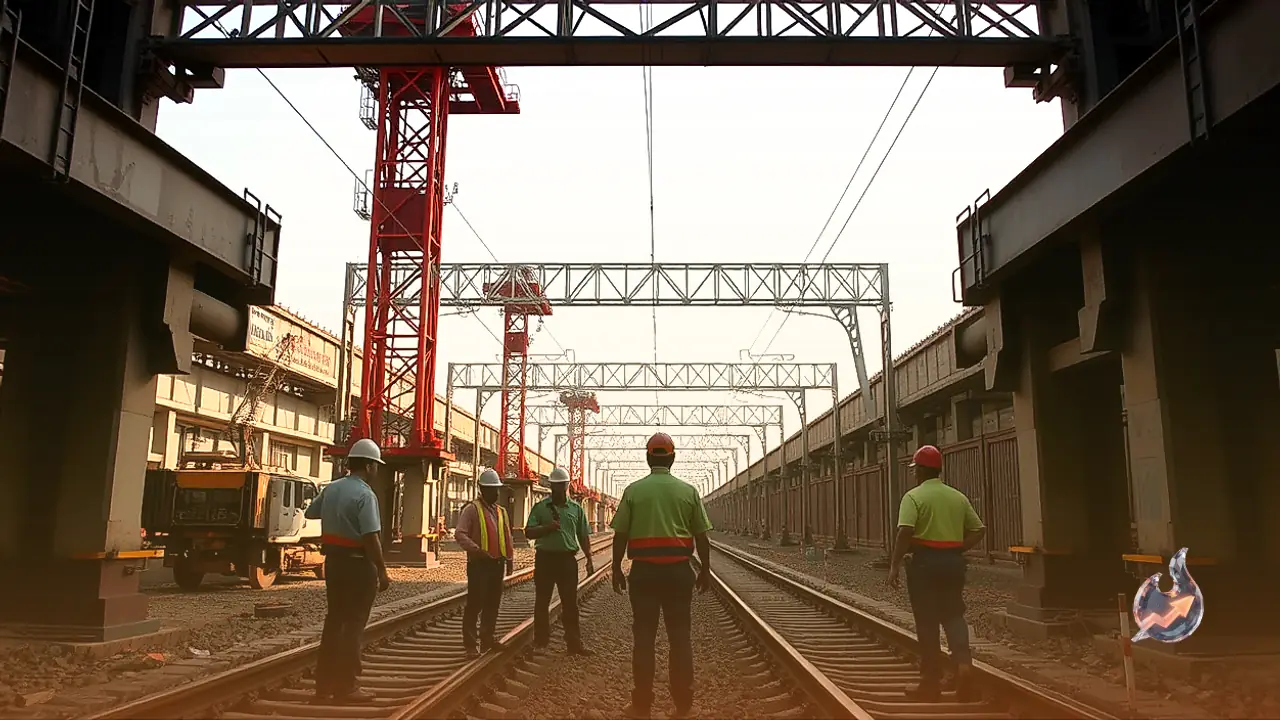

A critical engineering milestone has been achieved on the Mumbai-Ahmedabad bullet train corridor with the successful installation of all 14 heavy portal beams across the busy Delhi-Mumbai rail route in Vadodara, Gujarat. The structural work was completed directly above operational tracks without disrupting existing train schedules. This enables passenger and express services to continue running uninterrupted below while the elevated high-speed railway corridor will pass directly overhead, successfully resolving a major structural bottleneck on the national project.
Navigating Dense Urban Infrastructure and Five Rail Tracks
An 8.3-kilometer stretch of the bullet train route in Vadodara cuts through densely populated urban neighborhoods and an intricate rail hub. This specific alignment traverses five Indian Railway tracks, including two vital main lines. Furthermore, the elevated high-speed corridor crosses the Delhi-Mumbai Rajdhani route at an oblique angle. Building heavy infrastructure across one of the country's most heavily utilized passenger rail arteries required meticulous planning to guarantee passenger safety and maintain continuous rail traffic. Specially designed portal beams were engineered specifically to span the tracks and carry the weight of the elevated viaduct overhead.
Beam Placement Across the Vadodara Alignment
A total of 14 massive portal beams have been positioned strategically along the Vadodara section. Ten of these beams stand between the Vadodara bullet train station and Vishwamitri railway station toward the Surat direction. The remaining four beams are located between Vadodara railway station and Chhayapuri railway station facing toward Ahmedabad. Crews will now place composite girders measuring approximately 40 meters in length across these portal beams, creating the base for the elevated track bed. On adjacent stretches where track crossings are absent, construction is advancing via standard span-by-span methodology.
Massive Dimensions and In-Situ Concrete Casting
The structural scale of each portal beam posed severe execution challenges for site engineers. Once cast, each beam weighs approximately 1,500 tonnes. In terms of dimensions, every unit measures about 37 meters in length, four meters in height, and four meters in width. Fabricating a single beam required roughly 590 cubic meters of concrete, reinforced by an internal steel structure weighing approximately 55 tonnes. Given severe space constraints and active rail traffic running below, prefabrication elsewhere was unviable; engineers poured the concrete directly in place using heavy-capacity cranes, specialized hydraulic jacks, and rigorous safety rigging.
Next Steps for Corridor Construction
The completion of all 14 portal beams above the Delhi-Mumbai trunk line eliminates a formidable civil engineering obstacle within Gujarat. While this structural phase marks one specific component of the larger Mumbai-Ahmedabad high-speed rail development rather than the final commissioning of the entire network, it paves the way for uninterrupted girder launching and accelerated civil construction across Vadodara.