
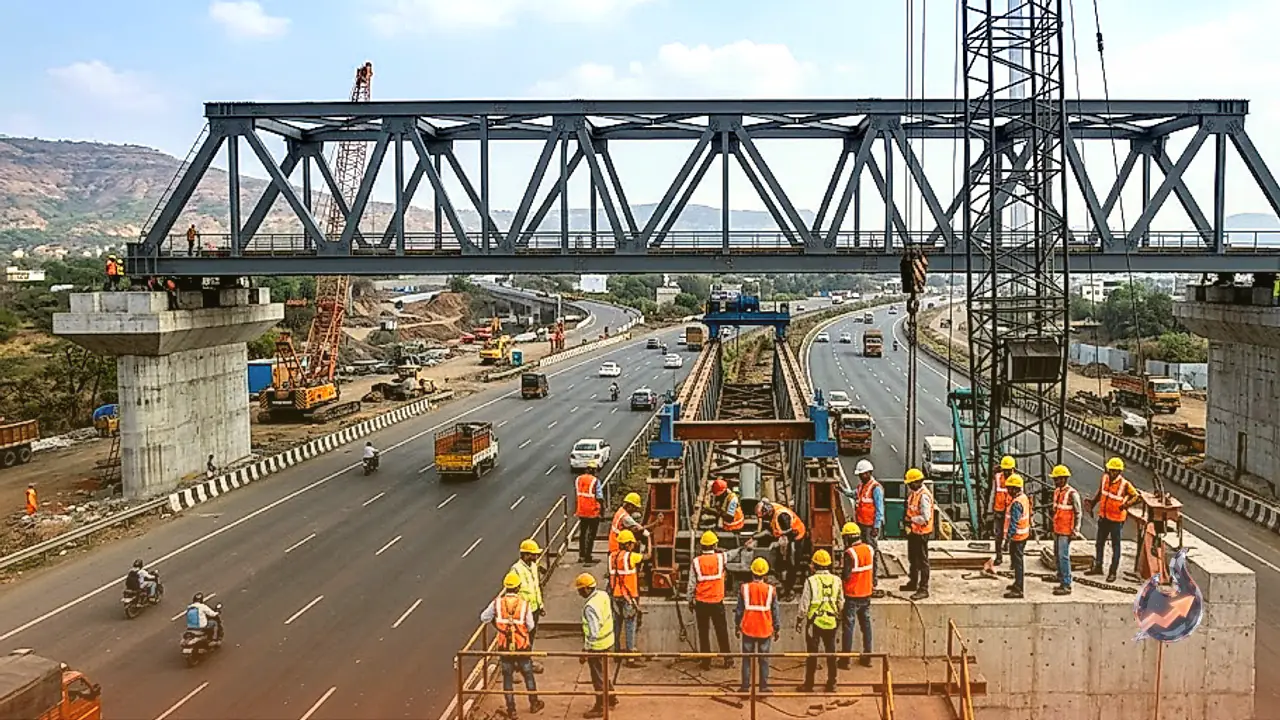




















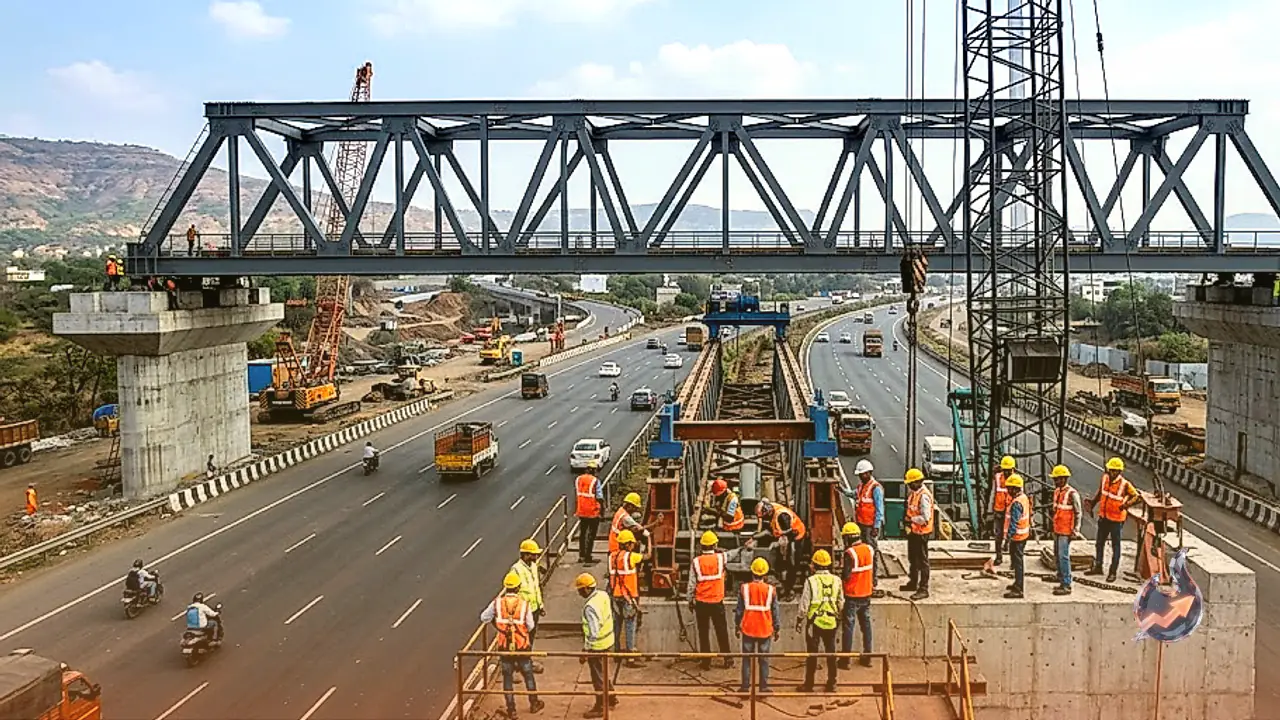

A critical engineering milestone has been completed inside Maharashtra for the upcoming Mumbai-Ahmedabad high-speed rail corridor with the successful installation of its first steel bridge. The massive structure, weighing approximately 1,405 tonnes and stretching 100 meters in length, was erected directly over the busy National Highway 3, widely known as the Nashik Highway, at Dive-Anjur village in Bhiwandi within Thane district. Adding to the logistical feat of the operation, the massive bridge components were fabricated nearly 1,300 kilometres away in Tiruchirappalli, Tamil Nadu, before being hauled cross-country by road and assembled directly at the Maharashtra project site.
Dimensions, Rigging, and Assembly Mechanics
The newly positioned superstructure measures 100 meters in length, 14 meters in width, and stands 14 meters high. Its overhead configuration was chosen specifically to cross the arterial roadway while keeping vehicular disruption on the ground to an absolute minimum. Structuring the components into a cohesive unit required around 54,076 high-strength tor-shear type bolts. To assemble the heavy steel framework, engineers erected temporary trestles raising the platform roughly 17.5 meters above ground level. A network of 22 skid arrangements guided the structure as it came together. Shifting the immense load into its permanent alignment relied on a specialized automated system powered by two 150-tonne capacity hollow jacks working in tandem with pre-tensioned Macalloy bars.
Cross-Country Haul from Tiruchirappalli and Rigorous Quality Checks
The journey behind this super girder highlights extensive inter-state industrial coordination. Initial manufacturing took place inside a specialized heavy engineering workshop in Tiruchirappalli. Once the structural components were fabricated, they were loaded onto heavy-duty trailer convoys and transported overland across roughly 1,300 kilometres to reach the staging area in Maharashtra. Factory production demanded extreme precision during cutting, drilling, welding, and surface treatment. Every single batch of structural steel underwent mandatory ultrasonic testing to identify any internal defects. Furthermore, the welders and site supervisors who handled fabrication and jointing held formal credentials validated by international welding experts.
Nighttime Launch Operations to Safeguard Highway Traffic
Because National Highway 3 carries substantial passenger and freight traffic between Mumbai and Nashik, civil teams scheduled the final launch operations during night hours under controlled traffic blocks. The multi-step shifting process was executed in tight phases according to predetermined technical timelines. To shield the metal bridge against weathering over decades of service, engineers treated the entire surface with an advanced C5 protective painting system. Elastomeric bearings were also integrated beneath the superstructure to dampen structural vibration caused by oncoming high-speed trains and reinforce long-term structural integrity.
Corridor Reaches 16 Out of 28 Planned Steel Crossings
The complete 508-kilometer Mumbai-Ahmedabad bullet train corridor incorporates a total of 28 dedicated steel bridges along its alignment. With this latest installation in Thane district, work on 16 of those 28 steel spans has now been completed. Engineers employ these fabricated steel truss crossings over high-density traffic arteries such as expressways, major rivers, and existing railway corridors, where wider single spans are required without building intermediate piers that would block traffic below.