























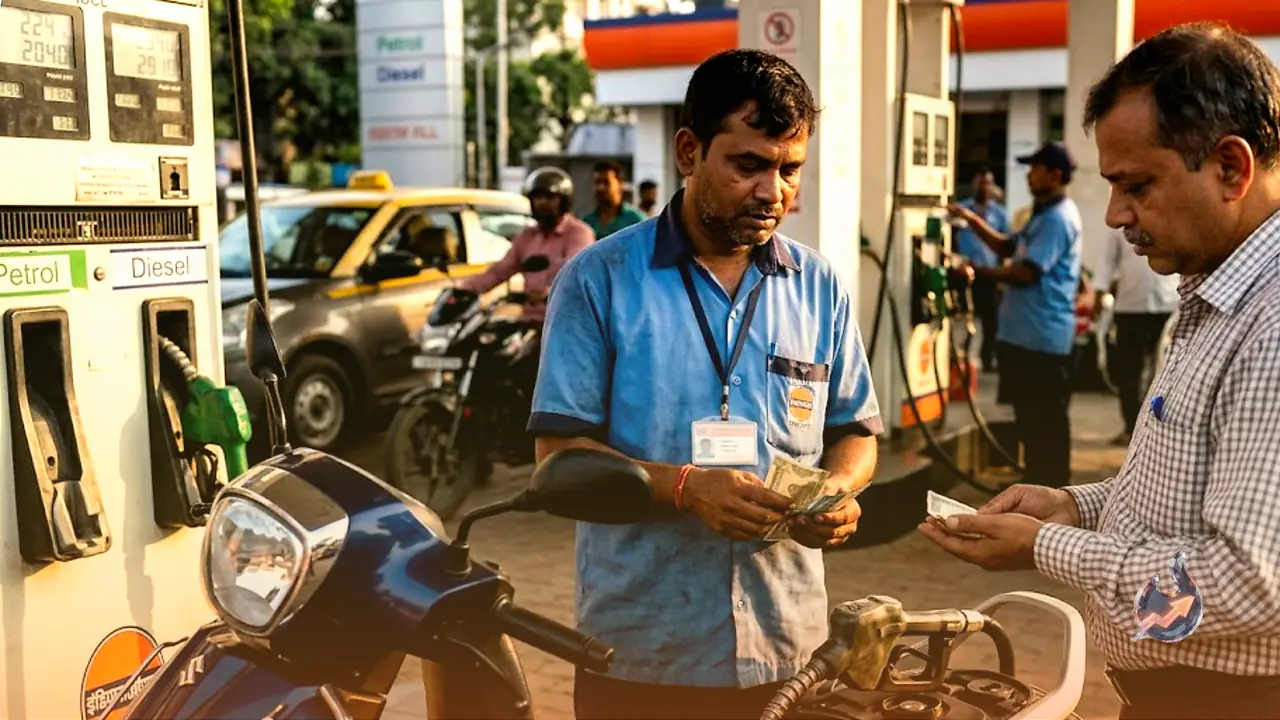

The new financial year has begun on a painful note for India's oil marketing companies (OMCs). During the first quarter, covering April to June, these firms took a hit of Rs 18.9 on every litre of diesel and Rs 6 on every litre of petrol sold in the retail market. According to brokerage firm ICICI Securities, domestic petrol and diesel prices stayed lower than international crude prices, and that gap was the main reason behind the losses.
A Year Ago, the Companies Were Minting Money
The picture was completely reversed just twelve months earlier. Back then, oil firms were pocketing Rs 8.2 on every litre of diesel and Rs 10.3 on every litre of petrol. By comparison, the retail margin in the June 2024 quarter stood at Rs 2.5 per litre on diesel and Rs 4.4 per litre on petrol. This time the equation flipped. In the first quarter of the current fiscal year, international crude and refined fuel prices rose, but that increase was not fully passed on to domestic prices. As a result, the retail margin slipped into negative territory.
Rs 75,000 Crore Wiped Out by Below-Market Sales
Petroleum and Natural Gas Minister Hardeep Singh Puri said on Thursday that in the quarter ending June, oil companies suffered a loss of roughly Rs 75,000 crore because they sold petrol, diesel, liquefied petroleum gas (LPG) and jet fuel below prevailing market rates. At the refinery gate, petrol and diesel prices are fixed in line with international fuel rates. After that, the companies add the cost of transport, marketing and distribution, along with dealer commission and their own retail margin, to arrive at the price at the pump.
Rs 12 Earned on a Litre of Petrol in the Third Quarter
The underlying math is simple. When pump prices at home do not rise in step with international rates, the retail margin shrinks, exactly what happened during the June quarter. On the flip side, when international fuel prices fall but pump rates stay unchanged, the margin swells. In short, the retail margin keeps moving up and down with the trend in global oil prices. According to ICICI Securities, over the past two financial years the petrol margin peaked at Rs 12 per litre in the third quarter of 2024-25, while the diesel margin hit its high of Rs 8.2 per litre in the first quarter of 2025-26.
Four Years of Handsome Earnings
The roots of this pattern go back to early 2022. When the Ukraine war broke out and global oil prices shot up, oil companies abandoned the practice of revising retail prices regularly in line with international markets. Over the past four years, pump prices have barely moved. This gave the companies a double experience: when global prices fell they earned fat margins, but when international prices climbed they had to absorb thin or negative margins. The current quarter is a textbook example of that second scenario.