






















Every morning across urban India, sanitation vehicles navigate residential streets, urging citizens to keep their household waste segregated into wet and dry categories. Modern apartment complexes and neighborhood societies routinely enforce the usage of separate collection containers. Despite these efforts, a lack of clear understanding leads many households to mix their everyday refuse. Similarly, the blue and green dustbins placed in public parks, transit hubs, and commercial zones often leave pedestrians confused about which item goes where. Yet, far from being mere trash, the organic refuse generated in kitchen spaces represents a massive, untapped economic reservoir. With systematically organized collection and primary segregation, organic waste is rapidly transitioning into a lucrative green enterprise.
Defining the Divide: Wet Waste vs Dry Waste
Solid waste management frameworks in India underwent crucial updates, with comprehensive rules established as of April 1, 2026. According to Priyanka Singh, Senior Program Lead at the Council on Energy, Environment and Water (CEEW), waste is fundamentally divided into two major operational categories based on its physical properties and degradation potential.
Wet waste, also termed organic waste, comprises biodegradable items that decay rapidly through natural biological processes. This category includes kitchen leftovers, spoiled food, vegetable and fruit peels, poultry and meat trimmings, as well as organic floral waste and fallen leaves. Because of its moisture content and organic nature, this waste decomposes quickly under ambient conditions.
Conversely, dry waste consists of non-biodegradable materials that do not decay naturally over short timeframes but possess high recyclability. This group includes rigid and flexible plastics, cardboard, paper products, glass containers, metal scraps, discarded textiles, and construction debris. Given their radically different physical characteristics, processing these two streams requires entirely distinct supply chains.
The Economic Equation: A $61.5 Billion Market Opportunity by 2047
Urban centers in India generate an estimated 17 lakh tonnes (1.7 million tonnes) of solid waste every single day. Approximately half of this daily total—around 8.5 lakh tonnes—consists purely of wet organic matter. Presently, a vast portion of this material ends up in municipal landfills, where anaerobic decay emits greenhouse gases and contaminates surrounding groundwater, creating serious environmental hazards.
However, viewed through an industrial lens, this organic stream offers an unparalleled commercial opportunity. Comprehensive research conducted by CEEW highlights that if India aggressively pursues its overarching green transition targets, the domestic organic waste market could scale to $61.5 billion by the year 2047. Realizing this potential would require a cumulative investment of $30.2 billion across processing infrastructure, logistics, and technology. Even under a conservative baseline scenario, the organic waste sector is projected to hit a market value of $10 billion by 2047, underscoring the tremendous economic yields obtainable through disciplined municipal management.
Why Source Segregation Is Essential
A frequent question among residents is why segregation must occur at the household level rather than at centralized processing facilities. As CEEW expert Priyanka Singh emphasizes, organic waste is an easily accessible source of high-value bioproducts, but its value drops exponentially when contaminated.
When wet organic matter is mixed with dry inorganic refuse, the moisture degrades paper and cardboard while fouling recyclable plastics and metals, rendering secondary sorting complex and financially unviable. Furthermore, separating intermixed organic sludge at a plant requires excessive energy and capital. Segregating at the point of origin—inside the home—ensures a clean, high-grade organic feed stream that can directly enter aerobic composting or anaerobic digestion facilities without costly pre-treatment.
Demystifying Public Bins: Green vs Blue Infrastructure
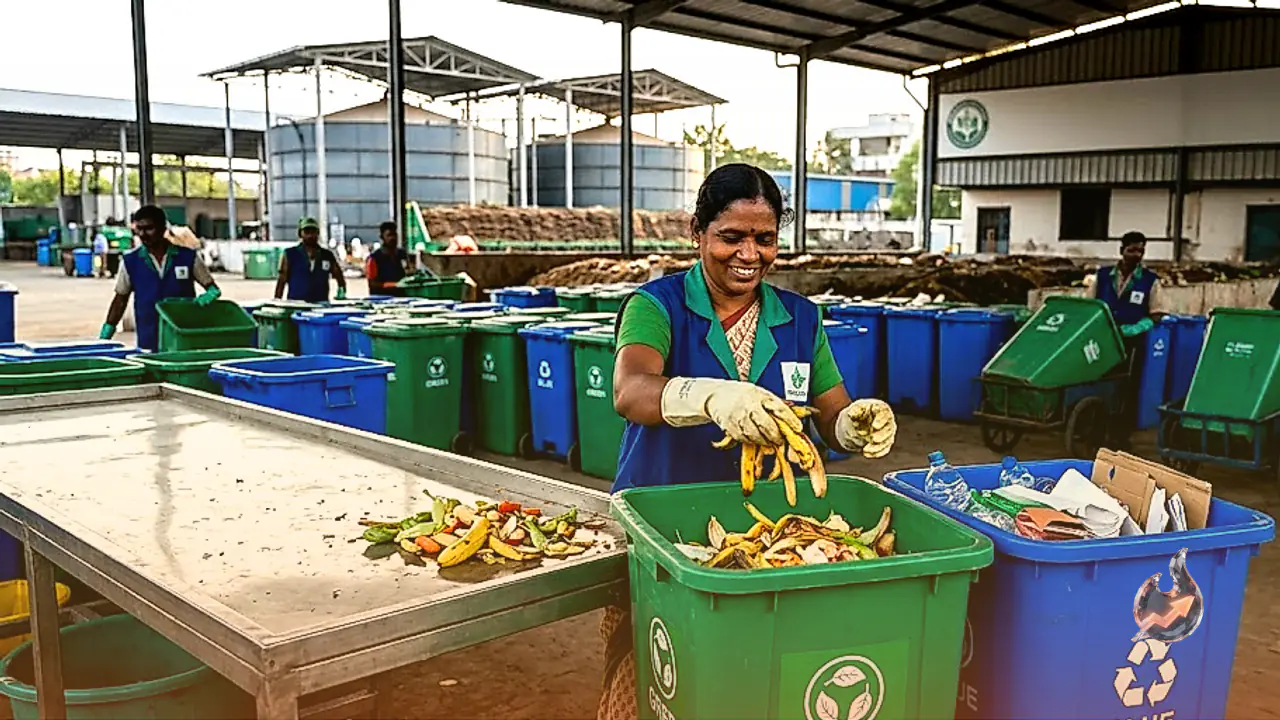
To streamline public compliance, civic authorities deploy color-coded bins across public locations, public parks, and residential neighborhoods. Understanding their designated functions is straightforward
- Green Dustbins: Exclusively designed for wet organic refuse. Items such as cooked food, agricultural produce peels, expired food products, garden clippings, and botanical waste belong here. These substances decompose naturally to enrich soil systems.
- Blue Dustbins: Reserved for dry, recyclable non-biodegradable waste. Paper, corrugated boxes, beverage bottles, glass jars, tin cans, and synthetic materials must be placed in these containers.
Educating households and younger generations on these color codes forms the backbone of sustainable municipal waste management strategies.
Converting Garbage into Bio-Energy and Soil Conditioners
Once collected cleanly, organic waste enters specialized recycling pathways. As a naturally biodegradable resource, it is primarily processed into two high-value commodities: organic compost and biogas.
Compost serves as a nutrient-rich organic soil amendment, replacing synthetic chemical fertilizers in agricultural fields and urban horticulture. Biogas technology utilizes anaerobic digesters to break down organic matter, capturing methane gas that can be utilized directly for thermal applications, power generation, or upgraded into compressed bio-gas (CBG) for vehicular fuel. Converting daily kitchen waste into clean energy directly supports national energy security while drastically reducing urban carbon footprints.