




















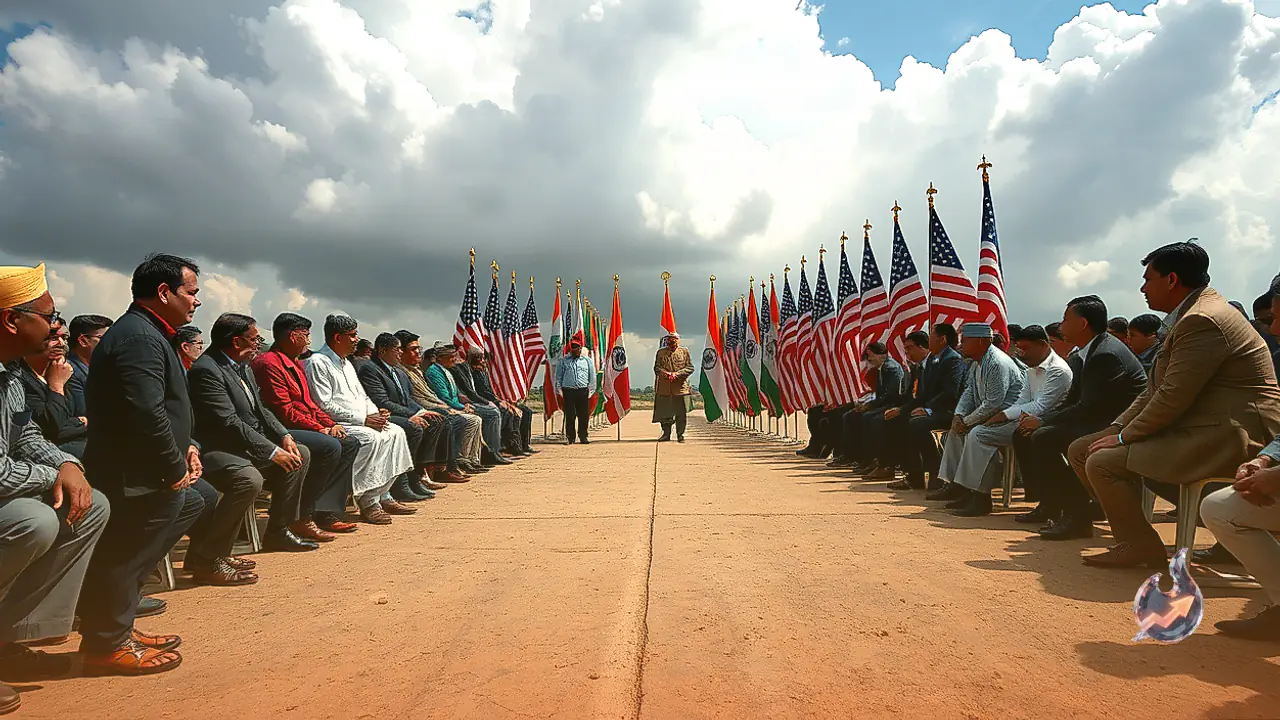

Addressing attendees at the Munich Leaders Meeting hosted in New Delhi on October 5, Finance Minister Nirmala Sitharaman stated that bilateral trade negotiations between India and the United States are confronting stringent boundaries. She noted that discussions between both governments continue to make progress, yet negotiators appear to be exhausting the available room for reciprocal concessions. The long-sought arrangement remains unresolved as commercial realities and political priorities clash over trade gaps and market access.
Characterising the intensity of the ongoing talks, Sitharaman remarked that both sides have effectively arrived at a plateau where further give-and-take could prove exceptionally demanding. Her assessment points to negotiations that have moved past routine technical exchanges into core economic sensitivities. She explained that negotiators might still evaluate whether any marginal maneuvering space exists, though the central architecture of what either party is willing to trade has largely been established.
The Growing Weaponisation of Import Duties
A central concern raised during her address was the transforming nature of global tariff policy and its impact on emerging markets. Tariffs historically functioned as bargaining instruments within structured, internationally recognised conventions. That established dynamic has shifted markedly toward more punitive unilateral tools. Offering a candid perspective on this trend, Sitharaman observed, "Tariff has become weaponised."
She argued that custom duties are being pushed upward despite the continued presence of established trade architectures. Such developments are troubling for developing economies that must constantly navigate export growth alongside domestic livelihood protections. India in particular must ensure that sensitive manufacturing lines and employment-heavy production sectors are shielded from sudden surges of foreign goods while seeking deeper access abroad.
Trade Balance Discrepancies and American Pressures
Sitharaman directly connected the current negotiating friction to the stark trade imbalance between the two partners. Because commercial merchandise transactions tip heavily in New Delhi's favour, officials in Washington have exerted continuous pressure to compress the deficit. The American side is largely pursuing concessions as restitution for historical imbalances accumulated over past trade cycles.
Official trade numbers demonstrate the underlying tension: during the April-July window of the ongoing fiscal year, Indian shipments to the United States reached $34.5 billion against inbound imports of $22.2 billion. This trade flow delivered an Indian surplus of $12.3 billion over those four months. For American policymakers, these persistent surpluses inevitably become central leverage points during bilateral dialogues, particularly amidst an environment favoring steep tariff measures. Because the United States remains India's premier export destination across diverse goods and services, the eventual outcome holds immense weight for domestic manufacturers and cross-border investors.
The February 2026 Framework and Background Context
The current impasse follows a multi-phase engagement timeline that formally commenced in early 2025. Prime Minister Narendra Modi and US President Donald Trump initially launched comprehensive bilateral discussions on February 13, 2025. Almost a year later, the two administrations unveiled a specific interim trade agreement framework in February 2026.
A formal joint statement issued by India's commerce ministry on February 7 confirmed that both governments were focused on codifying that interim document while maintaining tracks for a wider, long-term trade pact. The negotiating mandate spanned reciprocal tariff abatements, non-tariff barrier reductions, preferential market access regimes, and targeted supply-chain cooperation. Key chapters also covered digital commerce and additional market-access provisions. These topics inherently touch regulatory sovereignty, domestic data governance policies, and the competitive footing of Indian suppliers inside American borders.
Comparative Approaches: The China Deficit vs The European Union Pact
Sitharaman drew a sharp contrast between India's position with Washington and its commercial ties with Beijing. She pointed out that India's merchandise trade deficit with China has expanded exponentially since 2014. Despite that massive imbalance, questions arise over whether New Delhi could adopt similar unilateral tariff measures against Beijing, especially when global convention expects India to resolve such friction strictly via reciprocal diplomacy.
The structural realities are fundamentally inverted: India runs an enormous deficit with China across critical inputs such as electronics, heavy industrial machinery, chemicals, and intermediate supplies. With Washington, India enjoys an outright surplus, which flips the political leverage and subjects New Delhi to external demands. Sitharaman reiterated that traditional trade diplomacy sought to rectify imbalances through mutual market-opening rather than unpredictable policy measures that disrupt business forecasting.
In contrast, she cited the recent breakthrough with Brussels as evidence of India's capacity to conclude sweeping deals without sacrificing strategic domestic interests. According to the European Commission, India and the European Union concluded their free trade agreement negotiations on January 27, 2026. By September 11, the commission had formally presented proposals to the EU Council seeking sign-off and legal conclusion. Sitharaman endorsed describing that partnership as the mother of all deals because the two economies jointly constitute roughly one-quarter of global GDP. Crucially, Indian negotiators successfully safeguarded vulnerable agricultural sectors, including dairy, farming livelihoods, and soya production, proving that major commercial partnerships can be forged while keeping domestic welfare intact.