























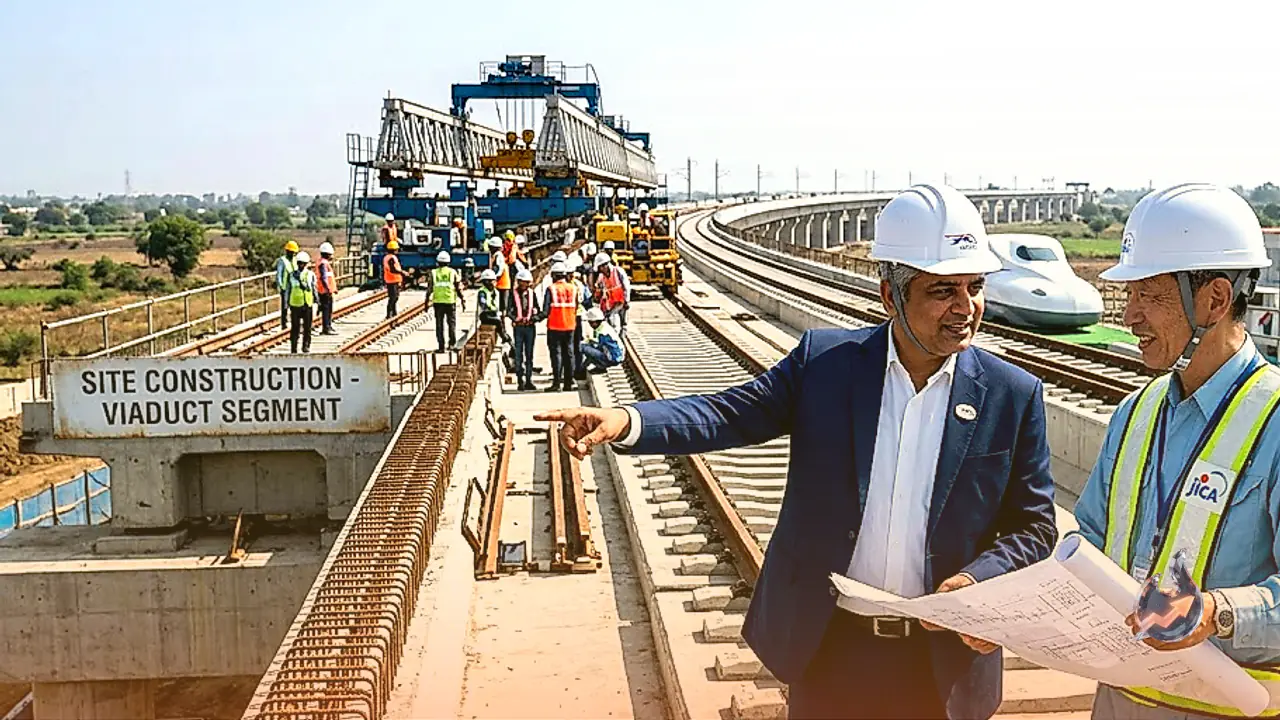

Japan's central bank, the Bank of Japan, is set to deliver a critical announcement regarding its benchmark interest rates at its monetary policy review meeting. Financial markets globally are closely monitoring Tokyo's trajectory following a rate increase executed in June. While analysts widely anticipate policy rates to remain unchanged in the immediate stance, subtle signals regarding future tightening are expected. Against this macroeconomic backdrop, concerns have emerged in India regarding whether potential rate hikes by Tokyo could escalate interest obligations on the funding secured for the high-profile Ahmedabad-Mumbai bullet train project.
Bullet Train Financing Structure and India's Shield
To construct the flagship Ahmedabad-Mumbai bullet train corridor, India secured financial assistance worth ₹88,000 crore from Japan. This funding was extended through the Japanese International Cooperation Agency at an exceptionally concessional interest rate of just 0.1% per annum. The credit facility is structured with an extended repayment timeline spanning 50 years.
Furthermore, the financing agreement incorporates a generous 15-year grace period. Under these terms, the Indian government is not required to repay any portion of the principal amount during the initial 15 years. Installment payments covering the principal will commence only from the 16th year onward. Crucially, the funding brought in by Prime Minister Narendra Modi operates under a fixed interest rate mechanism. Consequently, any interest rate increases enacted by the Bank of Japan on its domestic repo rate will have zero bearing on the interest burden of this bullet train loan.
Economic Strains Facing Japan and Central Bank Dilemma
Japan's macroeconomic environment currently faces significant stress due to external and internal headwinds. Ongoing military conflict in West Asia has driven up international energy and fuel prices, which in turn has elevated producer prices within Japan. Simultaneously, persistent weakness in the Japanese Yen has amplified domestic inflationary pressures.
These developments present a delicate balancing act for Bank of Japan Governor Kazuo Ueda. The central bank chief must project a hawkish communication stance to deter currency speculators betting against the Yen, while simultaneously respecting the views of the Japanese government, which remains reluctant to embrace aggressive monetary tightening. As a result, the central bank is taking a cautious approach to assess how input price inflation propagates through the broader economy before opening its hand on future policy actions.
Analyst Expectations and Potential December Tightening
Financial market watchers expect the central bank to maintain a cautious wait-and-see posture in the short term. However, market experts, including analysts at Mitsubishi UFJ Morgan Stanley Securities, project that the Bank of Japan could execute its next interest rate hike in December. Such policy tightening would become increasingly likely if inflation persistently overshoots official targets or if continuous Yen depreciation convinces political authorities that higher borrowing costs are indispensable for economic stabilization.