

















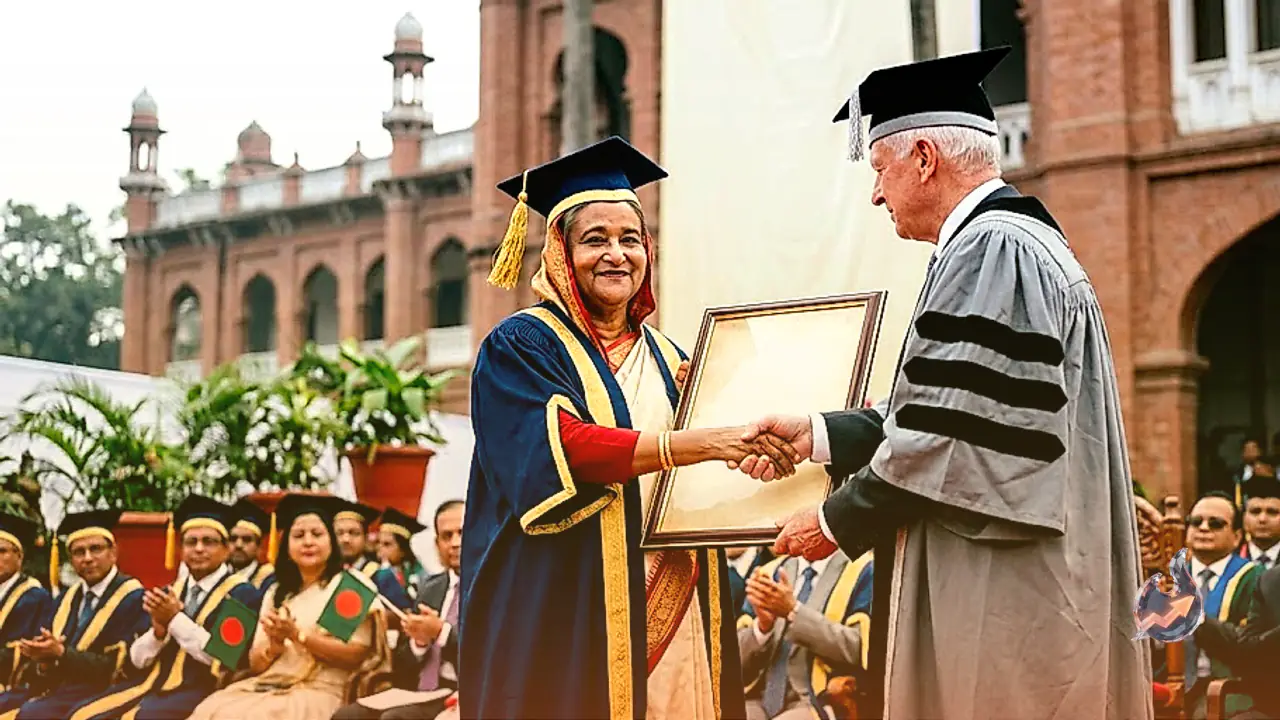

Beyond her long-standing presence in Bangladesh's political landscape, Sheikh Hasina possesses a strong academic background and a deep lifelong connection to literature. As the eldest daughter of Sheikh Mujibur Rahman, affectionately known as Bangabandhu and regarded as the nation's father, political involvement was a natural part of her upbringing. However, despite being immersed in a heavy political environment from an early age, she remained firmly committed to pursuing higher education. Her student years were characterized by a balance between intense academic focus and active student leadership.
Early Education: From Tungipara Village to Dhaka Colleges
Sheikh Hasina was born on September 28, 1947, in Tungipara village, located within the Gopalganj district of Eastern Pakistan (which is now Bangladesh). She completed her primary schooling at a local village institution, laying the groundwork for her academic journey. Later, when her family relocated to Dhaka, she pursued her higher secondary studies at Eden Mohila College and subsequently completed her intermediate education at the renowned Government Intermediate Girls College. This transitional phase in Dhaka helped shape both her educational goals and her expanding awareness of social issues.
Graduation in Bengali Literature from the University of Dhaka
Upon finishing her intermediate coursework, Sheikh Hasina secured admission to the University of Dhaka, widely recognized as one of the most prestigious and historically significant institutions of higher learning in Bangladesh. Driven by her passion for language and culture, she chose to specialize in Bengali Literature. Demonstrating steady dedication to her studies amidst political developments of the era, she successfully completed her graduation degree in Bengali Literature from the University of Dhaka in 1973.
Leadership Roles and Early Steps in Student Politics
Sheikh Hasina's engagement with public life began during her student days. While studying at Eden Mohila College, she took an active part in campus governance and student representation. During the 1966-67 academic year, she was elected Vice President of the Eden Mohila College Student Union, marking an early milestone in her leadership path. Later, during her time at the University of Dhaka, she became an active member of the Chhatra League, the student wing of her political organization. She also served as the General Secretary of the Rokeya Hall branch at the university, organizing campus activities and addressing student issues.
Literary Pursuit and Published Books
In addition to political discourse, Sheikh Hasina cultivated a serious interest in writing and literary expression. Drawing upon her formal training in Bengali literature, she authored several books over the years. Among her prominent published works are 'Ora Tokey Tokey Take', 'My Father, My Bangladesh', and 'Development for the Masses'. Her writings frequently offer historical perspectives on Bangladesh, detailing the national liberation movement as well as the personal and political struggles of her father, Bangabandhu.
Global Recognition and Honorary Doctorates
Beyond her formal graduation degree from the University of Dhaka, Sheikh Hasina's public service and leadership contributions have earned her wide recognition from higher education institutions globally. Numerous international universities have conferred honorary doctorate degrees upon her. Notable among these institutions are Visva-Bharati University in Santiniketan, India, and Tripura University, alongside several leading universities and educational bodies across the United States and the United Kingdom.