







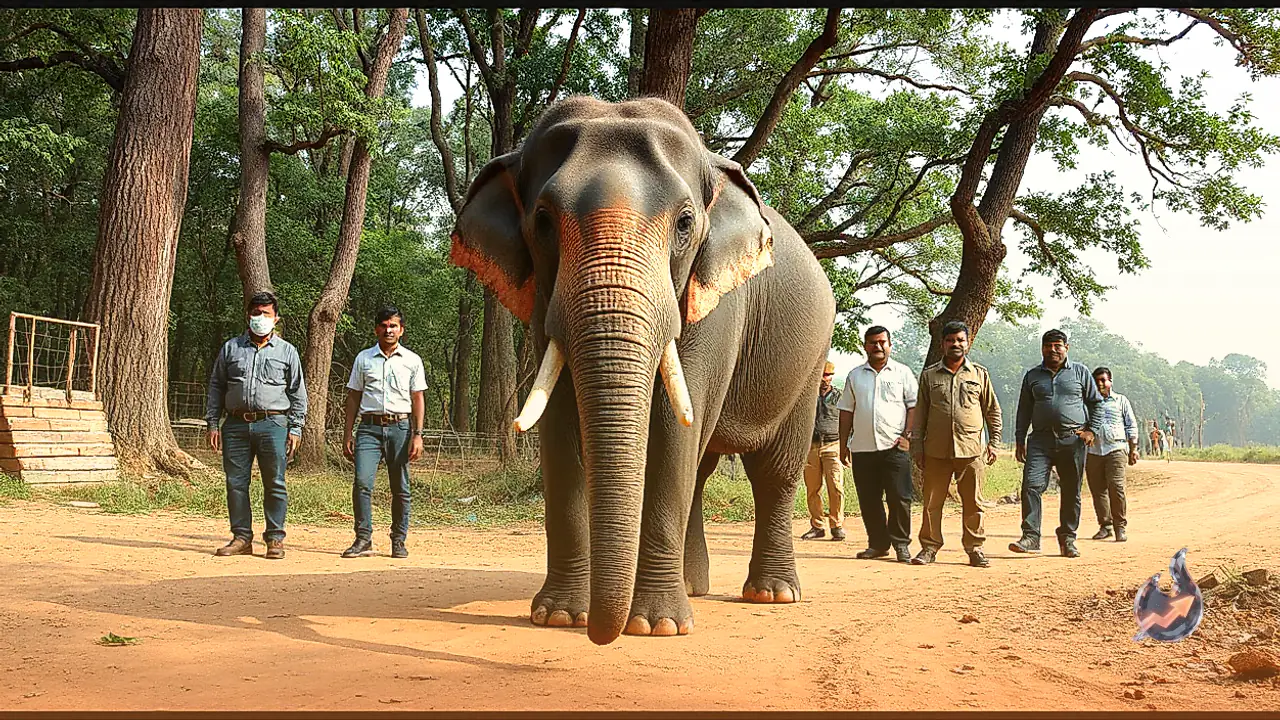















A massive tusker roaming the northern forests of Chhattisgarh has emerged into a formidable challenge for local wildlife officials and field teams. Weighing around three thousand kilograms, this male elephant is locally identified as Kabra Kaan due to a distinctive coloration and mark on its ear. According to forest authorities, the animal is currently highly aggressive and in a hyper-active state. Over the past six to seven months, the elephant has reportedly claimed the lives of sixteen people while moving across the forest divisions of Koriya, Sarguja, Surajpur, and बलरामपुर districts. Its roaming range spans roughly seventy-five kilometers, and it frequently shifts locations at an astonishing pace, covering thirty-five to forty kilometers in a single night.
Deployment of One Hundred Forest Staff and Drones
The forest department received official clearance from both the state and central governments on November 12 to tranquilize and capture the animal. Ever since, authorities have launched a massive tracking operation across the region. For the past four days, over one hundred forest personnel, including divisional forest officers, have been actively scouring the area to locate the beast. Three separate teams of veterinary doctors have been stationed along the exit routes leading out of the forest to provide immediate assistance if needed. Advanced drone technology is also being utilized to track the elephant's exact coordinates. Additionally, two trained kumki elephants brought from Karnataka nearly a decade ago have been integrated into the operation to help corner the rogue animal.
Hiding Within Herds of Other Elephants
The single biggest hurdle facing the forest administration right now is that Kabra Kaan has merged into a herd of other wild elephants. Officials believe the animal has likely sensed that a search operation is underway to locate it. Consequently, it attempts to mask its identity by staying surrounded by other tuskers. Officers note that it usually trails ten to twenty meters behind the main group. The other elephants do not appear very welcoming either, and occasional friction has been observed between them. The forest department remains hopeful that the target will soon separate from the herd, presenting a clear opportunity for capture.
The meticulous plan devised by the department involves tranquilizing the elephant only after it emerges from the dense forest cover. This precaution is necessary because subduing a three-thousand-kilogram animal deep inside the thick jungle would make transporting it out an impossible task. To solve this logistical challenge, a large trench has been excavated in the ground. The rear section of an eight-wheeled truck has been lowered directly into this pit. Once the animal is sedated, the kumki elephants will guide it slowly toward the truck via a specially constructed wooden ramp.
A Long History of Human-Elephant Conflict in the Region
Data indicates that human-wildlife conflict has remained a severe and persistent crisis in Chhattisgarh for years. According to findings from the Wildlife Institute of India, between the years 2000 and 2023, a total of 737 people lost their lives in elephant attacks across the state, while 91 individuals sustained injuries. During the same timeframe, 218 elephants also died, with 77 of those fatalities resulting from electrocution. The districts most severely impacted by these recurring incidents include Jashpur, Dharamjaigarh, Surajpur, and Korba. Furthermore, data tabled in the Chhattisgarh legislative assembly in January of this year revealed that over 340 people have died due to elephant attacks in the state across the past five years.