






















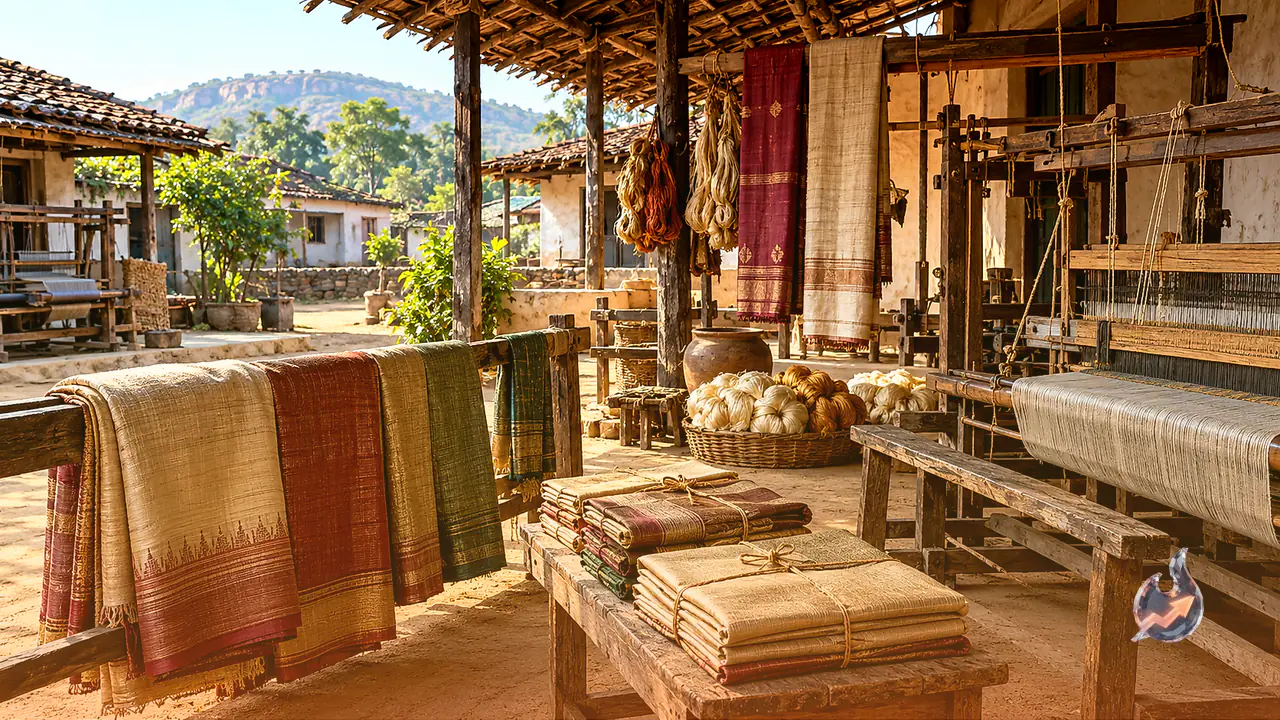

Chhattisgarh Kosa silk is widely recognized across the country for its distinctive natural sheen and exceptional texture. Sarees crafted from this exquisite silk remain highly sought after by patrons due to their unmatched elegance and intricate traditional craftsmanship. Members of the Maa Durga Weaver Group based in Sutli village, located within the Janjgir-Champa district, are actively producing these silk sarees to secure sustainable employment. Through their dedication and artistry, traditional weaving techniques are not only being preserved, but the financial well-being of their households is also witnessing a steady improvement.
The meticulous process of crafting a saree
Devendra, a member of the Maa Durga Weaver Group, explains that the collective specializes in creating sarees using authentic Chhattisgarh Kosa silk. Crafting a single saree demands considerable time, patience, and physical effort from the artisans. Every single stage of production, from raw thread preparation to intricate loom weaving and final finishing, requires specialized craftsmanship. Leveraging their years of experience and innate skill, the weavers produce visually appealing designs that consistently capture high demand in the marketplace.
Pricing structure and annual business volume
According to members of the collective, the price of a standard Kosa silk saree produced at their unit typically ranges between 4,000 rupees and 6,000 rupees. Depending on specific customer preferences and tailored orders, premium sarees with higher price points are also meticulously woven. The commercial distribution of these garments generates reliable income for everyone involved in the group. As noted by Devendra, the cooperative records a business turnover running into lakhs of rupees over the course of an entire year.
Expanding reach to major metropolitan hubs
The market footprint for Kosa silk sarees manufactured in Champa extends far beyond local retail boundaries. The cooperative regularly fulfills substantial orders originating from major commercial centers such as Delhi and Bengaluru. Group members highlight that through channels established in Delhi, these traditional garments occasionally find their way to international markets as well. This wider exposure grants broad recognition to the exceptional workmanship of Champa artisans, opening up fresh commercial horizons for individuals tied to traditional silk weaving.
How Kosa silk sarees are manufactured
The intricate journey of making a Kosa silk saree begins directly with the silk thread. Kosa silk itself is a specialized variety of tsar silk, which is extracted natively from the cocoons of wild silkworms. Appropriate processing techniques are applied to successfully extract fibers from the cocoons, which are subsequently spun into usable threads. Based on the desired quality and structural requirements, these threads are prepared and mounted onto handlooms for weaving. Artisans meticulously arrange the threads according to planned patterns, color schemes, and design motifs. The final finishing touches complete the garment, with the entire production cycle depending heavily on the steady hands, accumulated experience, and deep skill of the weavers.
Traditional craftsmanship fueling sustainable employment
The Maa Durga Weaver Group of Champa is actively keeping ancient weaving traditions alive through the production of Kosa silk sarees. Sustained market demand and recurring orders serve as a reliable source of livelihood for all participating members. This indigenous product effectively highlights the rich silk heritage of Chhattisgarh alongside the raw talent of local weavers. Consequently, Kosa silk sarees represent much more than mere apparel, serving instead as a vital lifeline supporting the hard work and daily sustenance of rural artisans.