























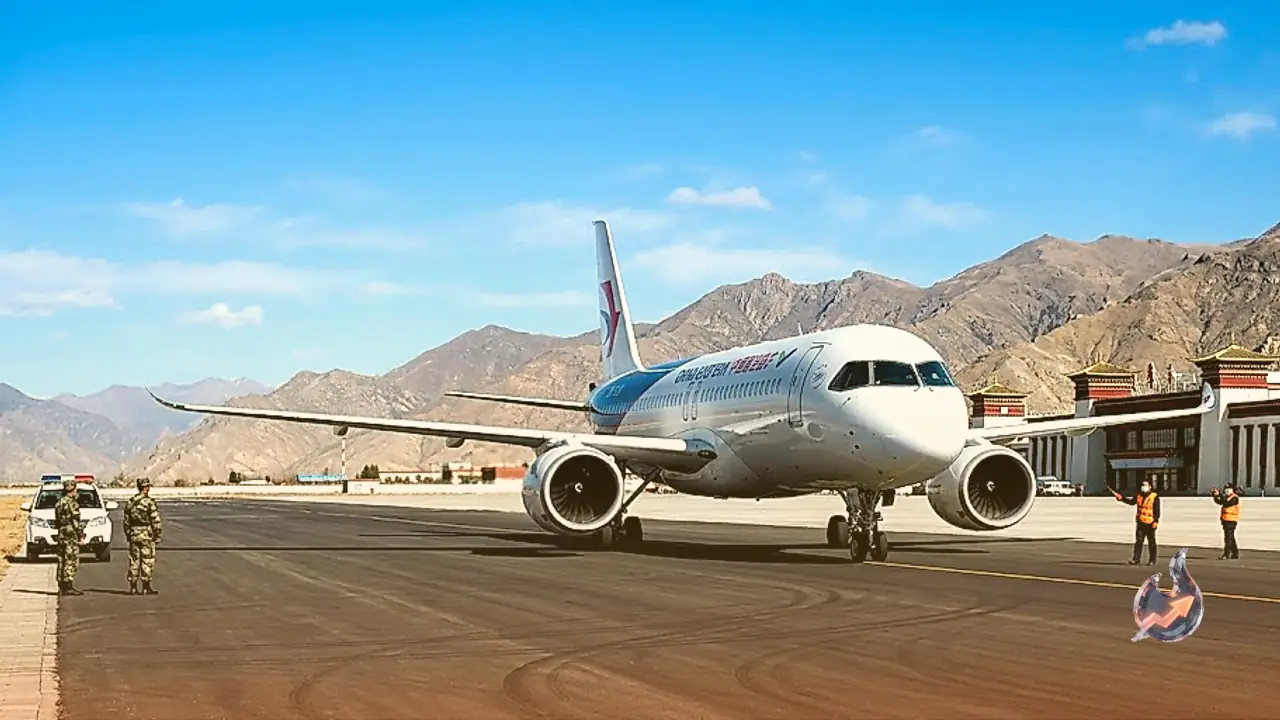

The successful landing of China's domestically developed C919 passenger aircraft at Lhasa Gonggar Airport in Tibet is being actively promoted by Beijing as a major milestone in commercial aviation. State media and the aircraft's manufacturer, Commercial Aircraft Corporation of China (COMAC), contend that the jet is designed to challenge the long-standing duopoly of US-based Boeing and European aerospace giant Airbus. However, the high-altitude operation has raised strong concerns among international defense analysts and security experts. Strategic observers view the deployment of the commercial airliner in the Himalayan region not merely as a civil flight test, but as a deliberate enhancement of dual-use military infrastructure along the Line of Actual Control (LAC) facing India.
Commercial Aviation Cover and Dual-Use Military Strategy
International affairs experts assess that the specialized high-altitude variant of the C919 serves as an operational execution of China's national policy of Civil-Military Fusion. While presented to the world as a sleek commercial airliner, the aircraft functions as a versatile strategic asset capable of serving military operational requirements under demanding geographical conditions. Through commercial flight testing, Beijing is validating high-altitude border infrastructure that can be seamlessly repurposed for rapid military transport during border contingencies.
High-Altitude Flight Physics and Technical Challenges Above 8,000 Feet
Operating aircraft at high-altitude airports situated more than 8,000 feet above sea level presents severe physical and aerodynamic challenges. Atmospheric pressure drops significantly at high elevations, resulting in extremely thin air. This reduced air density deprives jet engines of the atmospheric oxygen required for efficient fuel combustion, thereby degrading engine thrust. Furthermore, thin air reduces aerodynamic lift generated across the wings, making it difficult to maintain stability for heavy aircraft. During landing procedures, reduced air density impairs braking efficiency and increases the risk of thermal brake failure.
Engineering Adaptations of the Specialized C919-600 Variant
To overcome these physical constraints, Chinese aerospace engineers developed a specialized high-altitude model designated as the C919-600. The fuselage length of this variant has been shortened compared to the standard model to optimize structural weight. Additionally, the aircraft is equipped with upgraded high-thrust engines and an advanced cabin pressurization system. By completing flights in the challenging atmospheric environment of Tibet, the manufacturer demonstrated enhanced operational capability across high-elevation mountainous corridors.
President Xi Jinping Civil-Military Fusion Directive and Operational Impact
Under the Civil-Military Fusion directive mandated by President Xi Jinping, all civilian technological research, commercial assets, and transportation infrastructure are legally required to support the operational needs of the People's Liberation Army (PLA) during national emergencies. The C919 program adheres directly to this structural framework. In the event of escalating border tensions along the LAC in Ladakh or Arunachal Pradesh, Chinese military planners gain an augmented airlift platform to transport combat personnel and equipment rapidly to forward military positions.
Rapid LAC Troop Airfield Deployment and Winter Logistics Support
The high-altitude variant of the C919 is capable of carrying between 130 and 160 fully equipped combat troops per flight from major interior cities in China directly to key airfields near the border, such as Lhasa, Nyingchi, and Ali Gunsa, within hours. Moreover, during winter months when heavy snowfall blocks land supply routes across Ladakh and the northeastern border regions, the aircraft's high-altitude performance ensures round-the-clock 24/7 logistical transport of rations, medical supplies, and military hardware to forward posts.
Technical Synergy with Heavy Y-20 Military Airlifters
The aerodynamic data and high-altitude engineering insights acquired during the development and testing of the C919-600 are being directly transferred to enhance China's heavy military transport aircraft fleet, notably the Y-20. Integrating commercial aviation flight data into military transport development enhances the strategic airlift capability of the Chinese air force, carrying broader implications for regional security dynamics.
Disrupting the Boeing-Airbus Monopoly and Commercial Expansion
For over 50 years, the global commercial aviation market has been dominated by two Western manufacturers, Boeing of the United States and Airbus of Europe. Major carriers worldwide, including Indian airlines such as IndiGo and Air India, rely almost exclusively on these two manufacturers for fleet acquisition. COMAC aims to disrupt this duopoly with the C919, having already secured more than 1,000 total orders. This includes a firm contract signed by Lhasa-based Tibet Airlines for 40 units of the C919-600 high-altitude variant.
Export Strategy Across Developing Markets and Diplomatic Leverage
China's commercial roadmap envisions exporting the C919 to developing and middle-income nations across Asia, Africa, and South America that possess mountainous terrain but lack the financial capital to purchase expensive aircraft from Boeing or Airbus. By offering competitively priced airliners, Beijing seeks to generate commercial revenue while extending economic and diplomatic influence across partner nations.
Supply Chain Dependencies on Western Manufacturers and Sanction Risks
Despite being marketed as a triumph of domestic Chinese engineering, the C919 program remains heavily reliant on Western aerospace supply chains. The aircraft's critical jet engines are manufactured by a joint venture between companies from the United States and France. Furthermore, essential avionics, flight control systems, and safety equipment are supplied by Western manufacturers. Consequently, potential trade restrictions or sanctions imposed by the United States could significantly constrain the operational production of the aircraft.
Regulatory Certification Constraints and Strategic Lessons for India
The C919 has not yet received safety certification from international aviation regulators such as the Federal Aviation Administration (FAA) in the United States or the European Union Aviation Safety Agency (EASA). Without these regulatory approvals, the aircraft cannot operate commercial routes within major Western airspace. Ultimately, while the introduction of the C919 in Tibet does not constitute a direct military action, it highlights China's expanding dual-use aviation infrastructure and enhanced high-altitude mobilization capabilities along India's northern borders.