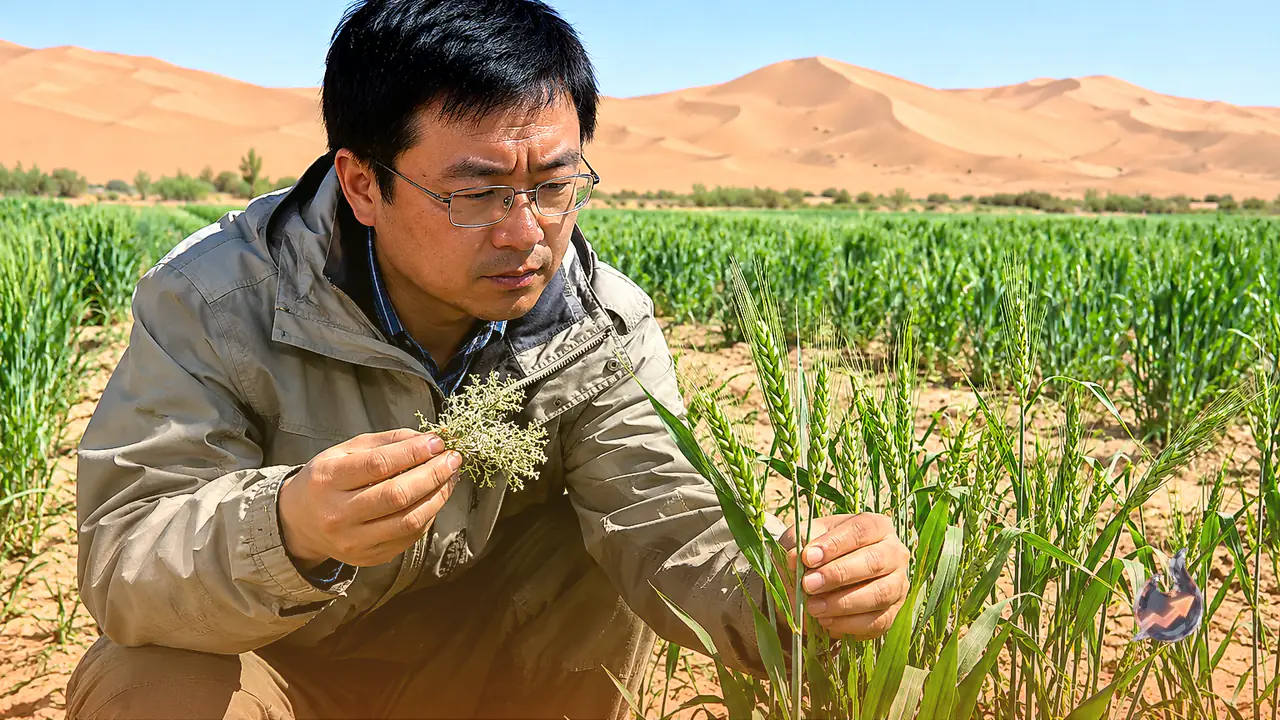

Farming has always been haunted by the constant threat of drought, a phenomenon where delayed rainfall or acute water scarcity ruins cultivated crops and inflicts heavy financial devastation on cultivators. However, scientists have now unearthed a groundbreaking solution to this formidable agricultural crisis from the most unforgiving environment imaginable: the desert. Chinese researchers have made a remarkable discovery that is widely heralded as a vital lifeline for agricultural producers. Following this breakthrough, staple crops such as wheat, paddy, and maize will not only survive under severe water deficits and drought conditions, but will also thrive while registering a yield increase of over 40 percent, thereby significantly boosting farmers' earnings.
Uncovering Secrets in Harsh Desert Environments
According to reports from China's state news agency Xinhua, Chinese researchers successfully isolated a brand-new gene residing within lichen-forming fungi. This unique gene endows crops with the remarkable ability to combat severe drought conditions. The research findings were published online on Thursday in the prestigious international science journal Nature. This discovery has paved an entirely new pathway for agricultural scientists across the globe to develop drought-resistant crops capable of delivering higher productivity.
Understanding Lichen and Its Unique Resilience
Expressed simply, lichen is a distinctive organism formed through the symbiotic relationship between fungi and microscopic photosynthetic entities. Its most defining characteristic is its extraordinary capacity to endure extended periods within the planet's most hostile terrains. Lichen easily persists in locations devoid of moisture or soil nutrients, enduring intense droughts or freezing temperatures. Consequently, scientists have long regarded these organisms as an untapped treasure trove of genes that impart resilience under extreme adversity.
The Identification of the Magic Gene EpTFIIAγ
The research team in China conducted extensive investigations and isolated this novel gene from the genome of a lichen-forming fungus that had adapted seamlessly to arid desert conditions. Scientists designated this specific gene as EpTFIIAγ. This gene generates a powerful capability within plants to withstand the physiological stress induced by water scarcity.
Stunning Results Observed in Field Trials
Rather than confining their experiments to laboratory settings, scientists performed extensive multi-year field trials across diverse geographical locations and varying seasonal conditions. The outcomes observed after introducing this gene into other plants astounded observers. The mechanism maintains a delicate balance between stress management and development, allowing crops to sustain themselves through adverse weather and moisture deficits without halting their growth.
Substantial Yield Increases and Benefits Under Normal Irrigation
During severe drought scenarios, this gene protected wheat, rice, and maize crops from withering, recording per-plant yield increases ranging from 19.7 percent to 42.4 percent. Furthermore, the gene also aided in enhancing the productivity of select crops even under normal irrigation conditions, proving beneficial beyond strictly arid environments.
The Research Teams Behind the Major Achievement
This critical research was accomplished collaboratively by scientists from two major Chinese institutions. The contributors included the team led by Kang Zhengsheng and Mao Hude from Northwest A&F University, alongside the research team headed by Wei Jiangchun from the Institute of Microbiology under the Chinese Academy of Sciences. Professor Kang emphasized the significance of the discovery, noting that historically, scientists restricted their search for superior genes within cultivated crops alone. However, this study shatters conventional paradigms, demonstrating that organisms thriving in extreme desert environments harbor an unexplored reservoir of genetic resources.
A Vital Lifeline for Farmers Amid Climate Change
In an era where the entire globe grapples with the severe impacts of climate change, manifest through unseasonal precipitation and devastating droughts, food security faces a formidable threat. Experts believe this novel discovery holds universal applicability across various crops and seasonal variations. The innovation will not only safeguard grain production in drought-prone regions but also trigger major transformations within the seed industry. If scaled effectively for agricultural communities, this technology will prevent crop devastation, elevate harvest volumes, and substantially improve the livelihoods of farmers worldwide.