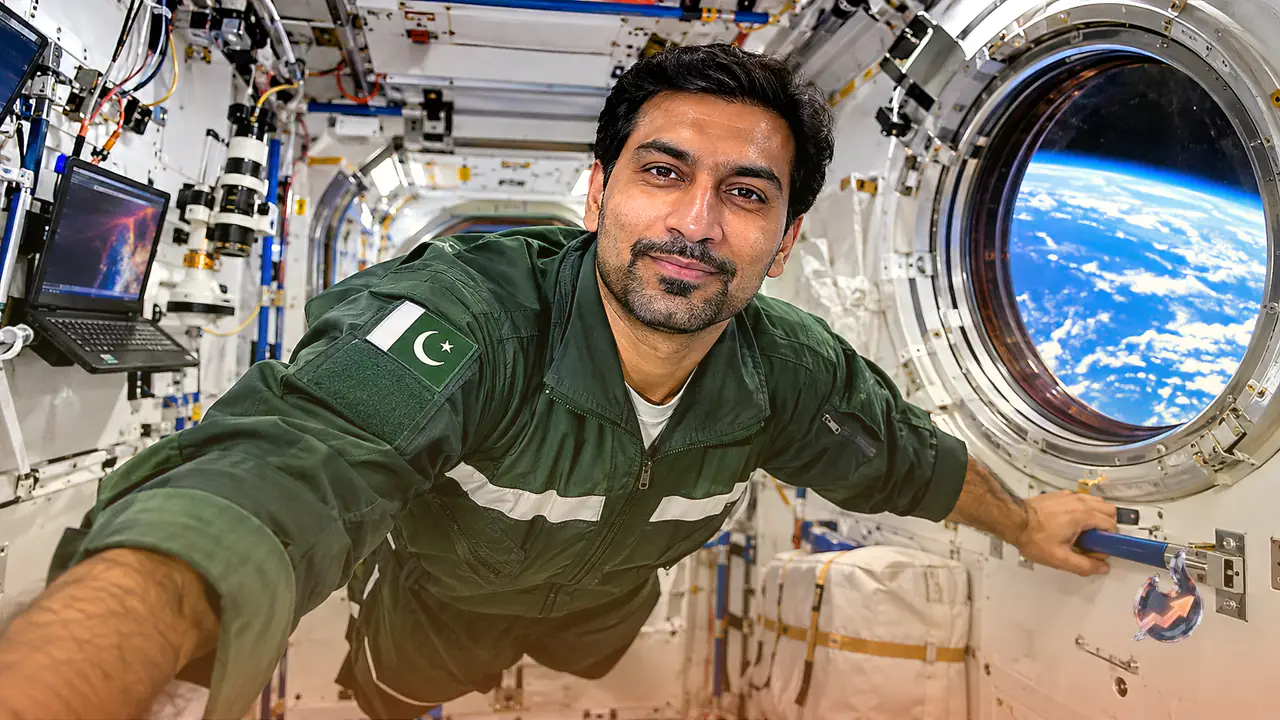

Wednesday, November 25, 2026, marked a significant milestone in space history for Pakistan as its first astronaut, Muhammad Zeeshan Ali, reached Earth's orbit through China's Shenzhou-24 mission. With this flight, he also becomes the first foreign astronaut to board China's Tiangong space station. He is accompanied on this mission by Chinese astronauts Tang Hongbo and Wu Yi. Pakistan achieved this milestone with the assistance of China, although India sent its first astronaut, Rakesh Sharma, into space 42 years earlier in 1984.
Launch and Technical Details of Shenzhou-24
The Shenzhou-24 spacecraft was launched at 8:18 AM on Wednesday from the Jiuquan Satellite Launch Center in the Gobi Desert, located in northwestern China. It was propelled into space using a Long March-2F Y24 rocket. Approximately 10 minutes after liftoff, the spacecraft separated from the rocket and successfully entered its designated orbit. According to the Chinese space agency, all astronauts are safe and the launch mission has been completely successful.
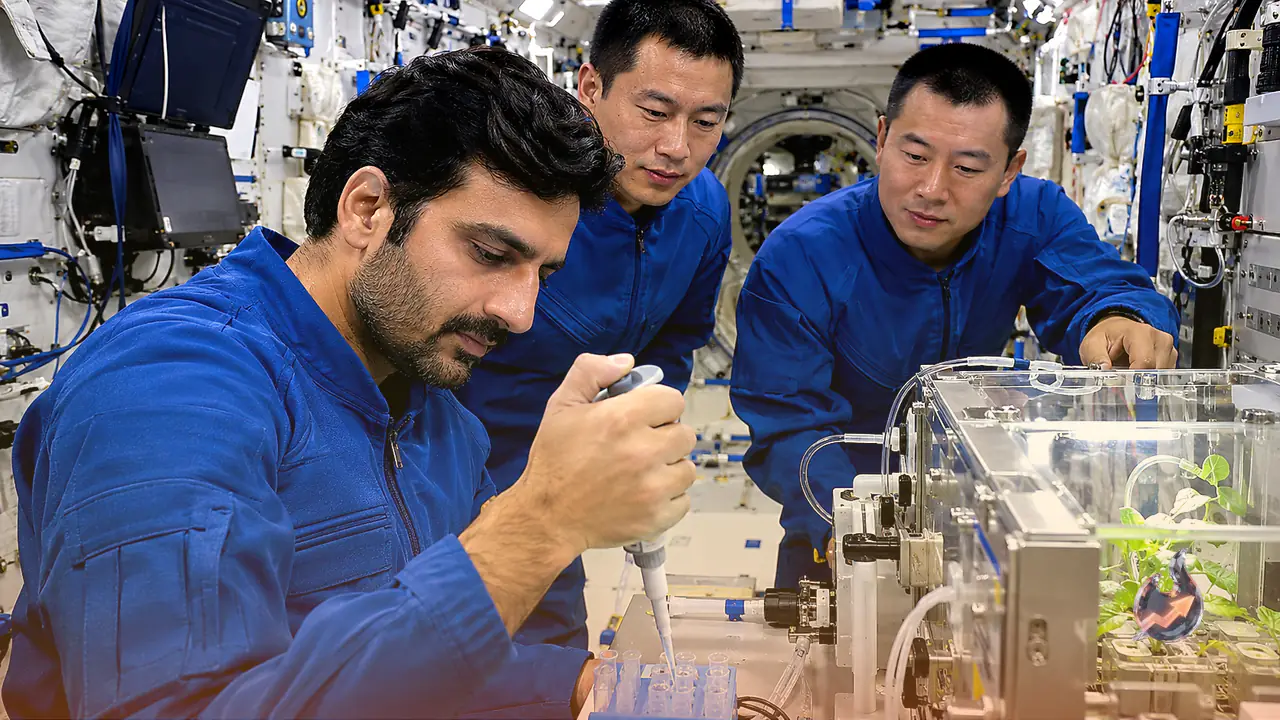
Muhammad Zeeshan Ali is serving as a payload specialist on this mission. Under an agreement signed between China and Pakistan, he will participate in various scientific experiments. During the mission, experiments related to life in space, the human body, microgravity, and new technologies will be conducted. Zeeshan Ali stated that he is carrying the hopes of Pakistan's 250 million people with him into space.
The 42-Year Gap Behind India's Space Milestones
The prospect of sending an astronaut into space has been a subject of long-standing discussion in Pakistan. Now, the country has sent Zeeshan Ali into Earth's orbit via China's Shenzhou-24 mission, creating another record. This is Pakistan's first official orbital space flight. Interestingly, India achieved this feat in the 20th century back in 1984, when Rakesh Sharma went into space under a Soviet mission. This means Pakistan has now reached a milestone that India achieved 42 years ago.
The development brings attention to the technological timeline between the two neighboring nations. While India has developed advanced indigenous space capabilities over the decades, including lunar exploration and human spaceflight preparations, Pakistan's entry into orbital spaceflight relied entirely on foreign partnership and Chinese infrastructure.
Motivations Behind Pakistan's Human Spaceflight
Since its inception, Pakistan focused its national resources and attention elsewhere, leaving little room to prioritize advanced space exploration. When India attempted a soft landing on the Moon under the Chandrayaan-2 mission in 2019 and the lander did not succeed, many social media users in Pakistan mocked India's space program. However, India continued working on its missions. In 2023, Chandrayaan-3 achieved a successful landing near the lunar south pole, making India the first country to do so.
Following this, young people in Pakistan began questioning their own country's space program on social media, asking when Pakistan would send its own astronaut into space. Meanwhile, in June 2025, Indian astronaut Group Captain Shubhanshu Shukla reached the International Space Station (ISS) under the Axiom-4 mission. He stayed there for several days and participated in scientific experiments. Shubhanshu Shukla became the second Indian citizen to go to space after Rakesh Sharma and the first Indian to reach the International Space Station. After this achievement, the Pakistani government faced domestic pressure to take visible steps.
China Partnership and Rigorous Training
Pakistan partnered with China to send its astronaut into space, with an agreement signed between the two countries in February 2025. Following this, Pakistani candidates were selected and given training in China. After about seven months of training, Muhammad Zeeshan Ali was selected for the Shenzhou-24 mission. Zeeshan Ali is a pilot in the Pakistan Air Force. His uniform and spacesuit feature the Pakistani flag. With this mission, Pakistan has sent an astronaut into Earth's orbit under an official government space program for the first time.
However, it is important to understand that Pakistan did not build its own rocket or spacecraft to make this flight. It achieved this opportunity with the help of China's space program. India also sent Rakesh Sharma and Shubhanshu Shukla through foreign space missions initially, but India's own human spaceflight program, Gaganyaan, is preparing to send astronauts into space using the country's own rockets and capsules.
Clarifying Previous Suborbital Space Claims
The question of whether Zeeshan Ali is the very first Pakistani in space requires some clarification. Namira Salim, a person of Pakistani origin, traveled to the edge of space in 2023 under a private Virgin Galactic mission. However, her flight was suborbital, meaning her spacecraft did not enter Earth's orbit. Zeeshan Ali is the first Pakistani citizen to enter Earth's orbit under an official government mission and the first foreign astronaut to visit China's Tiangong space station.