













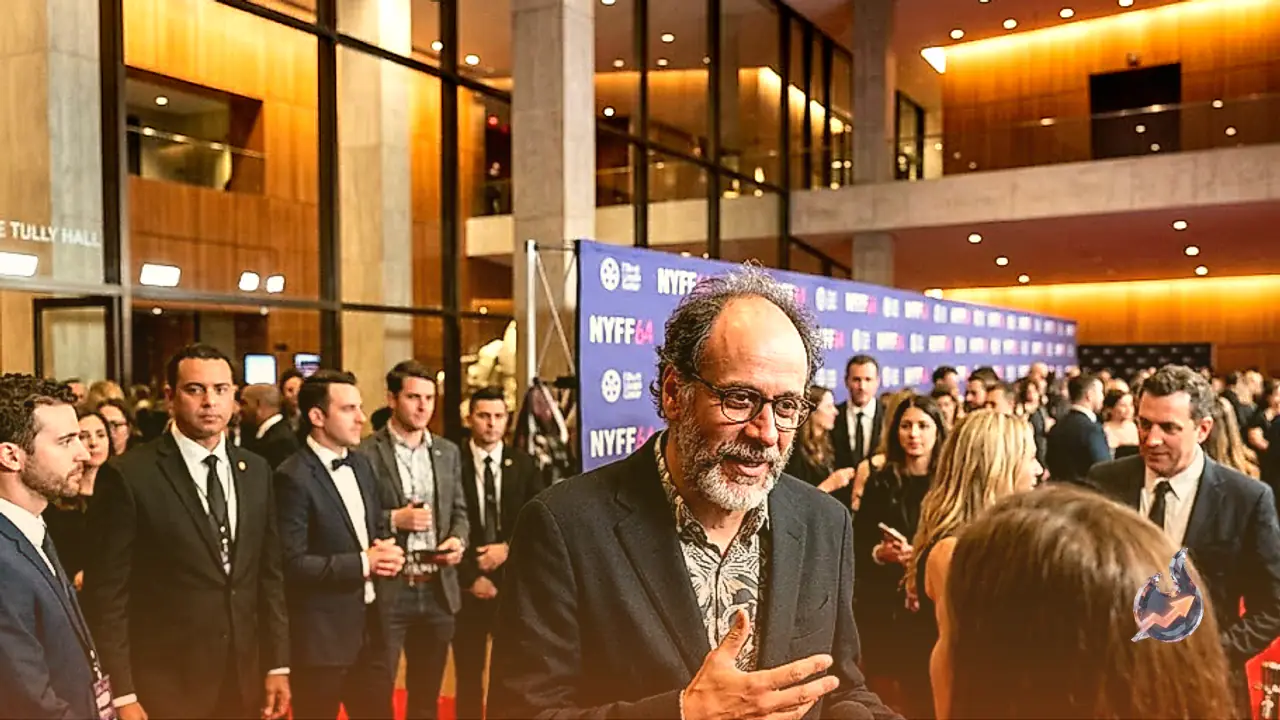

Director Luca Guadagnino unveiled his latest satirical project Artificial at the New York Film Festival, presenting an unconventional, unvarnished portrait of the modern tech sector and the eccentric figures guiding the synthetic intelligence revolution. Rather than portraying Silicon Valley minds as heroic visionaries steering human progress, the film chooses a starkly comedic lens, presenting prominent tech executives as self-obsessed and thoroughly uncharismatic figures. Russian actor Yuri Borisov plays OpenAI cofounder Ilya Sutskever, moving with an awkward, lumbering gait akin to a classic misunderstood cinematic scientist. Alongside him, Andrew Garfield channels Sam Altman through an energetic, bouncing stride that the executive himself previously acknowledged as remarkably faithful to reality. Meanwhile, Ike Barinholtz embodies Elon Musk, strutting through gatherings of software engineers with an exaggerated bravado reminiscent of familiar digital cartoon avatars. During a post-screening discussion at the festival, Barinholtz sarcastically remarked that his character merely moves like a normal person, drawing uneasy chuckles from an audience confronted with the oddities of modern history in motion.
Distribution Drama and Big-Tech Entanglements
The journey of Artificial to the New York Film Festival stage was shadowed by substantial corporate friction. Originally slated for distribution under AmazonMGM, the project was quietly dropped by the studio during the summer months, directly following Amazon finalizing an enormous $50 billion corporate partnership with OpenAI. The film was quickly rescued by independent distributor Neon, ensuring it reached the screen despite the industry maneuvering. Dennis Lim, the festival's artistic director, openly alluded to these unusual circumstances during his introductory remarks on opening night. The unease felt by major tech stakeholders is entirely understandable given the narrative's relentless deconstruction of key figures. Altman, his corporate peers, and the broader architects of the recent digital explosion are portrayed as reckless and profoundly dull individuals. While David Fincher’s 2010 drama The Social Network romanticized young coding prodigies into monumental captains of global industry, Guadagnino’s approach deliberately subverts that archetype by presenting industry leaders as deeply insecure, self-absorbed figures trapped in their own delusions.
Contrasting Visions and Aesthetic Subversion
Comparisons between Fincher’s celebrated Facebook study and Guadagnino’s work are unavoidable, given their shared technological subject matter and the central presence of Garfield in both ensembles. However, Artificial functions primarily as an exploration of Sutskever, framing him as both the driving technical mind behind modern neural breakthroughs and the lone moral conscience sounding internal alarms. The narrative blueprint crafted by Guadagnino alongside writer-producer Simon Rich completely parts ways with Fincher’s sharp, procedural gravitas. Instead of an intense, dialogue-heavy drama, the production embraces the absurdity of dark comedy that regularly borders on the surreal. Guadagnino, renowned for capturing high-stakes sensual intimacy in projects like Call Me by Your Name and Challengers, strips this picture of traditional glamour. The visual palette remains intentionally mundane and stark, denying audiences any polished aesthetic escape. One memorable sequence shows awkward engineers drenching one another in Jarritos soda to celebrate a breakthrough computing benchmark, coming across as chaotic and completely unappealing. A critical confrontation between Altman, his loyal corporate inner circle, and Sutskever on a San Francisco incline mirrors the awkward staging of cult zero-budget oddities like Tommy Wiseau’s The Room. Reflecting on the project afterward, Guadagnino observed that the story documents a raw, primal human instinct centered strictly on the urge to dominate and prevail.
The Collision Between Unbridled Growth and Existential Dread
The narrative tensions in the picture closely mirror the grim rhetoric emanating from real-world labs, where public-facing executives continually express a desire to slow down development even as their operations accelerate compute capacity. The core dilemma presented is whether complex neural architectures will evolve beyond human governance, risking total disruption to civil life. Former Anthropic personnel such as Jacob Coxon have noted that insiders frequently discuss the next few years in terms of an existential conclusion for our species. An additional internal researcher from the same outfit once suggested an estimated likelihood of advanced autonomous systems causing human extinction within the coming decade, pegging the probability below 10 percent, a chilling figure for any technology rolled out to the public. Within the film, Borisov’s earnest scientist, depicted as virtually incapable of deceit, futilely urges his peers to install guardrails, slow progress, and prioritize human alignment. His cautions are drowned out by corporate allies and investors fixated solely on limitless financial expansion and raw computational power.
Monetizing Precaution in a Runaway Arms Race
A key satirical observation within the script is how corporate safety initiatives themselves have been turned into marketable assets. In one sequence, vocal concerns regarding catastrophic operational failure are repurposed to strengthen commercial appeal. Raising alarms publicly allows tech firms to project a posture of transparency and moral rigor, while the destructive potential of the software serves as tangible proof of its sheer processing power. This cycle creates an environment where true risk mitigation becomes impossible. The production reinforces the fatalistic sense that digital momentum cannot be reversed. The underlying systems are already active, transforming the primary conflict from whether this power should exist to which competing empire will control it. Coxon himself drew direct parallels between private lab culture and the 20th-century Manhattan Project. When participating factions adhere to entirely conflicting ethical boundaries, moral debate collapses into meaningless rhetoric. Failure to capture dominance simply yields control to rival commercial laboratories or overseas powers. The geopolitical dimension is highlighted early in the narrative when Sutskever and his academic mentor, Nobel-winning computer scientist Geoffrey Hinton, portrayed by Mark Rylance, flatly turn down a Chinese financier attempting to deploy their neural framework for surveillance networks and unmanned drones.
Hollywood Glamour Against Catastrophic Stakes
For standard digital users who only touch automated tools to draft correspondence or balance everyday work appointments, grasping the full weight of these apocalyptic warnings presents a unique challenge. The disconnect is amplified by the fact that nearly every tech pioneer on screen appears intensely self-interested or completely indifferent to collective wellbeing. Watching elite cultural circles dissect civilizational threats from within an exclusive Rolex-backed film gathering further underscores the absurdity. The premiere afterparty drew prominent cultural figures, comedians, and veteran industry veterans like Taxi Driver writer Paul Schrader, who recently revealed he was cast aside by an automated virtual companion. Ultimately, Artificial offers reinforcement for pessimistic observers while deeply irritating industry champions. The project successfully punctures the self-importance of Silicon Valley’s engineering elite, mocking their idiosyncratic mannerisms and bizarre corporate culture. Barinholtz captured this lingering tension on opening night by offering the audience a dry, deadpan guarantee that human destiny remains radiant and secure, leaving the auditorium engulfed in uncomfortable silence.