























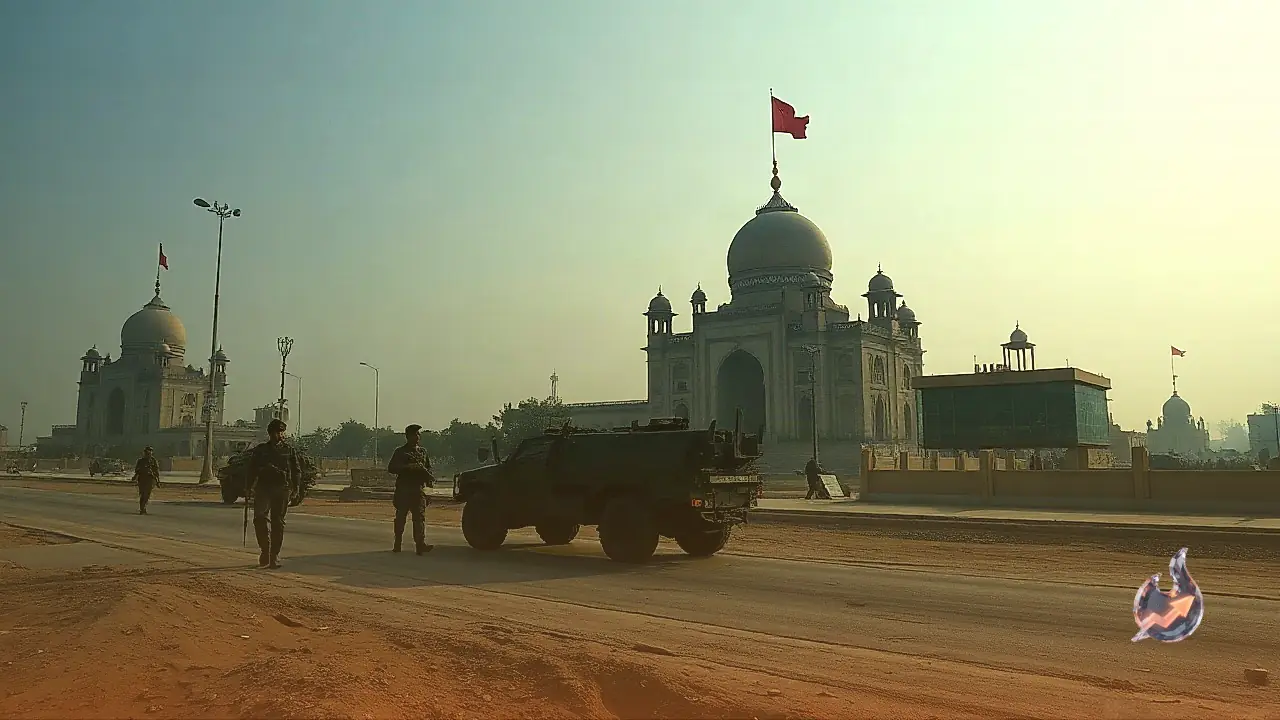

Following the successful conclusion of the BRICS Summit 2026 in New Delhi and the return of Chinese President Xi Jinping to Beijing, a major diplomatic and military breakthrough has emerged on India's strategic front. The underlying reason behind the warmth and smiles observed during Xi Jinping's bilateral discussions with Prime Minister Narendra Modi has now been clarified by the newly released annual report of the Ministry of Defence. According to the report, a substantial and unprecedented reduction in the deployment of the People's Liberation Army (PLA) was recorded along the Line of Actual Control (LAC) on the northern front during the year 2025. President Xi Jinping, who arrived in India on September 12 for the summit and departed on September 13, seems to have signaled a clear de-escalation of border tensions through this visit.
Current Status of Chinese Military Deployment Along the LAC
According to data compiled by the Ministry of Defence, the Chinese military presence along the LAC and in its traditional training areas has been scaled down significantly, now limited to just 10 Combined Arms Brigades. Despite this retreat by the PLA, the Indian Army has maintained a highly vigilant stance and has not lowered its guard. Indian security forces continue to maintain their robust and aggressive deployment posture across all strategic sectors along the border to counter any unexpected movements. This high state of alertness on the borders has run parallel to successful internal security operations, where security forces eliminated 19 terrorists in the hinterland of Jammu and Kashmir. The dual developments, spanning from Ladakh to Kashmir, demonstrate how India has successfully utilized a combination of diplomatic influence at the BRICS platform and military strength on the ground to persuade Beijing to temper its aggressive stance.
The Impact of Continuous Diplomatic and Military Dialogues
The Ministry of Defence report highlights that sustained interactions between India and China at political, diplomatic, and military levels played a crucial role in maintaining stability along the border. Discussions continued across multiple channels, including the meetings of the Working Mechanism for Consultation and Coordination on India-China Border Affairs (WMCC), talks between Special Representatives, Core Commander level meetings, and Border Personnel Meetings (BPM). During these interactions, both nations raised their respective concerns in a constructive environment, working towards resolving outstanding issues and ensuring peaceful co-existence along the disputed boundaries.
Infiltration Attempts and Ceasefire Violations Along the LOC
The situation along the Line of Control (LOC) presented a different set of challenges in 2025. The Ministry of Defence reported six infiltration attempts by terrorists along the LOC during the year. In response, Indian security forces neutralized 12 Pakistani terrorists during these operations. While direct infiltration attempts across the LOC showed a downward trend compared to previous years, intelligence and security agencies noted a tactical shift. Terrorist networks have increasingly redirected their focus toward the International Border (IB) sectors, attempting to smuggle narcotics and war-like stores into Indian territory.
Furthermore, ceasefire violations along the LOC witnessed a sharp spike during 2025, with a total of 163 violations recorded. This stands in stark contrast to the year 2024, when only two ceasefire violations were registered. Out of the 163 violations documented in 2025, a significant portion of 124 incidents took place during Operation Sindoor, highlighting the intense operational environment and heightened friction along the border during that specific timeframe.
Counter-Terrorism Operations in Jammu and Kashmir Hinterland
The internal security apparatus in Jammu and Kashmir remained highly active throughout 2025, executing intense counter-terrorism operations. These operations resulted in the elimination of 19 terrorists in the interior regions of the state. Strikingly, eight of those killed were identified as Pakistani nationals, representing approximately 40 percent of the total neutralized terrorists. The Ministry of Defence noted that this high proportion of foreign elements directly points to Pakistan's ongoing role in sponsoring and sustaining a proxy war within Jammu and Kashmir.
The Drone Menace and Technical Countermeasures along the International Border
The border security grid also had to contend with a significant increase in aerial intrusions via unmanned aerial vehicles. A total of 863 drone incursions were recorded along the International Border in 2025. This threat was heavily concentrated in the plains, with Jammu and Kashmir registering only nine drone sightings, while the borders of Punjab and Rajasthan accounted for a staggering 854 cases. To counter this technological challenge, Indian security forces deployed advanced spoofers and jammers with high efficacy. These defensive measures successfully neutralized and brought down 237 drones, five of which were found to be transporting weapons and other war-like military stores.