





















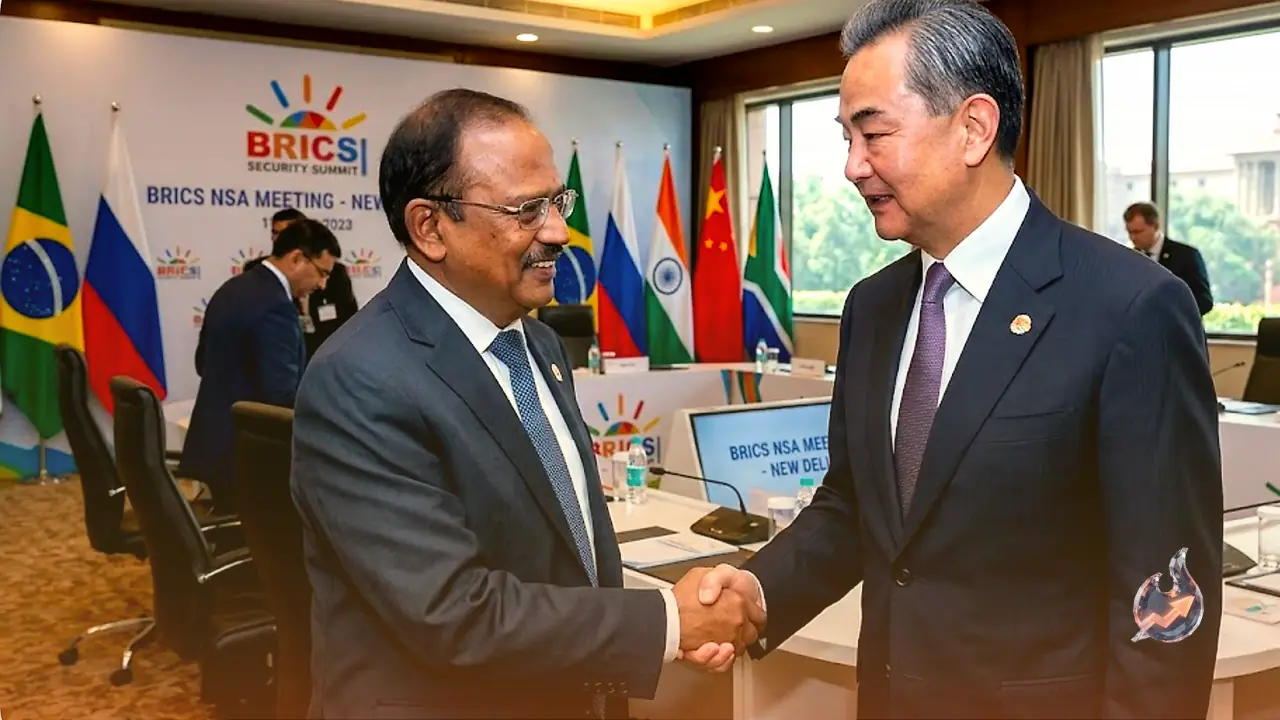

The BRICS platform once again served as a bridge for India-China diplomacy, as National Security Advisor Ajit Doval sat down with Chinese Foreign Minister Wang Yi on the sidelines of a two-day BRICS National Security Advisors meeting in New Delhi on Monday. The meeting, convened under India's presidency, brought together senior security officials from member nations and provided a timely opportunity to assess the trajectory of one of Asia's most closely watched bilateral relationships.
Key Takeaways from the Doval-Wang Yi Conversation
The Ministry of External Affairs shared details of the bilateral exchange on social media platform X, confirming that NSA Doval met with Wang Yi, who serves as a member of the Politburo of the Communist Party of China (CPC) and as China's Foreign Minister. The two sides conducted a comprehensive review of recent developments in India-China relations.
According to the Ministry of External Affairs, both sides expressed satisfaction at the gradual progress being made toward normalizing bilateral ties. NSA Doval underlined that stable, reliable and positive bilateral relations play an important role in strengthening mutual trust and deepening understanding between the two countries. The Ministry described the exchange as constructive, noting that the discussions were forward-looking and covered several important issues of mutual interest.
India-Brazil Cooperation Gets Attention Too
On the sidelines of the same gathering, NSA Doval also held talks with Carlos Cozende, Brazil's Secretary for Multilateral and Political Affairs. The Ministry of External Affairs said both sides welcomed the cooperation unfolding between India and Brazil within the BRICS framework and also conducted a review of the broader India-Brazil bilateral relationship.
What the BRICS NSA Summit Is Designed to Achieve
The two-day BRICS National Security Advisors meeting, hosted in New Delhi under India's chairmanship, has assembled the most senior security officials and delegation heads from member countries under one roof. The central theme guiding the summit is the nature and management of non-traditional security challenges facing the world today.
Delegates are sharing perspectives on how rapidly evolving threats, including those emerging from advances in new technologies, are reshaping the national security environment in their respective countries. The summit is also being used to take stock of the outcomes from two recently concluded working group sessions: the BRICS Joint Working Group on Counter-Terrorism and the Joint Working Group on Security in the Use of Information and Communication Technologies. These discussions aim to strengthen coordination among member nations on some of the most pressing security concerns of the current era.