



















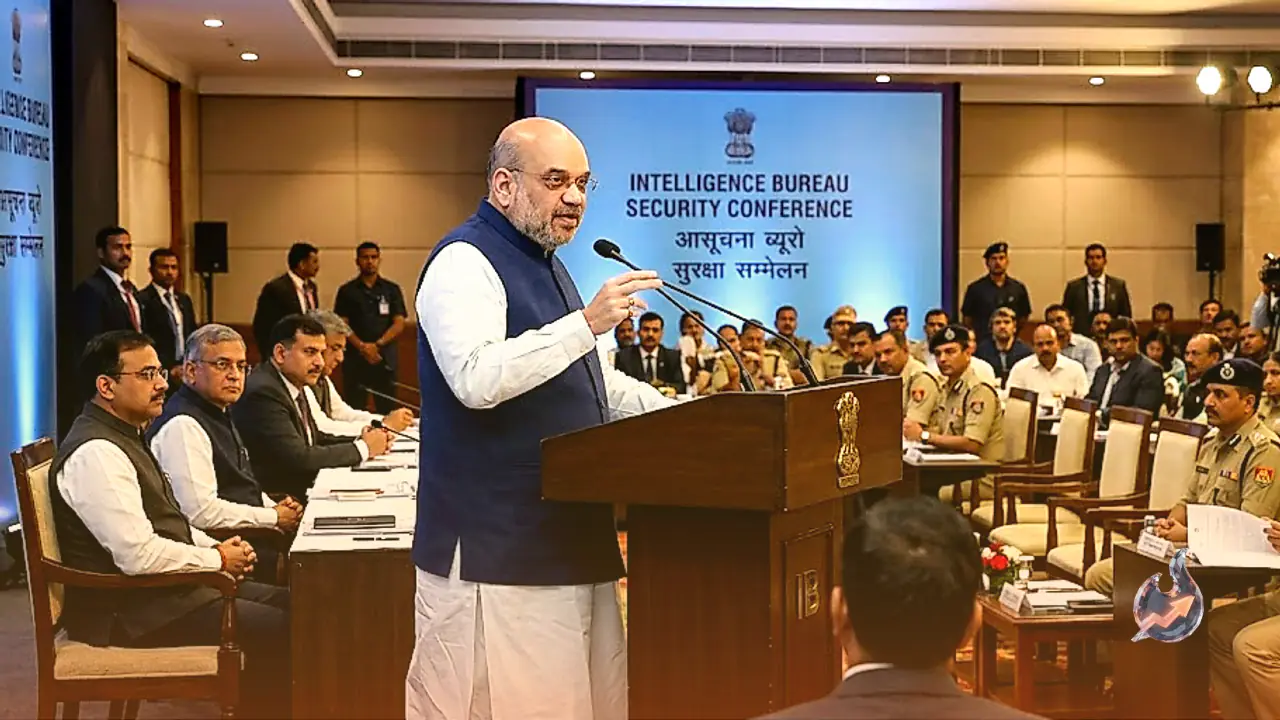

Addressing the valedictory session of the 'National Security Strategy Conference' organized by the Intelligence Bureau (IB) in New Delhi, Union Home Minister Amit Shah outlined a comprehensive security roadmap for the nation. He explicitly stated that maintaining a robust and peaceful domestic environment is an absolute prerequisite to achieving the 'Viksit Bharat 2047' vision established by Prime Minister Narendra Modi. For India to secure the top global position across economic growth, technology, manufacturing, and other critical sectors, the foundations of internal security must be substantially strengthened.
Long-Term Planning: Anticipating Threats Over the Next 15 to 20 Years
Amit Shah urged security agencies not to restrict their focus to reactive measures against immediate operational threats. Instead, he called for proactive planning to identify and analyze security challenges that could emerge over the next 15 to 20 years. Platforms like the National Security Strategy Conference must evaluate future security trends and formulate preventive measures before emerging threats evolve into severe national crises. He emphasized that the country's security apparatus needs to transition from a reactive mechanism to a forward-looking, preventive posture.
Neutralizing Internal Hotspots: Naxalism, Narcotics, and the North East
Reflecting on past security challenges, the Home Minister noted that had previous administrations identified Naxalism, illegal narcotics networks, and North East insurgencies early on, the nation would not have suffered for decades. He stated that challenges in these three major security hotspots have now been largely dismantled, crediting the seamless synergy between state police forces, central intelligence agencies, and Central Armed Police Forces (CAPF). This collaborative framework between the central government and states will serve as the benchmark for handling future security trials.
Border Safeguards, Anti-Infiltration Policy, and the 'Prahaar' Initiative
Highlighting border safety as a national priority, Amit Shah mentioned that over the past eight months, he visited every land-bordering state and distributed a comprehensive document on a quadrangular border security approach. The government aims to eliminate illegal infiltration across borders within the shortest possible timeframe. Illegal infiltration, he asserted, is not merely a routine policing matter but a direct threat to national security, economic stability, and demographic balance. He delivered a stern message: "This country is not a dharamshala, and only citizens of this country have the right to live here."
Regarding counter-terrorism efforts, he urged law enforcement agencies not to confine the 'Prahaar' strategy document to official binders. Instead, it must be integrated into daily security protocols to systematically dismantle terror networks using a 360-degree operational framework.
The PFI Crackdown Model and the 3D Strategy Against Narcotics
The Home Minister highlighted the swift, nationwide crackdown on the Popular Front of India (PFI) as a premier example of efficient central-state collaboration. Executing an overnight coordinated operation to ban the outfit and dismantle its cadre required exceptional synchronization between central intelligence agencies and state police forces. Connecting the fight against drugs directly to national security, he called upon states to execute the 'Narcotics Control Vision Document 2026-2029' on the ground. To protect the youth from addiction, he advocated the implementation of a 3D strategy—Detect, Disrupt, and Destroy—enabling joint action across all government departments.