





















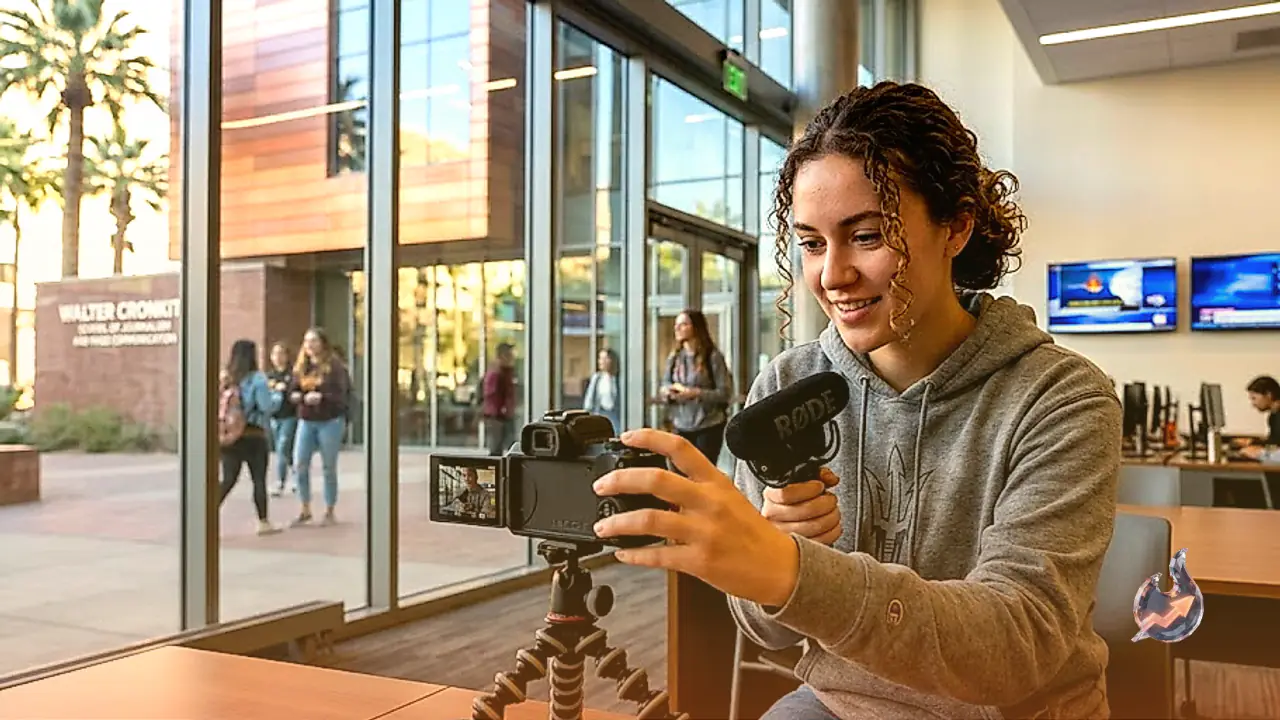

A major milestone has been reached in higher education for young individuals aiming to establish professional careers across digital and social media platforms. Arizona State University has formally launched a dedicated Bachelor of Arts degree program in Content Creation. Specifically tailored to meet the demands of modern digital storytelling, the curriculum targets students seeking to work as professional content creators, social media influencers, and digital media strategists. University officials assert that the new academic framework will equip graduates with the practical expertise and strategic industry insights needed to navigate the rapidly growing creator economy.
Curriculum Overview at the Walter Cronkite School
The specialized degree is offered through ASU's renowned Walter Cronkite School of Journalism and Mass Communication. While the foundational coursework shares key similarities with the university's established Mass Communication and Media Studies degree, it diverges significantly by incorporating targeted practical modules. Students enrolled in the program will take specialized electives focusing on podcasting techniques, digital studio production, and developing an effective on-camera presence, ensuring they possess the technical and performance skills required for online broadcasting.
Tuition Breakdown and Associated Expenses
The financial breakdown for the newly introduced degree reveals substantial cost variations between local and out-of-state applicants. For Arizona residents, the baseline tuition cost stands at approximately $12,000 per academic year before scholarships. When accounting for campus housing, meal plans, books, and institutional fees, the overall annual expense for instate students exceeds $37,000. Conversely, out-of-state students face tuition fees exceeding $35,000 per year, bringing their total estimated annual expenditure to nearly $60,000 prior to any financial aid awards.
Industry Skepticism and Academic Debates
The unveiling of the degree program has triggered immediate debate among educators, industry analysts, and the public. Skeptics have questioned whether content creation constitutes a legitimate academic discipline, with critics voicing doubts over whether a university degree is truly necessary to succeed on social media. Analysts note that universities across the country, facing shrinking traditional enrollment numbers, are increasingly rolling out unconventional degree tracks to attract students interested in non-traditional careers, though the long-term employment outlook for such programs remains a topic of active discussion.
Expert Analysis on the Creator Economy
Addressing these concerns, Brooke Erin Duffy, a professor of communication at Cornell University, described the emergence of such degree programs as a pivotal turning point in higher education. Duffy noted that over the past year, academic and corporate institutions have increasingly recognized content creation as a viable career path, despite persistent discomfort around terms like influencer. She pointed out that public perception often reduces influencers to young individuals taking casual selfies for easy profits. In reality, professional creators manage complex media production schedules, audience retention algorithms, corporate brand deals, and commercial monetization strategies. Duffy emphasized that creating online content professionally is a labor-intensive, time-consuming effort that frequently yields minimal pay in its early stages, a reality often masked by the glamorous image of a dream job.
Providing further market perspective, Max Willens, a principal analyst at eMarketer, underscored the intense competition facing new creators. Willens observed that social media channels are already crowded and will become progressively more competitive in the coming years. According to eMarketer projections, total revenue generated by social media creators in the United States is set to top $20 billion this year. However, Willens cautioned that a massive industry figure does not translate to widespread individual wealth, noting that the vast majority of that capital fails to reach the pockets of average individual creators.
Student Perspectives and Institutional Precedents
Sammy Cristerna, an actor and digital content creator who graduated from Arizona State University this year with degrees in sociology and political science, expressed strong enthusiasm for the initiative. Cristerna remarked that had the content creation major been available during his tenure, he would have enrolled in its classes and seriously considered it as his primary major. He noted that structured coursework would have been invaluable for learning how to negotiate brand partnerships, maximize channel monetization, and master audience engagement strategies. While acknowledging that many creator skills are acquired through trial and error, Cristerna stressed that formal academic guidance provides a distinct advantage.
ASU is not the sole institution venturing into this domain. Over recent years, several higher education institutions have introduced minor and certificate options focused on the creator economy, including Syracuse University, Quinnipiac University, and Colorado State University. Additionally, St. Bonaventure University previously announced plans for its own major in content creation, signaling a broader shift across American academia.