



















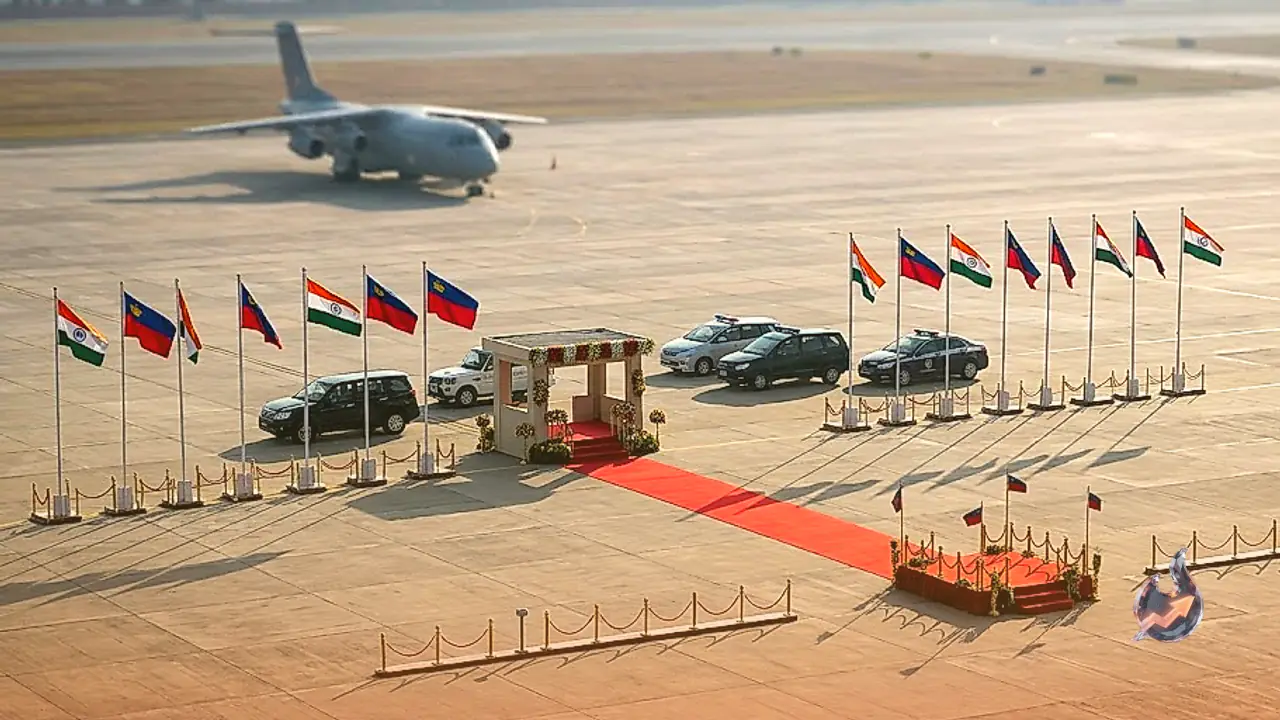

Prince Alois, who currently serves as the acting head of state of Liechtenstein, commenced a four-day official trip to India on Sunday. He is joined on this diplomatic mission by his spouse Princess Sophie as well as a prominent delegation comprising top business executives. The high-profile tour centers on holding extensive discussions with Prime Minister Narendra Modi and External Affairs Minister Dr. S. Jaishankar to expand bilateral collaboration across commerce, international investments, scientific exploration, and technological advancements.
Tiny Alpine Territory With Unrivaled Wealth
Tucked neatly within the Alpine mountain range, this sovereign European nation holds global fascination for balancing an extremely tiny demographic footprint with extraordinary financial prosperity. Inhabited by just 40,000 residents, the country has set striking economic benchmarks. Figures compiled by World Atlas show that Liechtenstein recorded an annual gross domestic product (GDP) per capita based on purchasing power parity (PPP) of 195,372 US dollars in 2026. On the back of these remarkable figures, it earned the distinction of being the wealthiest country in the world in 2026 while remaining a favorite destination for international travelers.
Shared Currency Structure Without a Domestic Central Bank
Bordered entirely by Austria and Switzerland, the nation functions from its picturesque capital city of Vaduz. One of its most distinctive structural realities is that it operates neither an independent central bank nor its own domestic legal tender. Instead, transactions throughout the territory rely on the Swiss Franc (CHF), which is administered and supplied by the Swiss National Bank. This financial mechanism is formally sustained through a comprehensive customs and monetary union forged with Switzerland, allowing Liechtenstein to retain full sovereign authority despite its close monetary integration with its neighbor.
Sovereign Lineage and a Century-Old Commitment to Neutrality
Historical documentation maintained by the US Department of State highlights that Liechtenstein has existed as an autonomous sovereign entity since 1719. Its roots trace back to the Austrian Liechtenstein dynasty, which acquired the territory of Vaduz in 1699 followed by Schellenberg in 1713. By 1719, under the auspices of the Holy Roman Empire, these combined geographic domains were formally elevated into an independent principality bearing the name Liechtenstein.
While French troops under Napoleon briefly occupied the territory for a handful of years, the realm regained its self-governance in 1815 under the framework of the German Confederation. When this confederation subsequently dissolved in 1868, Liechtenstein made the landmark move to disband its standing army of 80 soldiers. The principality declared perpetual neutrality from that moment onward, a strictly preserved status that was uniformly respected throughout the turbulence of both World Wars.
Unique Transport Landscape With No Sea Access or Runways
The geography of the nation lacks any domestic or international airport facilities, and being entirely landlocked, it has no maritime harbor. Visitors and returning residents typically touch down at major commercial airports located in neighboring Switzerland or Austria before completing their travel into the country via railway networks, bus routes, or passenger vehicles. The only aviation facility situated inside the principality is a heliport located at Balzers, which manages helicopter flights and specialized air transport.
Governance Model Blending Monarchy With Parliamentary Checks
The constitutional architecture of Liechtenstein is structured as a hereditary constitutional monarchy. The reigning prince acts as the official head of state, directing foreign diplomacy and formally executing treaties signed with other sovereign nations. The executive apparatus functions as a collegial council composed of a head of government and four additional government councillors, who receive their formal royal appointments only after securing confirmation from parliament.
According to the US Department of State, the prince exercises substantive legislative prerogatives, including the right to introduce government legislative drafts and veto measures cleared by lawmakers. In scenarios where public order or state welfare faces grave danger, the monarch holds authority to enact emergency princely decrees, provided such executive actions carry the countersignature of the head of government.
Expanding Bilateral Horizons Under the TEPA Framework
The Ministry of External Affairs (MEA) pointed out that the visit by Prince Alois marks an important milestone in deepening mutual engagement. Bilateral commercial momentum received a major boost following the entry into force of the India-EFTA Trade and Economic Partnership Agreement (TEPA) in 2025. Official statements from the ministry emphasize that these discussions offer a timely opportunity to build durable commercial bridges and explore new avenues of technological collaboration between the two nations.