




















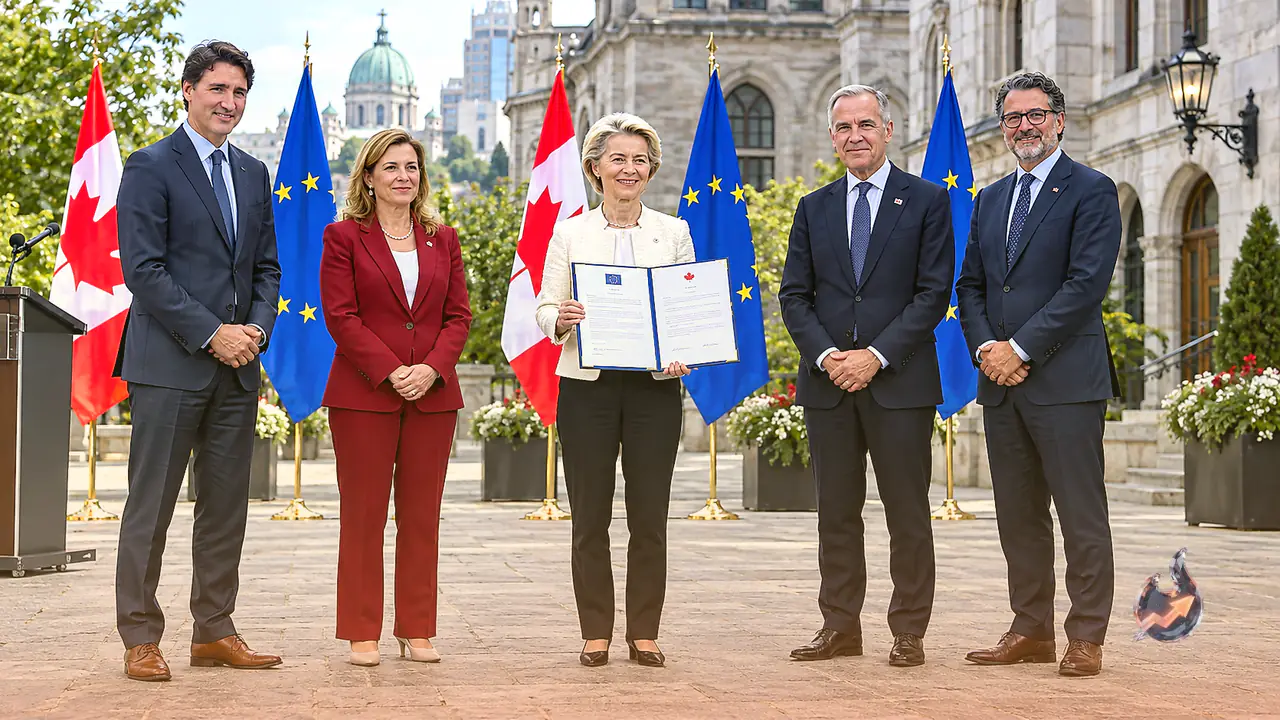

European Commission President Ursula von der Leyen set out a detailed framework for a transformative alliance between Canada and the European bloc during a two-day summit in Montreal. Speaking on Thursday, she characterized the initiative as a partnership closer to membership than anything previously established by the European Union. She explained that such an arrangement is reserved strictly for the most trusted external allies who demonstrate readiness to break new ground together. The proposed model focuses on deep policy harmonization, integrated governance, joint scientific innovation, and collaborative research initiatives.
Shifting Geopolitics and the Montreal Gathering
For several decades, high-level summits between Canadian and European leaders unfolded with little public scrutiny or fanfare, but this year's convention in the Canadian metropolis represents a notable departure from that routine. Global observers are tracking Thursday and Friday's sessions closely to understand how the transatlantic partners plan to integrate their diplomatic, industrial, and security operations. Von der Leyen introduced the prospect of opening the bloc's doors to Canada under an associate membership concept last month, floating an official category that does not exist within the Union's legal architecture.
Her initial diplomatic overture followed an address by Prime Minister Carney to the European Parliament in Strasbourg. During that appearance, Carney told European lawmakers that Canada and Europe stand significantly stronger together when navigating an era marked by geopolitical rupture. While leaders on both sides of the Atlantic broadly favor expanding bilateral engagement, disagreements have surfaced regarding the precise diplomatic terminology used to define the relationship.
Member State Objections and the Debate Over Associate Status
The push to designate Canada as an associate member triggered concerns among several European capitals, with Germany leading questions about whether such branding confers preferential standing relative to other hopeful nations. European governments intervened prior to the summit to excise direct references to the title from draft communiqués, substituting milder diplomatic phrasing centered around an ever closer association.
Germany's ambassador to Canada, Matthias Lüttenberg, explained that several member states experienced surprise when von der Leyen made her initial announcement. While solid support exists for building stronger connections, he observed that the practical mechanics of associate membership remain ambiguous when applied to Canada. Lüttenberg noted that Berlin traditionally applies the term to completely distinct contexts, specifically the structured accession pathways involving Ukraine and Moldova, two nations that have spent years seeking formal entry into the European bloc. Von der Leyen, however, has maintained the phrasing across her public statements without directly addressing the member states' linguistic dispute.
Advancing Defence, Critical Raw Materials, and Commerce
Following morning discussions on Thursday, Carney and von der Leyen joined corporate executives and business leaders from both continents for a dedicated commercial forum. Canadian officials indicated that bilateral teams expect to finalize concrete pacts spanning critical minerals, technological innovation, industrial procurement, defence integration, and trade over the course of the two-day summit.
European representatives speaking before the meetings downplayed expectations for an immediate sweeping pronouncement on institutional status, clarifying that technical frameworks will require several months of negotiation. Still, representatives from both sides highlighted specific avenues of cooperation, including intensified commercial partnerships and reciprocal student mobility arrangements across the Atlantic.
Canadian representatives confirmed that Ottawa will not contribute standard membership dues akin to full EU member states. Instead, Canada intends to fund and participate selectively in targeted European programmes that offer mutual strategic advantages. Reflecting on the naming controversy, a senior Canadian official speaking anonymously noted that the disputed vocabulary simply reflects the scale of mutual ambition driving the process.
Transatlantic Realignment Amid Trade Frictions
Prime Minister Carney has systematically accelerated Canada's pivot toward European markets since assuming office last year, responding directly to economic headwinds caused by an ongoing trade war with the United States, Canada's neighbor and primary commercial client. Across the border, US President Donald Trump ridiculed the prospect of Canada securing associate status in the European bloc, branding it laughable and threatening very serious tariffs against European exporters if he views the alignment as a hostile act.
Addressing international scrutiny on Wednesday, Canadian authorities emphasized that deepening ties with Europe is not designed to antagonize third parties, but rather to institutionalize strategic work that has been underway for years. Canada recently concluded an accord granting its domestic defence manufacturers procurement access inside the EU's Security and Defence Partnership programme.
Energy cooperation has also advanced rapidly following a landmark bilateral agreement with Germany in May, paving the way for the inaugural long-term shipments of Canadian liquefied natural gas to European destinations in the coming years. Furthermore, Canada unveiled its first comprehensive National Security Strategy in two decades on Thursday, cementing security and geopolitical stability in Europe as core national priorities. Addressing the debate over formal designations, Carney stated that administrative nomenclature remains secondary to delivering tangible benefits for everyday Canadians.