















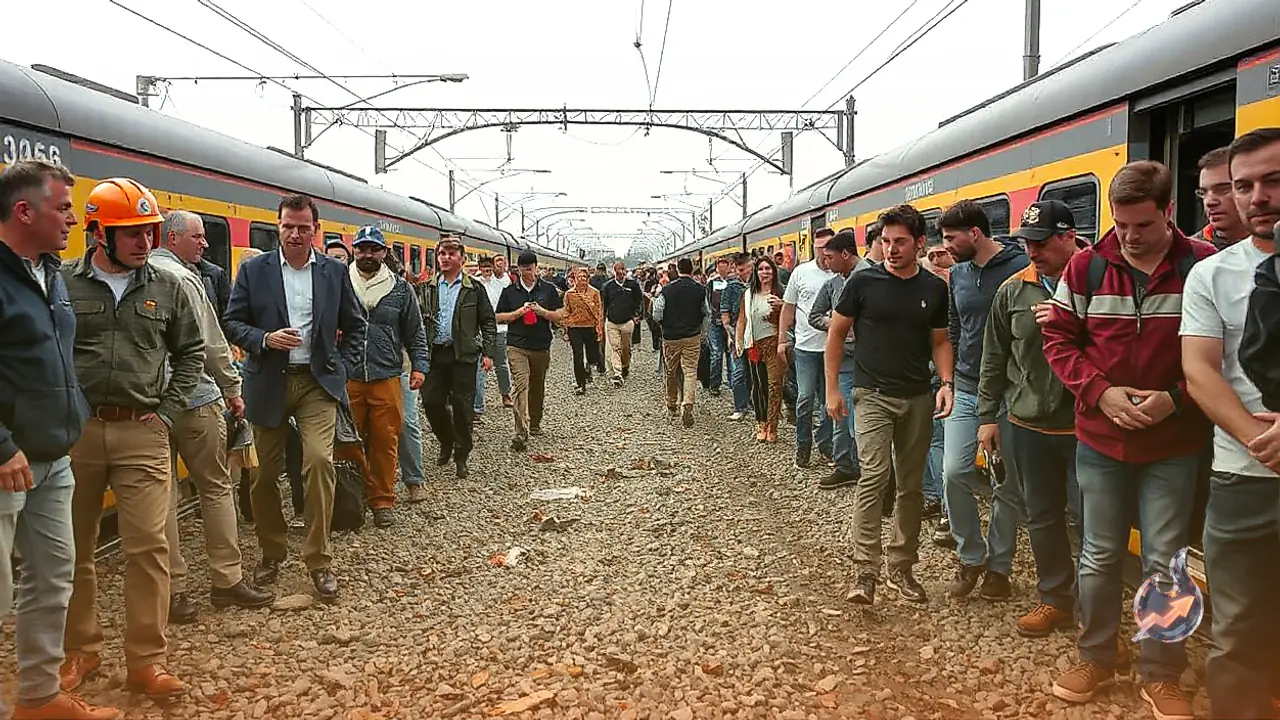

A catastrophic high-speed rail collision claimed at least 68 lives and left dozens injured in central Spain on Wednesday morning, marking one of the worst rail disasters in modern European history and the country's deadliest train crash in 13 years. A fast-moving passenger service operating on the route from Madrid to Seville crashed directly into another high-speed train that was stationary along the line. The violence of the impact caused multiple carriages to derail and tumble down a steep embankment beside the track.
Mid-Morning Disaster 140 Kilometres South of Madrid
The crash occurred shortly after 09:00 (08:00 GMT) approximately 140 kilometres (100 miles) south of Madrid. The stationary train, operated by the private rail carrier Iryo, was carrying 147 passengers when it was forced to halt on the tracks due to a sudden computer failure, according to Spain's Transport Minister Óscar Puente.
Under standard operational safety protocols, whenever an automated computer or signalling failure occurs, an overarching 24-hour centralized control centre in Madrid takes command of train movements. However, during this emergency, the control hub made what the transport minister described as an inexplicable operational decision: personnel instructed trains on the line to resume moving without imposing any mandatory speed restrictions or caution orders to account for the stalled carriages ahead.
Renfe Train Hits Stationary Iryo Service From Behind
Iryo confirmed that its halted train was struck from behind by another high-speed train, this one operated by Spain's state-owned railway enterprise, Renfe. The moving Renfe train had 397 passengers aboard when it rammed into the rear of the stationary carriages at high momentum. Metal frameworks buckled under the kinetic force, throwing multiple carriages off the ballast and down the bank.
Salvador Arriza, a 62-year-old passenger travelling aboard the Renfe train, recounted the moment of collision, describing the sheer violence of the impact as brutal. He recounted that passengers immediately started smashing the carriage windows in a desperate bid to scramble outside, noting that several fellow travellers could not move at all because they were pinned firmly between crumpled seats.
Flames, Crushed Metal and Speared Rails
A blaze broke out in one of the wrecked carriages shortly after the impact. Terrified survivors described horrific scenes inside the derailed cars, where bleeding, trapped passengers wept and shouted for help while partly buried beneath debris and sheared interior fittings. Photographs taken at the crash site revealed that a massive, displaced section of steel railway track had speared cleanly through the fuselage of one carriage.
Several passengers later suggested that the substantial section of railway track impaling the carriage structure may have created immense mechanical drag, potentially decelerating the train and preventing an even worse secondary catastrophe as the coaches slid off the formation.
Survivors Recount Moments of Sheer Terror
Tangui Binier, a 22-year-old passenger on the Iryo train, recalled that suitcases and heavy luggage began flying across the carriage cabin while people screamed in terror as the train ground violently to a halt. Thick plumes of smoke rapidly filled the air amidst widespread disorientation. When he finally managed to climb out of the coach, he witnessed that parts of the train had flipped over entirely onto their sides.
Binier stated that the aftermath was extremely distressing to behold, mentioning that his father personally carried an injured young girl suffering from a broken hip out of the mangled wreckage. He also spoke of seeing severed limbs and dead bodies strewn around the site, confessing that he did not know whether he would ever emotionally recover from what he had witnessed.
Passengers Caught Mid-Commute
Spanish journalist Antonio Jiménez Barca, a reporter for the newspaper El Pais, was travelling aboard the Renfe train and had stood up to walk toward the onboard cafeteria when the impact occurred. He recounted feeling as though an immense force shoved him violently from behind, throwing him straight to the floor.
Jiménez Barca explained that he struck his head with terrible force and quickly found himself covered in blood, with other passengers falling directly on top of him during the chaotic tumble. Beside him, he observed one person with a badly fractured arm and another suffering from severe head trauma.
Another traveller, 46-year-old Sebastián Herrero, gave an account to the newspaper El Mundo, explaining that he saw numerous fellow passengers suffering from broken noses and fractured arms in the immediate moments following the impact. He characterized the event as a terrible impact, estimating that he was tossed into the air for four or five seconds, a duration that felt like an eternity under the circumstances.
Severe shock gripped the survivors who made it outside. During an emotional broadcast on a local television station, one male passenger broke down in tears as he recounted holding a dying female passenger in his arms amid the wreckage. He noted that the woman was freezing cold and completely alone, a description that brought the television presenter to tears on air.
Mass Emergency Response and DNA Identification
Emergency medical teams and dozens of ambulances were dispatched to the rural crash site, while rescue helicopters were mobilized to airlift the most critically wounded passengers to regional trauma centres. Due to the severe trauma inflicted upon the victims, Spain's Civil Guard announced that investigators would need to collect DNA reference samples from family members in order to identify several of the deceased.
Prime Minister Pedro Sánchez visited the devastated collision zone, stating that the entire nation of Spain was plunged into mourning. He observed that lives had been shattered, families torn apart, and that the collective grief felt across the country was immense.
The catastrophe struck a nation that was already reeling from an earlier high-speed rail disaster near Córdoba in January, which resulted in 46 fatalities. That incident had occurred along the exact same high-speed trunk corridor, though located further to the south. Wednesday's tragedy represents Spain's deadliest railway disaster since 2013, when 80 people lost their lives in a high-speed derailment on the outskirts of Santiago de Compostela in north-western Spain.
Union Demands and Political Scrutiny
The disaster triggered immediate political and administrative friction. Alberto Núñez Feijóo, who leads the primary opposition People's Party, voiced strong criticism, asserting that the Spanish public has an absolute right to understand the actual condition and oversight of the nation's railway infrastructure. Simultaneously, the Spanish civil service trade union CSIF demanded the immediate resignation of the transport minister, accusing government officials of scapegoating a traffic controller by attributing the disaster to human error in the control centre rather than accepting systemic political responsibility.
In response to the tragedy, Prime Minister Sánchez alongside competing political figures suspended all official public events and halted scheduled campaign activities for the upcoming parliamentary elections next month. Sánchez emphasized that experiencing two catastrophic railway accidents within a single calendar year is utterly unacceptable. He pledged that an exhaustive investigation would uncover the full truth and establish whether criminal or procedural negligence played a role, adding that any detected security shortcomings would be confronted with unyielding firmness.