

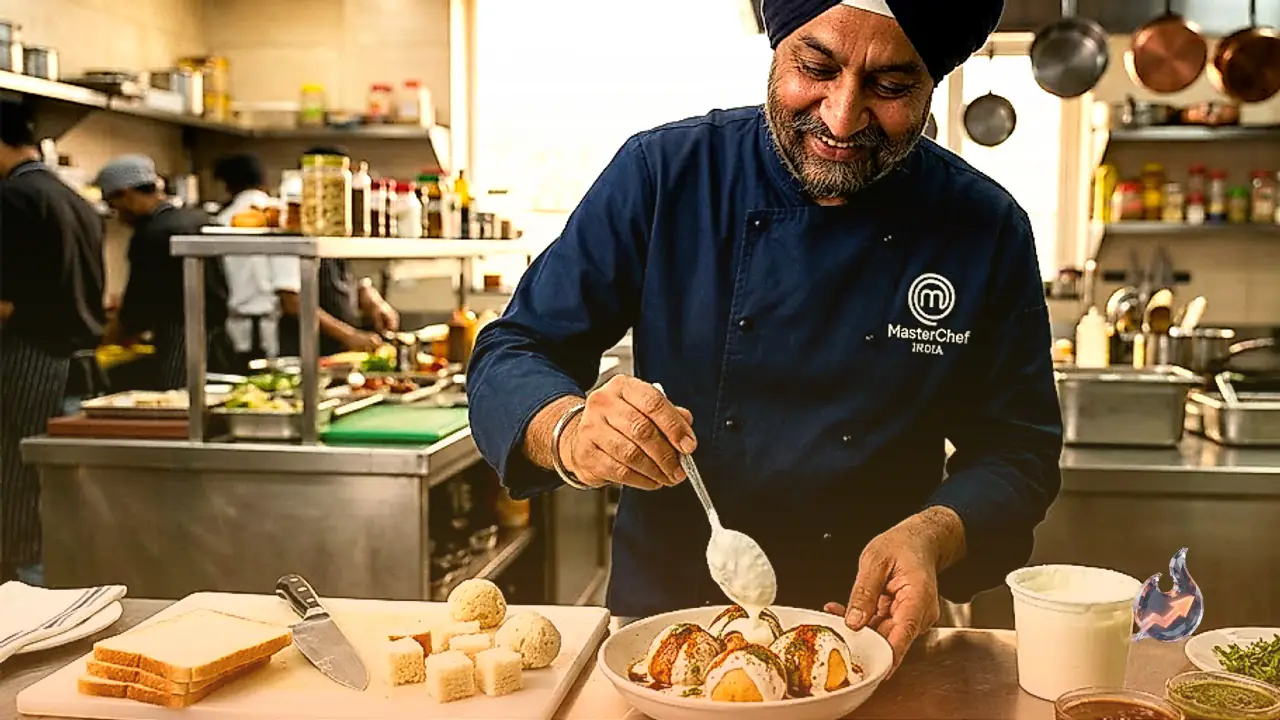



















Unannounced guests at the door, or a sudden craving for something tangy and sweet in the evening, usually rule out dahi bhalla because the urad dal never got the hours of soaking it normally needs. MasterChef Gurkirat Singh has worked around that problem entirely, showing a version of the dish that needs no lentils soaked at all and comes together in roughly five minutes, yet still turns out soft and spongy enough to melt in the mouth.
Shaping bread into bhalla bases
The base of this version is not urad dal batter but ordinary bread. Six to seven slices of fresh white bread are enough for a full plate. Each slice goes into a wide bowl of water for barely a second, since leaving it in any longer would make it fall apart instead of holding together. As soon as it comes out, it is pressed firmly between both palms to squeeze out every bit of water. Once dry, the fingers are used to fold and roll the bread gently until it turns into a smooth, round ball, similar in shape and size to a regular bhalla. These balls are then arranged with a little gap between each one on a serving plate, ready for the next layer.
A whisked curd layer does the soaking work
Where a traditional recipe relies on soaking fried bhalla in water and then in curd, this trick shifts all of that work onto the curd itself. One and a half to two cups of fresh, thick curd go into a separate bowl, along with one to two teaspoons of powdered sugar and a pinch of salt. Whisking this mixture with a hand whisk or a churner smooths it out until it looks and feels as creamy as the curd sold ready-made in shops. This sweetened, chilled curd is then poured generously over the bread balls, enough that every ball disappears under it and has the chance to soak in the flavour and moisture in the process.
The spice and chutney layer that defines the taste
The actual character of a dahi bhalla comes from what goes on top of the curd, and this shortcut version does not skip any of it. Equal pinches of roasted cumin powder, red chilli powder and black salt are dusted over the curd first, and together they balance out its sweetness. Next comes a thick, tangy-sweet chutney made of tamarind and jaggery, added according to taste. Anyone who prefers a spicier bite can finish it off with a green coriander and mint chutney as well. The combination of the red tamarind chutney and the green mint chutney is what gives the dish its familiar look and its balance of sweet, sour and spicy flavours.
Crunch, garnish and serving it right away
Soft bhalla taste even better with a bit of crunch mixed in, so two to three crisp papdi are crushed by hand and scattered over the top, along with a sprinkle of fine sev or namkeen. For a richer, more festive presentation, finely chopped pistachios, almonds or pomegranate seeds can be added as well. The dish needs to be served immediately after this final step, since waiting too long lets the papdi and sev turn soft and lose their crunch. Done right, the bhalla end up so soft that they can be cut with just the edge of a spoon and dissolve in the mouth almost instantly. It is a trick worth trying over a weekend get-together or on any evening when a chaat craving strikes but there is no time to soak lentils.