






















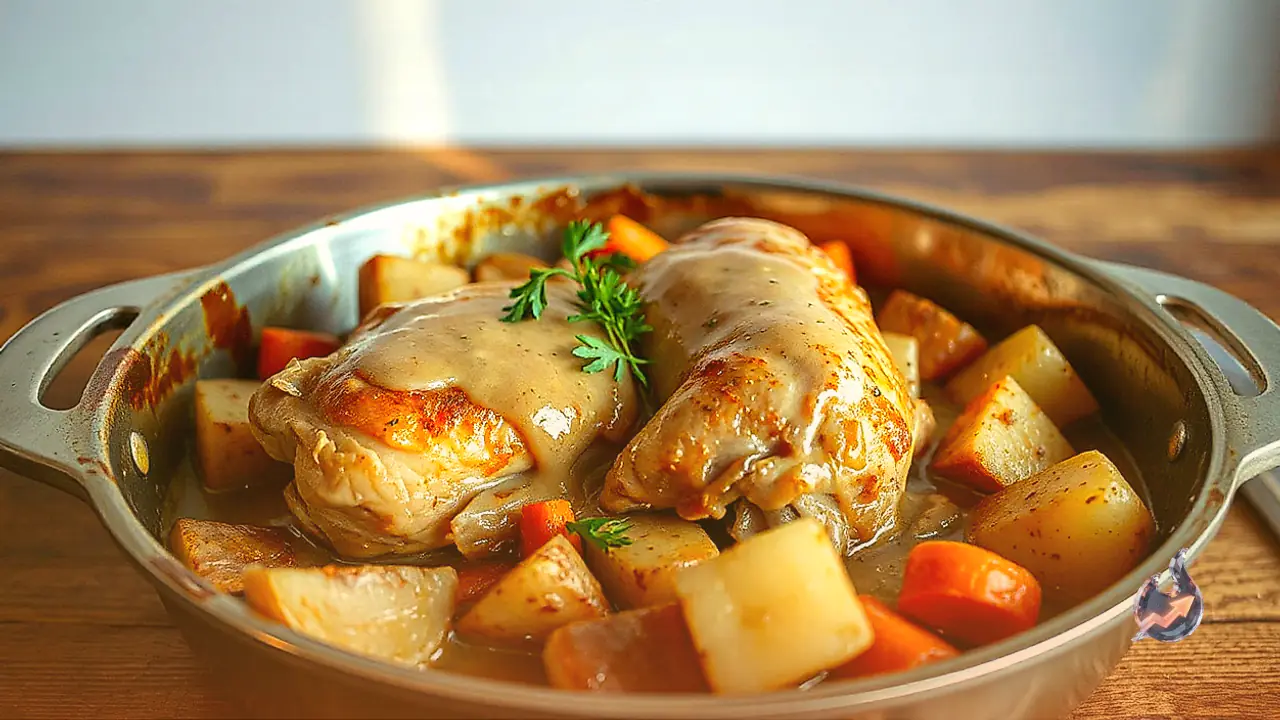

A hearty, comforting roast dinner usually demands juggling multiple pots, boiling vegetables on the stove, searing meat, and whisking roux in a separate saucepan to build a rich gravy. This clever one-pan baked chicken dinner completely bypasses that complexity through an ingenious self-saucing technique. Raw bone-in chicken, cut root vegetables, and an uncooked mixture of flour and seasoned broth are placed directly into a single roasting pan. As everything bakes side by side in the oven, the flour thickens the liquid into a silky, savoury gravy enriched by the natural juices dripping from the roasting chicken pieces above.
The Science Behind the Self-Saucing Oven Method

The concept relies on a simple yet effective culinary reaction similar to a slow baked stew, adapted for roasting pans. A mixture of unthickened flour and beef stock is poured into the bottom of the pan around raw vegetables. Under the steady heat of a 200°C or 390°F oven, the starch granules in the flour swell and burst, absorbing liquid and thickening the broth. At the same time, the chicken rests elevated on the vegetable bed. As its skin crisps and renders fat, the savoury meat drippings flow downward, merging directly into the bubbling sauce.

The idea originated after food writer and recipe creator Nagi received an inquiry on Instagram from a follower named Jane, who asked whether vegetables could be added to an existing chicken and gravy bake. The resulting adaptation creates a complete, balanced meal from scratch in just 55 minutes, requiring only 15 minutes of hands-on preparation. The pan goes into the oven completely uncooked, and emerges with tender root vegetables, perfectly roasted poultry, and a fully developed brown gravy without requiring cornstarch slurries or stovetop reduction.

Ingredients for the Country Seasoned Chicken

The foundation of the recipe is 1 to 1.25 kilograms or 2 to 2.5 pounds of bone-in, skin-on chicken thighs, which generally equates to 4 large or 5 to 6 medium pieces weighing roughly 220 to 250 grams or 7 to 8 ounces each. Bone-in thighs are uniquely suited for this cooking method because their dense meat stays exceptionally juicy across a 45-minute bake while allowing ample time for the potatoes to become fork-tender. The rendering skin also releases the vital fats needed to give the baked gravy authentic roasted richness.

The meat is seasoned with a robust country spice rub made from 1 1/2 teaspoons of sweet or regular paprika, 1/2 teaspoon of garlic powder, 1/2 teaspoon of onion powder (which can be swapped for additional garlic powder if preferred), 1 teaspoon of dried thyme crushed between the fingertips, 1 teaspoon of cooking salt or kosher salt, and 1/4 teaspoon of cracked black pepper. If using standard fine table salt, reduce this measurement by half, or double it if using coarse flake salt. One tablespoon of olive oil is used to help the rub adhere securely to the meat and promote even crisping in the oven.

Vegetable Selection and Proper Sizing

Choosing the right vegetables is crucial to prevent excess liquid from thinning the gravy. Root vegetables perform best because they withstand 45 minutes of roasting without collapsing into mush. The recipe calls for 600 grams or 20 ounces of baby potatoes with skins left on, sliced into 1.75-centimetre or 0.7-inch pieces. If working with waxy potato varieties, cutting them slightly smaller ensures they soften fully within the standard cooking window.

Alongside the potatoes are 3 medium carrots, peeled and sliced into rounds roughly 7 millimetres or 1/3-inch thick, splitting wider pieces into half-moons so they cook at an identical pace. One large red onion cut into 1-centimetre or 0.4-inch thick wedges and 2 cloves of garlic crushed with a press round out the aromatic base. These vegetables are tossed with 1 1/2 tablespoons of olive oil, 1 teaspoon of cooking salt, and 1/4 teaspoon of black pepper to ensure thorough seasoning before entering the roasting pan.

Whisking the Magic Self-Saucing Gravy

The liquid base of the dish is built using 2 1/2 cups of low-sodium beef stock or broth. Beef stock is intentionally selected over chicken stock because it offers a much deeper, more robust flavour profile and naturally darkens the sauce. To build body, 1/3 cup of plain all-purpose flour is incorporated as the thickening agent.

To solve the issue of pale pan gravies, the recipe introduces 1 teaspoon of dark soy sauce as a secret colouring and flavour booster. Despite being an East Asian staple, just a single teaspoon in this volume imparts rich golden-brown coloration and savoury depth without leaving any detectable soy taste. The gravy mixture is completed with 1/2 teaspoon of black pepper. No additional salt is added to the liquid, as the sodium from the stock and the seasoned vegetables seasoning provides ample balance. For the final touch, 1 cup of frozen peas thawed at room temperature and an optional teaspoon of fresh thyme leaves are reserved for post-bake assembly.

Step-by-Step Cooking Instructions

Cooking begins by preheating the oven to 200°C or 390°F, or 180°C for fan-forced models. In a large prep bowl, combine the sliced potatoes, carrots, red onion wedges, minced garlic, olive oil, salt, and pepper. Toss until evenly coated, then transfer everything into a roasting pan measuring approximately 35 by 26 centimetres or 13.8 by 10.2 inches, spreading the vegetables out into a level layer.

To minimise clean-up, use the same bowl to prepare the chicken. Place the thighs into the bowl, drizzle with 1 tablespoon of olive oil, and turn to coat, using the chicken to pick up remaining seasoned oil from the vegetables. Combine the country seasoning spices in a small ramekin and sprinkle evenly across the meat, concentrating the majority on the skin side. Avoid excessive handling once seasoned so the spices remain in place. Arrange the chicken pieces skin-side up over the bed of vegetables, tucking loose skin underneath each piece to create neat bundles.

Return to the prep bowl to make the sauce. Place 1/3 cup of plain flour in the bowl and pour in approximately 1/2 cup of the beef stock. Whisk vigorously until a completely smooth, lump-free paste forms. Gradually whisk in the remaining 2 cups of stock, the dark soy sauce, and 1/2 teaspoon of black pepper. Pour this liquid carefully down the inner edge of the roasting pan. Never pour directly over the chicken pieces, as this would wash away the spice crust.

Drizzle approximately 1/2 teaspoon of olive oil over the skin of each chicken thigh. Place the uncovered roasting pan into the oven and bake undisturbed for 45 minutes, until the poultry skin turns deep golden brown and the surrounding sauce bubbles vigorously. If your oven cooks unevenly, rotate the pan midway through.
Finishing, Consistency Tweaks, and Servings
Once the baking time finishes, remove the pan from the oven and transfer the chicken pieces onto a warm plate to rest. Scatter the thawed frozen peas across the hot pan. Because frozen peas are pre-blanched during processing, the residual thermal energy in the pan warms them through completely in seconds.
Using a flexible rubber spatula, scrape the bottom and get deep into the corners of the pan where flour concentrates during reduction. Stir the bubbling liquid and vegetables together for 30 to 60 seconds until the mixture emulsifies into a smooth, glossy gravy. If using an oversized pan has caused excessive evaporation, whisk in a splash of boiling water to loosen the texture. If the sauce appears thinner than desired due to chicken moisture, cover the resting chicken with foil and return the pan of vegetables and gravy to the oven for an extra 5 to 10 minutes, keeping in mind that gravy thickens substantially as its temperature drops.
Nutritional Profile and Storage Guidelines
Based on 4 generous servings with one large chicken thigh per portion, each serving delivers 676 calories, 37 grams of protein, and 48 grams of carbohydrates. Total fat content stands at 38 grams, comprising 9 grams of saturated fat, 7 grams of polyunsaturated fat, and 18 grams of monounsaturated fat, with trans fats remaining at a negligible 0.1 grams. Sodium measures 1614 milligrams and potassium reaches 1596 milligrams, accompanied by 167 milligrams of dietary cholesterol.
The meal also provides 8 grams of dietary fibre, 6 grams of naturally occurring sugars, 8424 International Units of vitamin A, 48 milligrams of vitamin C, 78 milligrams of calcium, and 4 milligrams of iron. Leftovers store exceptionally well in sealed containers, keeping in the refrigerator for 3 to 4 days or in the freezer for up to 3 months. When reheating, add a small splash of water or stock to restore the gravy to its original consistency.