























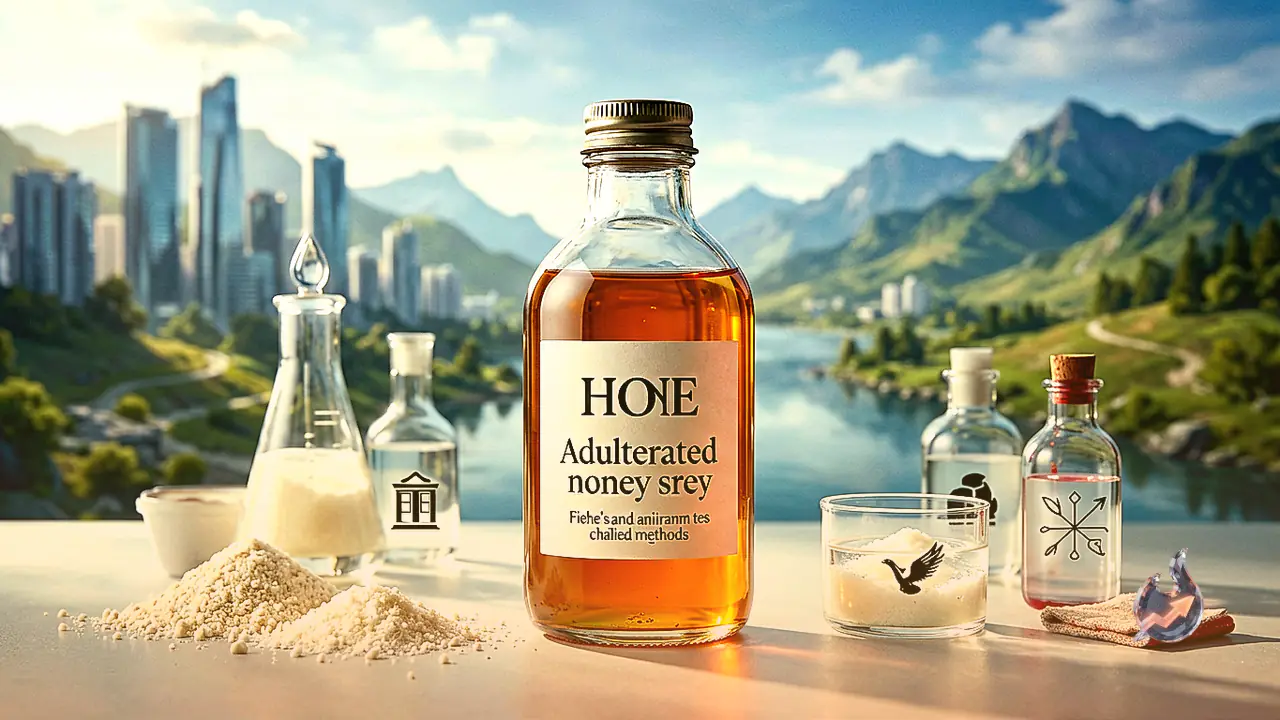

Honey is widely valued for its numerous health benefits, maintaining high market demand year round. However, this consistent demand often leads to the proliferation of fake or adulterated products in the market. Unscrupulous manufacturers frequently mix honey with cheap sugar syrups or jaggery concentrates. Such practices ruin the natural enzymatic benefits of authentic honey and present health risks to consumers. Determining honey purity requires reliable detection techniques, ranging from simple home-based physical tests to precise chemical analyses in specialized laboratories where color changes reveal added sugars.
Simple Water Test for Checking Purity at Home
For individuals suspecting the authenticity of their honey at home, the water dispersion test serves as a preliminary evaluation. The process involves taking a clean glass filled with room temperature water and gently adding a single teaspoon of honey. The behavior of the honey upon hitting the water offers key insights into its physical composition. Pure honey features high density and viscosity, causing it to sink directly to the bottom of the glass as a solid mass without immediately dissolving. Conversely, adulterated honey containing high amounts of artificial sugar syrup or excess water breaks down rapidly and dissolves into the water almost instantly.
Fiehe Test: Step-by-Step Procedure Using Ether
To definitively detect commercial invert sugar or jaggery adulteration, professional laboratories rely on the standardized Fiehe test. The testing procedure begins by measuring exactly 5 milliliters of the honey sample into a clean container. Next, 5 milliliters of ether is added to the sample, and the mixture is shaken vigorously to ensure complete extraction. The mixture is then left undisturbed for a short period, allowing the lighter ether phase to separate completely into a distinct upper layer. Once separation occurs, the ether layer is carefully decanted into a clean petri dish. The liquid ether is allowed to evaporate entirely, leaving behind a chemical residue in the dish for further analytical testing.
Resorcinol Reaction and the Red Color Indicator
After the ether has evaporated completely, 2 to 3 milliliters of a specially prepared resorcinol reagent is added to the residue in the petri dish. This reagent solution is formulated by dissolving 1 gram of resorcinol in 5 milliliters of concentrated hydrochloric acid. Upon contact between the acid reagent and the extracted residue, analysts observe the sample for immediate color changes. If a distinct red color develops during this stage, it confirms the presence of commercial invert sugar or jaggery adulterants in the honey sample.
Aniline Chloride Test for Detecting Added Syrups
The aniline chloride test represents another established chemical protocol used to identify artificial sugar additions in honey samples. This test also starts with a 5 milliliter sample of honey. An aniline chloride solution is prepared using a specific combination of 3 milliliters of aniline and hydrochloric acid. This reagent solution is then thoroughly mixed into the honey sample to ensure uniform reaction across the test volume.
Color transformation serves as the ultimate diagnostic sign in the aniline chloride test. If the mixture turns a bright red color after the chemical solution is added and mixed, it indicates clear adulteration with industrial sugar syrups. In contrast, pure honey maintains its natural color profile under this treatment. A bright red outcome warrants caution, signaling that the batch is unfit for pure honey classification.
Crucial Safety Guidelines for Chemical Testing
While chemical evaluations like the Fiehe and aniline chloride tests provide accurate detection of synthetic sweeteners, they are unsuitable for routine household execution. These procedures require hazardous laboratory chemicals, including concentrated hydrochloric acid, which is highly corrosive, along with ether and aniline, which are flammable and toxic. Exposure to concentrated hydrochloric acid fumes or skin contact can cause severe burns. Consequently, these chemical verification steps should only be conducted by trained technical personnel inside properly equipped laboratory environments with necessary safety apparatus.