




















Budget projection hardware frequently promises an expansive home theater experience at a fraction of high-end costs, and the Aurzen EAZZE D1 MAX targets precisely this territory. Positioned as an entry-level standard throw projector, it is built around a native 1080p resolution powered by an LED light source and standard LCD imaging technology. As an upgraded and higher-tier revision of the earlier Aurzen EAZZE D1, it arrives designed to compete directly against other affordable counterparts carrying similar core specifications, such as the NexiGo PJ40 Pro. The headline convenience feature here is the native integration of Google TV, allowing users to fire up streaming applications natively without plugging in a separate media dongle or streaming stick.
Ease of use stands at the core of the physical design and software suite. The unit incorporates automatic adjustment utilities including autofocus, automatic keystone correction, screen fit, and obstacle avoidance routines to align the canvas rapidly against a blank wall or dedicated screen. It supports projected diagonal dimensions spanning from 80 to 200 inches. Wireless options encompass onboard Wi-Fi for screen mirroring straight from mobile handsets and Bluetooth 5.1 for offloading audio to wireless speakers. For standalone listening, it houses internal 10W speakers compatible with Dolby Audio decoding. However, technical limits quickly emerge: the chassis lacks HDMI 2.1 bandwidth and remains capped strictly at a 60Hz refresh rate, meaning modern consoles cannot leverage higher-performance output modes.
Dark Room Cinephile and Home Theater Performance
When evaluated as a centerpiece for dedicated dark-room home theater spaces, the Aurzen EAZZE D1 MAX falls short. Although testing shows it is capable of displaying reasonably deep black floors during darker passages, the projector fundamentally lacks the overall illumination strength needed to inject dimensional depth into the frame. Consequently, subtle background textures and low-light details get obscured. The low native contrast ratio leaves the picture looking flat, while scenes featuring mixed or brighter highlights exhibit raised black levels that leave the image appearing noticeably washed out.
Color reproduction presents another severe bottleneck. The engine fails to produce a wide, saturated gamut across conventional color spaces, resulting in imagery that lacks punch and vibrancy. Right out of the box, the unit exhibits a persistent blue tint that proves stubbornly difficult to eliminate even when attempting thorough post-purchase calibration. In terms of motion integrity, the internal processing cannot eliminate judder from any playback source, leaving camera pans and tracking movements looking noticeably jittery. On the positive side, viewers will not encounter any rainbow effect artifacts typically associated with single-chip DLP competitors, though moving content does reveal unwanted image reflections during pans. Adding to the drawbacks, the internal cooling fan runs loudly at maximum brightness settings, easily pulling attention away during quiet dramatic sequences.
Outdoor Projection and Daytime Illumination Limits
Transporting the Aurzen EAZZE D1 MAX to an outdoor patio or open-air yard highlights clear functional compromises. While it manages to register higher brightness figures than baseline entry-level competition, it still lacks the sheer lumen output required to overcome stray ambient illumination or wash away daylight glare. Furthermore, light distribution is highly uneven across the panel; the brightness uniformity is poor, creating visible drop-offs where the outer borders and corners appear significantly darker than the middle. This luminance vignette becomes considerably more prominent as projection sizes expand toward the 200-inch ceiling.
Portability remains decent from a purely mechanical perspective. The housing is compact, lightweight, and comes with a protective lens cap to guard against transport scuffs. Combined with automatic keystone, autofocus, and screen alignment sensors, physical placement is painless. Yet, critical optical hardware omissions impose heavy restrictions: the projector contains neither optical zoom nor physical lens shift. As a result, users cannot manipulate image boundaries optically and must align the projector dead-center to the projection plane at an exact physical distance to prevent loss of edge-to-edge sharpness. Furthermore, the absence of an internal battery pack means outdoor operations remain strictly tethered to the proximity of an AC mains wall outlet.
Bedroom Utility and Everyday Gaming Limitations
For casual entertainment in a secondary bedroom, the Aurzen D1 MAX provides an adequate though compromised secondary screen. Its lightweight enclosure allows hassle-free transport across rooms, and its automatic geometry features quickly shape the picture against bare drywall. The integrated Google TV interface provides direct access to video libraries without cable clutter. Nonetheless, if physical space constraints force you to place the projector off to the side, the lack of lens shift degrades optical sharpness compared to an aligned setup. In tighter sleeping quarters, the whir of the cooling fan at peak output can become intrusive, pushing viewers to lower brightness levels simply to achieve a quieter auditory backdrop.
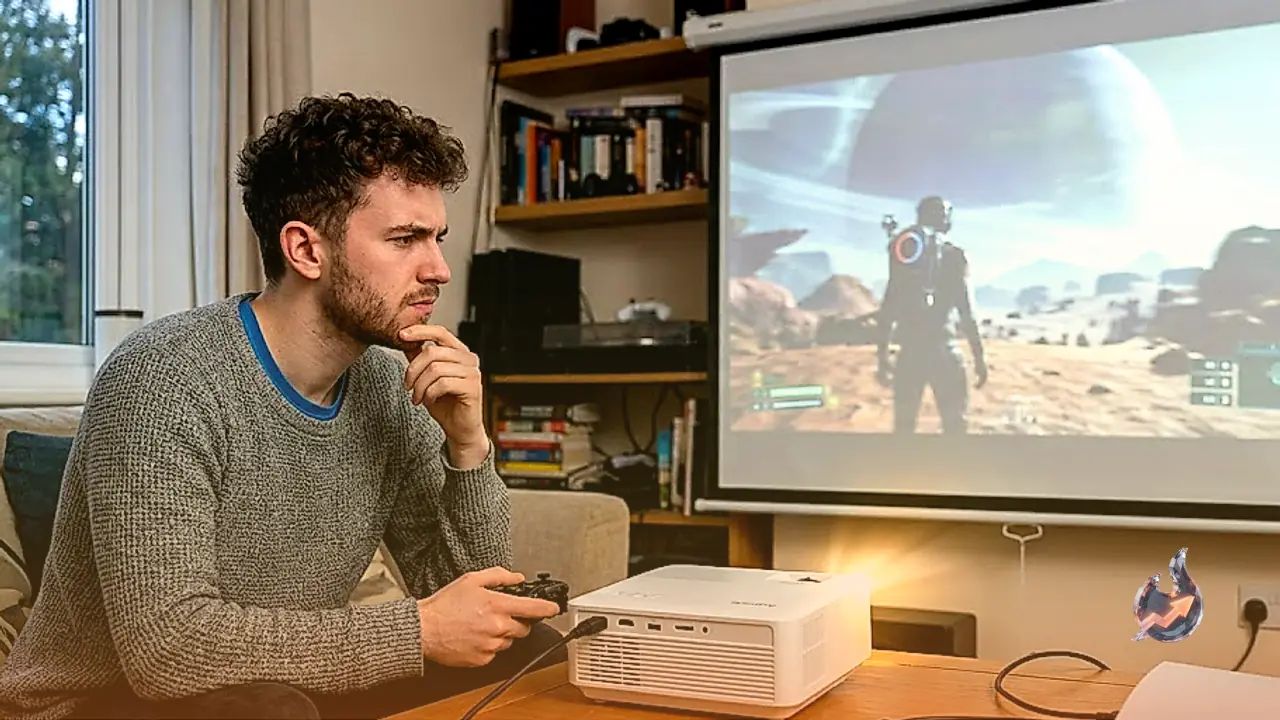
For video gaming, the Aurzen EAZZE D1 MAX is entirely ill-suited. With input latency measuring exceptionally high, players experience a jarring tactile disconnection between controller actuation and onscreen response, making the hardware unusable for reaction-heavy titles, platformers, or competitive multiplayer matches. The panel is constrained to a basic 60Hz refresh rate, and the underlying LCD response times generate noticeable motion blur whenever the in-game perspective shifts rapidly. Compounded by muted color saturation and inadequate contrast, modern gaming graphics end up looking both sluggish and visually compressed.