





















When operating a steering wheel is no longer mandatory, the experience inside an automobile transforms entirely. Occupants in the front area find themselves free to dine, play video games, stream shows, or tackle office work. For many, catching up on sleep is the most tempting option of all. In vehicles like the Tesla Cybercab, the cabin layout allows seat backs to tilt generously backward, creating an inviting space to doze off during a trip. Yet, this futuristic comfort introduces an alarming safety predicament that is forcing global transportation authorities to rethink decades of occupant safety science.
Tesla outlines clear restrictions in its official Cybercab rider instructions, cautioning that riders should never tilt their seat backs beyond 35 degrees from vertical. The guidelines specify that lap belts must sit securely over the hips and passenger feet must remain firmly on the vehicle floor. Adhering to these positions minimizes injury hazards during sudden stops or collisions. Biomechanics researchers strongly validate this guidance, pointing out that improper postures inside any moving automobile heighten the chances of physical trauma in an impact, even when seatbelts are properly buckled. According to US federal traffic safety records, 42 fatalities over the preceding decade involved vehicle occupants whose seat backs were reclined rather than kept in standard upright positions.
The Hidden Dangers of Reclining and Missing Crash Data
Safety specialists emphasize that the recorded death toll of 42 is almost certainly an underestimation. Becky Mueller, a senior research engineer working at the Insurance Institute for Highway Safety, explains that tracing a passenger's precise seating orientation prior to a collision is extraordinarily difficult. Severe crashes thrust human bodies in erratic directions, and paramedic crews focus primarily on pulling trapped, injured people out of mangled machinery as rapidly as possible. Responders rarely have the time, tools, or situational awareness to log how victims were angled moments before impact.
A spokesperson from the US National Highway Traffic Safety Administration (NHTSA) affirmed that real-world field data regarding reclined travelers remains scarce. Nevertheless, the arrival of autonomous models such as the Tesla Cybercab has prompted regulators to examine this persistent hazard with renewed urgency. NHTSA opted to prioritize reclined occupant studies as the foundation for driverless vehicle safety evaluations, recognizing that riders are far more inclined to lay back once active driving duties are removed from their hands.
Archaic Rules and Seatbelt Mechanics on the Human Body
Modern vehicle safety benchmarks assume that passengers sit completely upright while facing forward. Deployed airbags are engineered around this predictable profile, and conventional crash test mannequins feature rigid, unyielding pelvic structures that cannot physically slump or recline. Updating federal mandates requires years of proposing projects, securing funding, running crash trials, interpreting metrics, and sorting through extensive public feedback.
Standard three-point seatbelts are engineered to restrain the hard skeletal framework of the pelvis. When a passenger reclines or faces sideways, the harness shifts away from the sturdy pelvic bones and rides up onto the soft abdominal tissue. During a crash, the belt violently constricts the abdomen, creating high risks of internal hemorrhaging, severe lumbar spine fractures, pelvic fractures, and ruptured vital organs. Lower extremity trauma involving the legs and feet is equally common when restraints sit incorrectly, leading to long-term mobility impairment even after patients recover from primary wounds.
From Regulatory Exemptions to Next-Generation Dummies
Makers of autonomous shuttles experimenting with unconventional interior cabins currently endure grueling bureaucratic processes to secure experimental waivers. Zoox, a subsidiary of Amazon, developed a bidirectional vehicle with carriage-style bench seating where passengers sit opposite one another. After attempting to self-certify compliance in 2022, Zoox had to submit a formal application for special exemptions in the fall of 2025. Following extensive review, the company received permission in the summer to deploy up to 5,000 driverless units over a two-year operational window. Tesla is currently pursuing similar self-certification avenues for its Cybercab under NHTSA review.
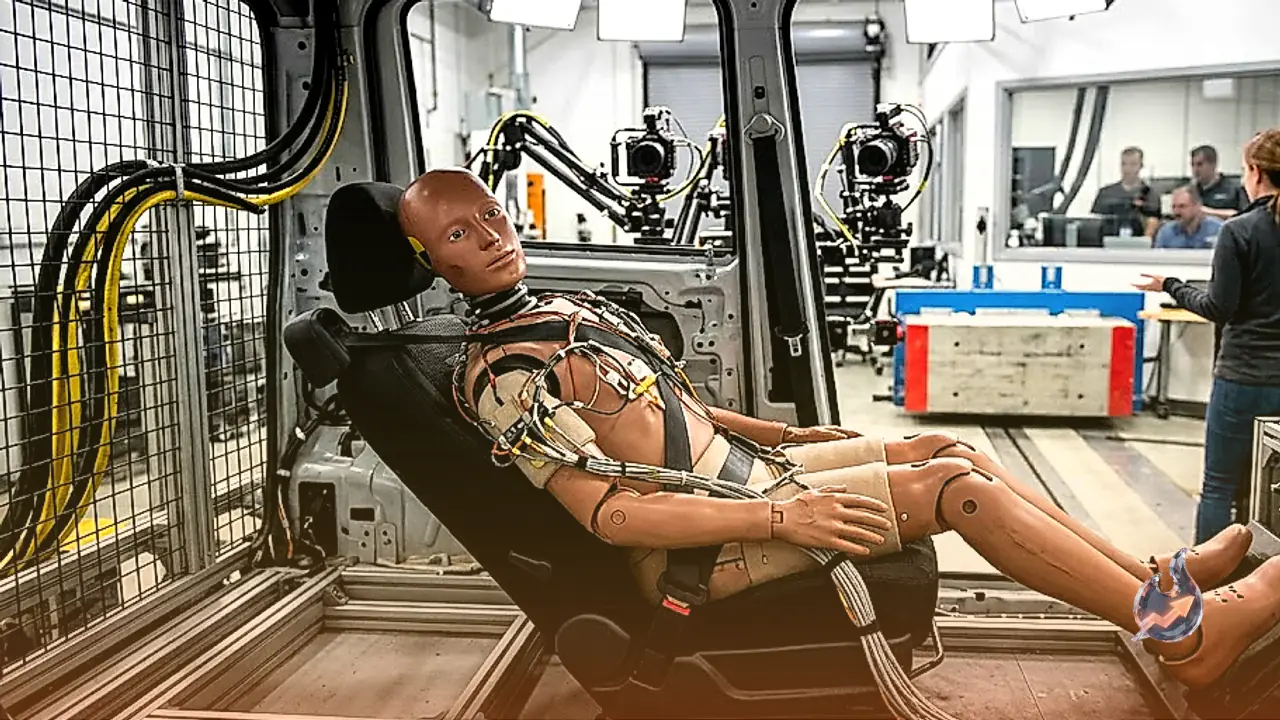
To establish lasting regulations, NHTSA is studying human motion kinematics and impact trauma across diverse body sizes in forward and rearward tilted configurations. Central to these inquiries is the development of next-generation test dummies capable of replicating real-world relaxation. Humanetics, the leading manufacturer of crash mannequins globally, produces the THOR family of instruments, short for Test device for Human Occupant Restraint. Since 2019, the firm has refined the specialized THOR-AV lineup, tailored specifically for autonomous interiors. Unlike standard units, THOR-AV incorporates an articulated pelvis capable of adjusting to 25, 45, and 65-degree tilt angles while utilizing dozens of onboard sensors to capture granular stress forces.
Global Regulatory Shifts: China Advances as the US Lags
Chris O'Connor, president and CEO of Humanetics, notes that no official government body currently mandates crash validation using THOR-AV dummies. However, he predicts China will become the first nation to codify these protocols into law, driven by its aggressive international expansion in the electric vehicle sector. CCARI, a Chinese vehicle testing authority, has already performed hundreds of experimental runs using THOR-AV. O'Connor projects China will introduce mandatory reclined crash evaluations within two to three years, forcing European exporters to adopt matching methodologies.
In June, Chinese automotive authorities also introduced draft regulations targeting popular zero-gravity seats, which distribute passenger weight across deep angles to encourage napping. The draft mandates that driver seats must not recline beyond 35 degrees and requires automated dashboard warnings whenever high-speed travel occurs with tilted seats. O'Connor expresses concern that the US has fallen behind, noting that years of optimistic promises regarding flawless robotic driving caused regulators to postpone safety rule updates. At the same time, Alex Mueller, a senior research scientist at the Insurance Institute for Highway Safety, stresses that efforts by the Trump administration to streamline driverless vehicle deployments must not compromise foundational road protections. Altering interior geometry, removing steering columns, or permitting passengers to recline requires exhaustive reassessment of entire vehicle occupant protection systems.