























Backlight architecture is experiencing a fundamental shift in the television market, and LG has stepped into the arena with its flagship offering for the 2026 model year. Positioned directly above the LG MRGB85B in the brand lineup, the LG MRGB95B represents an ambitious engineering departure from traditional quantum dot and phosphor filters. Instead of relying on passive color conversion layers, this display incorporates a discrete RGB Mini LED backlight structure featuring distinct red, green, and blue diodes aimed at directly augmenting color volume. The television is driven by LG's proprietary Alpha 11 Gen 3 AI Processor and operates on webOS 26, backed by a five-year operating system upgrade commitment through the manufacturer's Re:New Program. On the dynamic range side, the set supports Dolby Vision, though it omits HDR10+ as well as the emerging Dolby Vision 2 standard.
Audio Pass-Through and Home Theater Dynamics
For dedicated home theater environments, the LG MRGB95B brings formidable physical traits alongside an ongoing audio constraint. In keeping with the brand's 2025 release cycle, this set only passes through Dolby audio tracks, completely foregoing DTS format decoding or pass-through. This absence remains a persistent hurdle for physical media enthusiasts who maintain substantial collections of Blu-ray and 4K Ultra HD discs mastering sound in DTS-HD Master Audio or DTS:X. When light is extinguished in a dedicated viewing room, the television performs admirably. The native vertical alignment panel configuration produces high native contrast, which works in close harmony with the full-array local dimming system to produce deep, uniform black levels with exceptional black uniformity. High dynamic range cinema sequences pop with authority thanks to generous specular brightness. However, standard dynamic range presentation reveals sub-par accuracy out of the factory box, and HDR tracking exhibits an uneven adherence to director intent, meaning discerning purists will need a dedicated calibration session to tame brightness tracking discrepancies.
Bright Room Legibility and Surface Glare
Sun-drenched living rooms pose virtually no challenge to this display's raw photometric output. The screen drives peak brightness to extraordinary thresholds, allowing sports, morning broadcasts, and vibrant daytime programming to cut through ambient illumination effortlessly. Ambient room lighting causes negligible degradation to baseline black levels or overall chromatic saturation. However, the glossy screen finish handles direct reflections with mixed success. While overall room diffuse glare is overpowered by raw panel output, focused point sources like uncovered windows or evening room lamps reflect directly with mirror-like clarity. In low-lit dramatic sequences, these reflections remain visible against shadowy backgrounds, requiring thoughtful placement away from direct opposing lighting sources.
Sports Viewing and Uniformity Traits
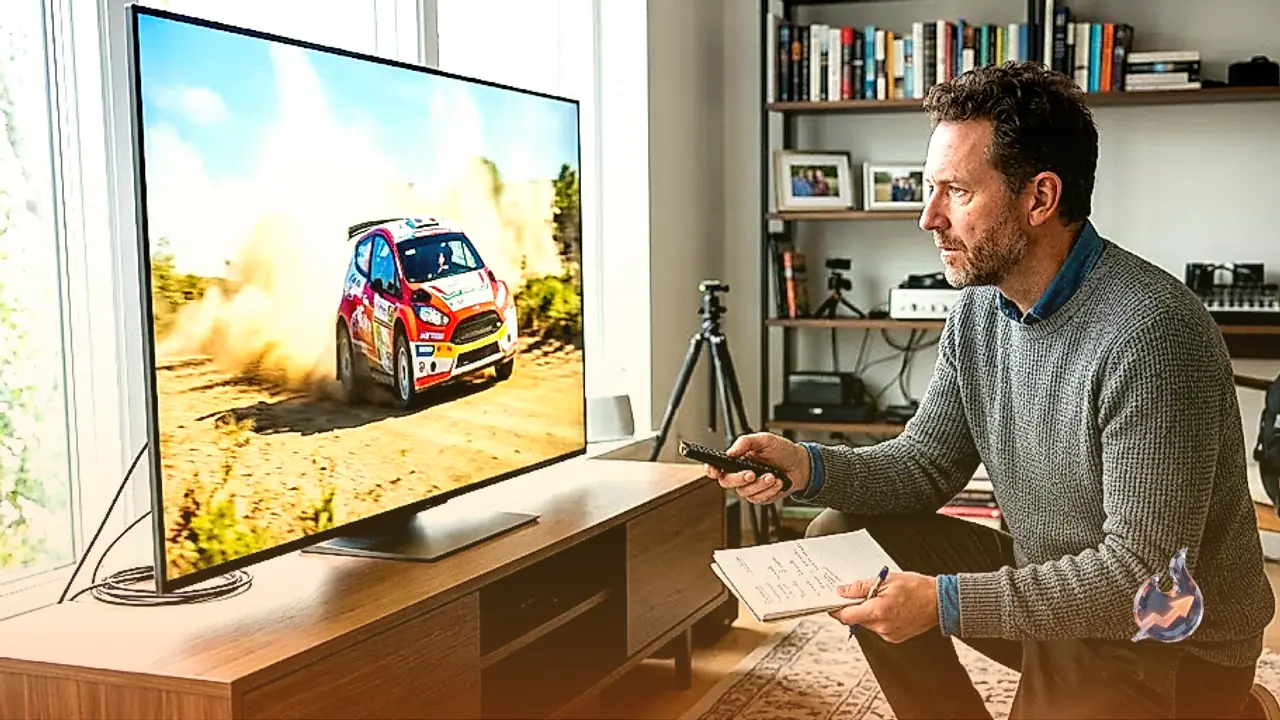
Sports enthusiasts will find plenty of technological strengths balanced against acute hardware tradeoffs. The panel demonstrates solid screen uniformity across its surface with relatively minor dirty screen effect across the middle area, preserving the smooth appearance of football pitches and open courts. Crucially, LG's execution avoids the severe color crosstalk that has historically troubled early RGB Mini LED implementations, ensuring white yard lines and rink markings remain pristine without picking up distracting green fringes. Digital cleanup routines handle low-bitrate cable broadcasts and compressed streaming channels effectively. However, the underlying VA panel structure creates a severely restricted viewing sweet spot. Color fidelity, perceived contrast, and overall luminance degrade steeply as viewers move off-center, making the screen poorly tailored for expansive, wrap-around seating arrangements. Compounding this is a noticeably slow pixel response time, leaving fast-moving balls and running athletes clouded with visible motion blur.
Gaming Performance and Refresh Capabilities
From a connectivity and bandwidth standpoint, the LG MRGB95B is equipped with an uncompromising gaming suite. All four physical HDMI ports provide full HDMI 2.1 bandwidth, enabling full-resolution variable refresh rate gaming across all major VRR formats with zero compression compromises. PC gamers receive standout support, including native 4K resolution up to 165Hz alongside an aggressive 1080p mode running at 330Hz for competitive esports titles. Button press response feels instantaneous due to exceptionally low input lag across every operating mode. Regrettably, visual motion clarity does not keep pace with input responsiveness. The panel exhibits very high cumulative absolute deviation across its entire refresh spectrum, generating heavy ghosting and slow pixel transition blur behind moving targets. Fast-twitch first-person perspectives lose sharpness during rapid camera pans, giving competitive gameplay a less responsive visual feel.
Luminance, Dimming Control, and Color Tracking
The display's luminance engine produces exceptional specular highlight presentation. Compact glints of metal, torches, and neon signs burst through with intense punch, though the panel pulls back slightly when asked to sustain extreme brightness over larger sustained portions of the screen. In real-world viewing, high-luminance outdoor scenes remain bright and vivid throughout. The local dimming algorithm manages light zones smoothly, yielding deep inky blacks with only faint blooming around crisp white text on black backdrops. The color story, however, is a mix of highlights and instability. In HDR, colors display remarkable saturation and expansive color volume without washing out under high luminance. Conversely, SDR color balance struggles, out-of-the-box white balance is imperfect, and viewers will notice subtle shifts in panel color temperature as average picture levels change between cuts.
Signal Processing and Resolution Upscaling
Under the hood, the Alpha 11 Gen 3 AI Processor demonstrates commanding video restoration capabilities. Low-resolution sources such as vintage DVDs or legacy digital feeds are upscaled into clean 4K output without creating jagged edges or halos. The picture engine smooths compressed streaming noise effectively, though it occasionally scrubs away delicate facial textures and background grain in the process. Color gradient reproduction is remarkably clean, showing virtually no color banding across smooth skies except for faint traces in near-black gradients. Cadence detection strips out judder cleanly across most physical and streaming frame rates, with the lone exception of 25p material encapsulated inside a 60p container. Furthermore, uneven PQ EOTF tracking causes several scene categories to track brighter or darker than creative reference targets. In addition to the 75-inch configuration evaluated in test labs, the lineup includes expansive 86-inch and 100-inch options.