




















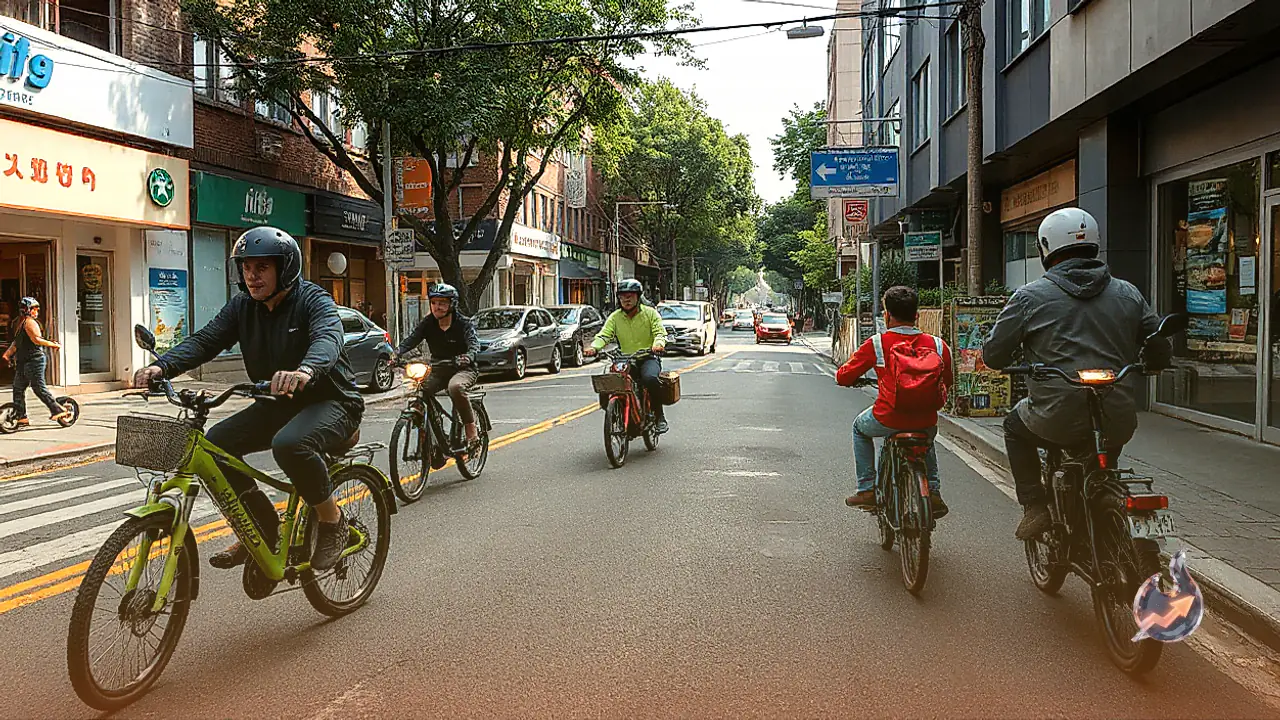

A pioneering legislative effort designed to curb traffic accidents has triggered an escalating regulatory crisis across New Jersey. Signed into law in January by outgoing Governor Pat Murphy, the measure known as S-4834 established the country's first statewide mandate requiring electric bicycle operators to obtain licensing and formal registration. The legislation was spearheaded by state Senate President Nick Scutari and cleared the legislature with broad bipartisan backing following a spate of fatal crashes involving teenagers on motorized two-wheelers. Among the tragedies cited was the death of a 13-year-old boy who collided with a landscaping truck during the preceding autumn. In an official statement explaining his rationale, Scutari emphasized that the exponential proliferation of ebikes had dramatically heightened danger levels for riders, pedestrians, and surrounding vehicular traffic alike.
Under the new statutory framework, anyone owning or operating a two-wheeler equipped with pedal-assist mechanisms or a throttle must be at least 15 years old. Riders are obligated to possess either a standard driver's license or a standalone motorized bicycle license, the latter requiring candidates to successfully complete a formal road test. In addition, all ebikes must be officially cataloged with the state Motor Vehicle Commission (MVC), and models capable of exceeding 20 mph must carry dedicated liability insurance policies. Rather than smoothly bolstering highway safety, however, mobility advocates and industry leaders warn that New Jersey's bold licensing test has descended into a protracted operational tangle.
Gridlock at Motor Vehicle Commission Branches and Scant Adoption
Frontline implementation of the mandate has been plagued by logistical bottlenecks. Cyclists reporting to local MVC facilities encounter branch staff who appear largely unfamiliar with the unfamiliar statutes, while several locations have run out of the physical decals required for registration. Longtime ebike owners who arrived without original store receipts have faced bureaucratic ultimatums to repay state sales tax on vehicles bought years ago. Practical accessibility poses another hurdle: most MVC hubs provide zero dedicated bike parking and remain virtually inaccessible via municipal transit networks.
On-the-ground enforcement has been erratic and inconsistent throughout the state, while vacationers accustomed to bringing motorized bikes to coastal destinations have begun avoiding New Jersey entirely. Official data reflects the sluggish pace of public compliance. New Jersey MVC spokesperson William Connolly stated that the agency has processed 16,825 ebike registrations to date. That figure represents only a tiny slice of the roughly 300,000 ebikes and e-motos that bicycle advocacy groups calculate are circulating across the state. Furthermore, the agency has granted a mere 221 dedicated motorized bicycle licenses. Connolly acknowledged via written communication that the state experienced an inevitable transition window as personnel underwent training and users adapted to novel administrative workflows, though he maintained that the broader rollout had proceeded in an orderly manner. Motorists who already held passenger car licenses reported comparatively minor friction when recording their bicycles.
Devastating Retail Fallout as Dozens of Bike Shops Shutter
The consumer enthusiasm that drove historic sales spikes during the pandemic has evaporated under the weight of the new statutes. Scott Chambers, who operates Zippy's Bikes in Wildwood, New Jersey, observes that state authorities have essentially demonized the entire ebike category. His commercial outlet has absorbed a staggering 90 percent year-over-year plunge in ebike sales alongside a 50 percent drop in total retail revenue. Saddled with unsold warehouse stock from the previous season, Chambers characterizes his business prospects as extraordinarily bleak, noting how difficult it is to regain financial footing. The statewide impact runs far deeper: according to the New Jersey E-Bike Coalition, an advocacy collective organized specifically to resist the statute, 37 specialty bicycle storefronts have been forced out of business across the state.
A similar crisis has enveloped Jesse's E-Rides in southern New Jersey, owned by Shannon Connor. Store turnover has plummeted by half over the past calendar year, forcing the enterprise to downsize and relocate into a smaller building with cheaper monthly rent. The business was founded around her 18-year-old autistic son, Jesse, who relies on a fleet of four red electric tricycles to navigate his community autonomously. While state authorities eventually determined this past summer that electric tricycles do not fall under the statutory restrictions, Connor emphasizes that public misunderstanding remains rampant. Many prospective shoppers incorrectly assume that all electrified pedal-craft have been completely outlawed in the state.
Disproportionate Burden on Non-Drivers and Low-Income Commuters
For metropolitan workers and residents who chose electric assist as an economical alternative to personal automobiles, the legislative hurdles have brought daily routines to a standstill. Karin Vanoppen, a resident of Jersey City, relied on her pedal-assist bicycle to run household errands and navigate demanding uphill grades. Since state troopers and local police began enforcing the law in July, she has abandoned riding entirely. Vanoppen has never held a motor vehicle driver's license because urban life never necessitated one. To secure a motorized bicycle credential, she faces traveling to testing hubs situated more than an hour away, often reachable only via highway corridors where non-highway two-wheelers are legally prohibited from traveling.
During a state legislative hearing, one lawmaker flippantly advised non-drivers to ask their parents for rides to designated testing lots, prompting Vanoppen to lament that she would have to recruit her 85-year-old mother just to take a bicycle test. Advocates underscore that the statute falls most severely on individuals with disabilities who cannot drive automobiles, as well as gig-economy delivery workers and lower-income commuters lacking the schedule flexibility to navigate testing sites. Although the state waived administrative fees during the inaugural year, baseline statutory costs will soon require riders to pay $8 annually for registration and an $11 combined fee for examination and licensing.
The Critical Distinction Between Pedelecs and High-Speed E-Motos
A primary driver of public friction is widespread confusion regarding the technical distinctions among electrified two-wheelers. Standard pedal-assist machines rely on low-output hub or mid-drive motors that deliver power exclusively when the cyclist pedals, cutting out at 20 mph. Higher-tier ebike configurations feature throttles or beefier motor packs capable of reaching 25 to 28 mph. In stark contrast, vehicles known as e-motos occupy a completely separate class. These heavy, high-powered machines frequently dispense with pedals altogether and can easily exceed speeds of 50 mph. While e-motos have exploded in popularity, they have inhabited an ambiguous gray zone where regulatory criteria governing minimum age, registration, and driver licensing are rarely policed.
Frontline law enforcement officers routinely find it difficult to tell these two vehicle classes apart during roadside encounters. Public records obtained under New Jersey's open government statutes by Shannon Connor reveal that in at least five of the eight major crashes documented in the state over the prior year, the vehicles involved were high-velocity e-motos rather than standard ebikes. That includes the tragic accident that claimed the life of the 13-year-old boy during the preceding autumn. New Jersey statutory law has long classified mopeds and e-motos as motorcycles, establishing a minimum operating age of 17 along with formal licensing mandates. Comparable legal issues have emerged in Southern California, where prosecutors have filed criminal charges against at least 12 parents for knowingly permitting their underage children to operate illegal motorized two-wheelers, predominantly e-motos.
Proposed Reforms and Safer Alternatives to Licensing Mandates
New Jersey's regulatory experiment unfolds amid broader national debates over micromobility. Alarmed by reckless teenage driving, excessive speeds, and catastrophic accidents, legislators in Illinois, New York, and California have drafted licensing frameworks for electric bicycles, though none have successfully crossed the legislative finish line. New York City lawmakers abandoned a similar licensing ordinance this summer in the face of widespread community pushback. Recognizing the fallout inside New Jersey, State Senator Raj Mukherji introduced amending legislation in October. His proposal seeks to carve out an exemption from licensing and insurance mandates for lower-velocity ebikes that reach a maximum motor-powered speed of 20 mph. Mukherji framed the bill as a sensible compromise designed to preserve affordable, clean transit while maintaining fundamental road safety. Under his framework, higher-speed Class 3 ebikes would remain subject to licensing and registration.
National cycling organizations maintain that roadway protection can be achieved far more effectively without imposing punitive red tape on everyday riders. Federal regulators could use existing consumer protection powers to crack down on e-moto distributors who market high-powered machines over the internet at budget prices, frequently misrepresenting them as benign recreational toys suitable for children. Transportation reformers also advocate for embedding structured two-wheeled safety instruction directly into school curricula. Ken McLeod, policy director for the 200,000-member League of American Bicyclists, pointed out that while educational institutions routinely invest in driver training, youth are never taught how to safely navigate vehicular roads on bicycles. As a result, legislators reflexively reach for bureaucratic licensing mandates instead of solving the fundamental education gap.