




















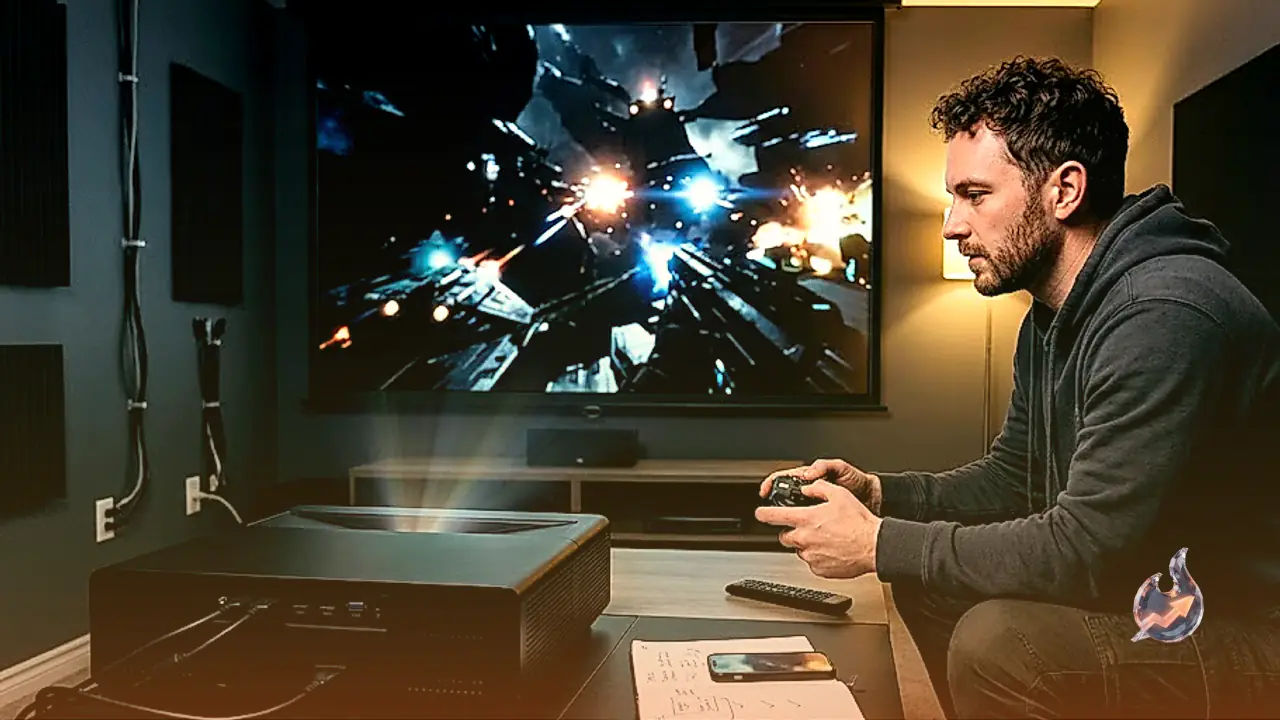

Ultra-short-throw projectors have become an appealing alternative to massive television displays, delivering expansive screen real estate from a console positioned inches away from the wall. The NexiGo Aurora Pro MKII utilizes triple-laser DLP hardware combined with pixel-shifted 4K imaging to project imagery spanning 80 to 150 inches via an ultra-short 0.21:1 throw ratio. Audio duties are handled by an integrated 60W sound setup featuring two 15W woofers alongside two 15W tweeters. Connectivity includes three HDMI 2.1 inputs with eARC compatibility. Despite its advanced imaging core, the physical chassis and adjustment suite remain surprisingly bare-bones, making alignment and everyday handling a noticeable exercise in patience.
Home Theater Performance and Lighting Limits
In dedicated movie viewing environments, the projector demonstrates distinct visual strengths alongside clear performance compromises. Its standout asset is black-level rendition, producing exceptional contrast across both pitch-dark sequences and bright highlights. Dark scenes avoid the washed-out gray look common in entry-level projection, lending meaningful spatial depth to the frame. The optical engine handles frame pacing reliably as well. When paired with external hardware capable of dynamic frame-rate matching, such as an Apple TV or an NVIDIA Shield, the projector completely eliminates motion judder, keeping film panning sequences fluid.
Ambient illumination, however, quickly degrades this fidelity. While output levels look punchy in a dark room, the projector lacks the luminance headroom required to overpower daylight or moderate room lighting, causing image contrast to wash out. Color reproduction also struggles straight out of the package. The factory calibration skews noticeably cool with a prevalent blue tint across all content, drifting far from creator intent. The overall color volume is narrow, leaving hues looking muted and lacking visual richness. Viewers susceptible to DLP color separation will spot rainbow flashes during high-contrast scenes. Fortunately, a thorough manual calibration significantly corrects the color balance and warms the picture to proper targets.
Gaming Response and Refresh Rate Capabilities
Console and PC gamers will find a capable collection of display modes tailored to interactive media. The system supports full 4K output at 60Hz for visual clarity, while dropping down to 1080p enables ultra-fast 120Hz or 240Hz refresh rates for rapid action. Low input lag ensures buttons feel snappy and responsive during standard play sessions, while Variable Refresh Rate and Auto Low Latency Mode help maintain clean visual delivery free from horizontal tearing. Because the DLP chipset switches micro-mirrors instantly, pixel persistence and motion blur remain virtually nonexistent.
Nevertheless, competitive players should note a couple of crucial functional constraints. Variable Refresh Rate is unavailable when operating at the maximum 240Hz ceiling. Furthermore, the input latency, though low enough for casual campaigns, sits slightly higher than what top-tier competitive tournament players typically demand where every single millisecond dictates the outcome. The muted color volume also impacts modern games, causing lush fantasy landscapes and saturated worlds to look less striking than they would on a wider-gamut display.
Form Factor, Mobility, and Physical Setup
Setting up the physical chassis demands substantial effort due to the device's footprint and sparse mechanical adjustments. The unit is bulky and heavy, occupying a prominent space on any media console and making bedroom placement awkward. Setup is further complicated by the complete absence of powered lens shift or optical zoom mechanisms. Users are restricted entirely to manual focus dials and digital keystone correction, which turns alignment with fixed projection screens into a slow, delicate chore.
These dimensional traits completely rule out casual outdoor portability. The chassis lacks handles, carrying cases, or protective lens covers, making regular trips to the backyard risky and inconvenient. While it can produce a readable picture outdoors under dark night conditions with subdued patio lights, daytime outdoor viewing is completely out of the question due to brightness limits. One welcome design highlight is the thermal acoustic signature, as the cooling fans run quietly enough to avoid intruding during soft dialogue.
Platform Limitations and External Sourcing
The proprietary software layer handles basic device settings and supports direct wireless screencasting from phones, tablets, or laptops. However, it does not supply built-in streaming applications, necessitating a dedicated external streaming dongle or dedicated media box to watch popular streaming services. The device also lacks an internal battery, requiring constant access to wall power. The trio of HDMI 2.1 terminals provides generous headroom to hook up home soundbars and gaming systems simultaneously.