























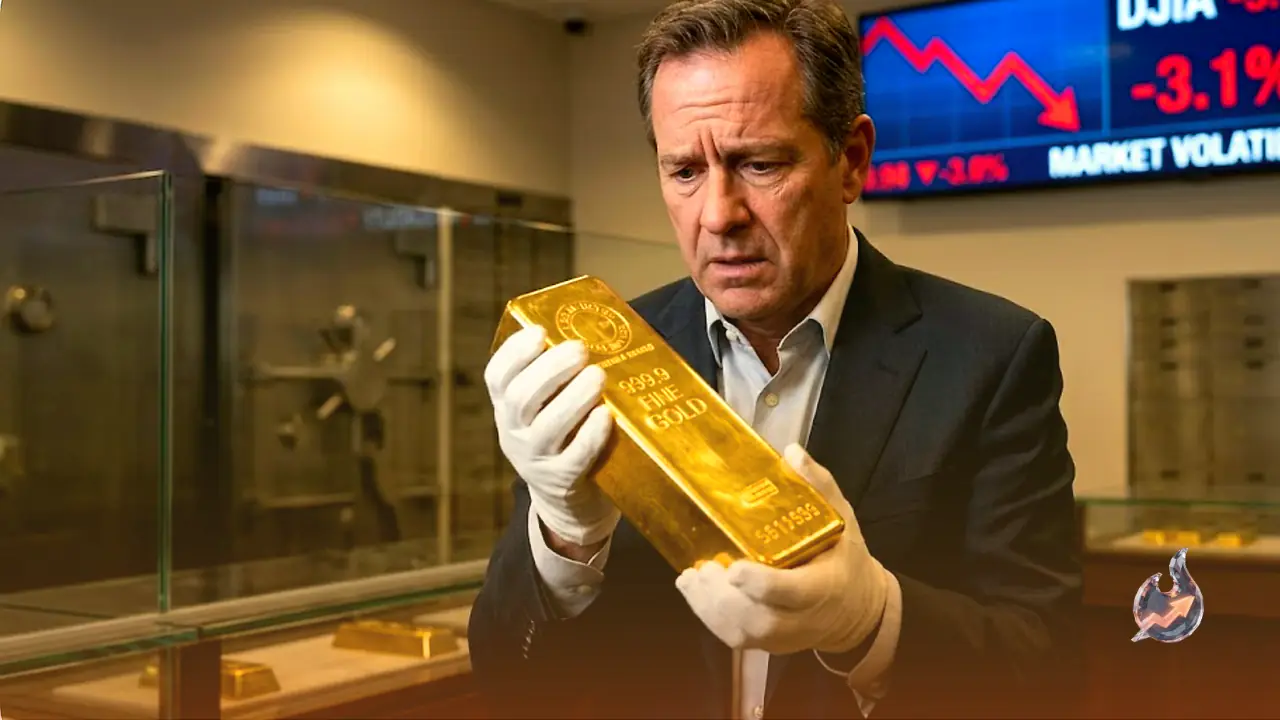

Every time the stock market shudders, currencies weaken or the world grows tense, a large section of investors starts looking for somewhere their money can feel safe. On almost every such occasion, one name rises above the rest: gold. The metal's performance over the past two years is the strongest proof of that trust.
Amid geopolitical tension, trade disputes and inflationary pressure, 2024 turned into a historic year for gold. In that single year the metal set 40 separate record highs. Its average price sat at roughly $2,380 an ounce, a 23% jump from the year before. The climb did not stop there. In October 2025 gold pushed past $4,300 an ounce to a fresh all-time high, a 60% surge in a single year.
What the latest prices are saying
Live market data shows gold trading around $4,132 right now, up 1.55% from its previous close of $4,068. Over the past 52 weeks the metal has swung between $3,264 and $5,586, while its RSI currently reads 43. That churn underlines how firmly investors still treat gold as a dependable refuge.
Central banks are hoarding it
The clearest sign of gold's status as a safe-harbour asset comes from the behaviour of central banks. In the aftermath of the Russia-Ukraine conflict, their gold buying went through the roof. Figures from the World Gold Council show that between 2014 and 2016 central banks bought around 525 tonnes a year on average. That number shot up to 1,136 tonnes in 2022 and stayed high in the years that followed.
The psychology behind the fear
When markets turn volatile, investors instinctively gravitate towards tangible assets whose value they can trust and physically hold. Gold delivers exactly that reassurance, offering the comfort that hard-earned savings are parked in something solid when everything else feels shaky.
A shield against inflation
One of gold's biggest strengths is that it holds its value even during bouts of high inflation. When a currency is devalued, whether through central bank intervention or a weakening economy, the worth of people's money erodes. Gold behaves differently. It cannot be artificially devalued, because its price is tied to its limited supply and its persistently high demand.
Trusted across borders for centuries
Long before modern currencies existed, gold was prized across borders, cultures and political systems for its appearance, its rarity and its durability. That wide acceptance still holds today. Through Russia's invasion of Ukraine, the supply chain crisis that followed and the more recent trade tensions, gold has stayed in demand and remained a highly liquid asset that is easy to sell.
More than just an investment
Gold is not only an attractive investment tool, it is also central to several industrial and technological uses. Its electrical conductivity, malleability and resistance to corrosion make it a crucial material for many high-tech sectors, including electronics, automotive applications and energy. On top of that, its use in jewellery, particularly across Asia, gives its price further support. These real-world applications ensure gold will always carry an appreciable value, whatever other economic forces are at play.
Why gold stands apart
Even among other precious metals, gold stands out as a remarkably reliable asset in uncertain times. Its versatility as both an investment tool and an industrial resource is a big reason for that. Investors who want physical ownership and a liquid portfolio will always be drawn to gold for peace of mind. Jon Cavuoto, Founder, President and Chief Executive Officer of First National Bullion Inc., a precious metals brokerage firm, believes it is precisely these qualities that make gold the first thing investors reach for in every crisis.