























They say that the fruit of hard work is always sweet, and guava cultivation in Fatehpur Billouch village of Faridabad serves as a great example of this. Here, about 300 trees have been planted across one acre of land. Taiwanese pink variety guavas are being grown in this field, and the market prices for the fruit are running quite high at present. Farming is never an easy task, as farmers manage their fields even under scorching sunlight. Pruning the trees, managing irrigation, and constantly caring for the fruits require continuous effort.
Taiwanese pink variety and bumper yield
In a conversation, woman farmer Sushila shares that she has planted the Taiwanese pink variety in her field. She regularly prunes the trees from time to time. Cutting the branches encourages more fruit growth on the tree and results in a better overall harvest. Right now, the market rate for guava goes up to around 50 to 60 rupees per kilo in the mandi. If prices continue to hold this way, she earns a good income from this crop.
Protecting the crop from insects during the rainy season
Woman farmer Sushila explains that the problem of insect infestation in guavas increases as soon as the monsoon arrives. During such times, she carefully inspects the guavas hanging on the trees. If she spots any threat of pests on a fruit, she arranges to protect it immediately. More time must be spent in the field during the rainy days. A little bit of negligence can ruin the ready fruit, which is why she maintains constant surveillance.
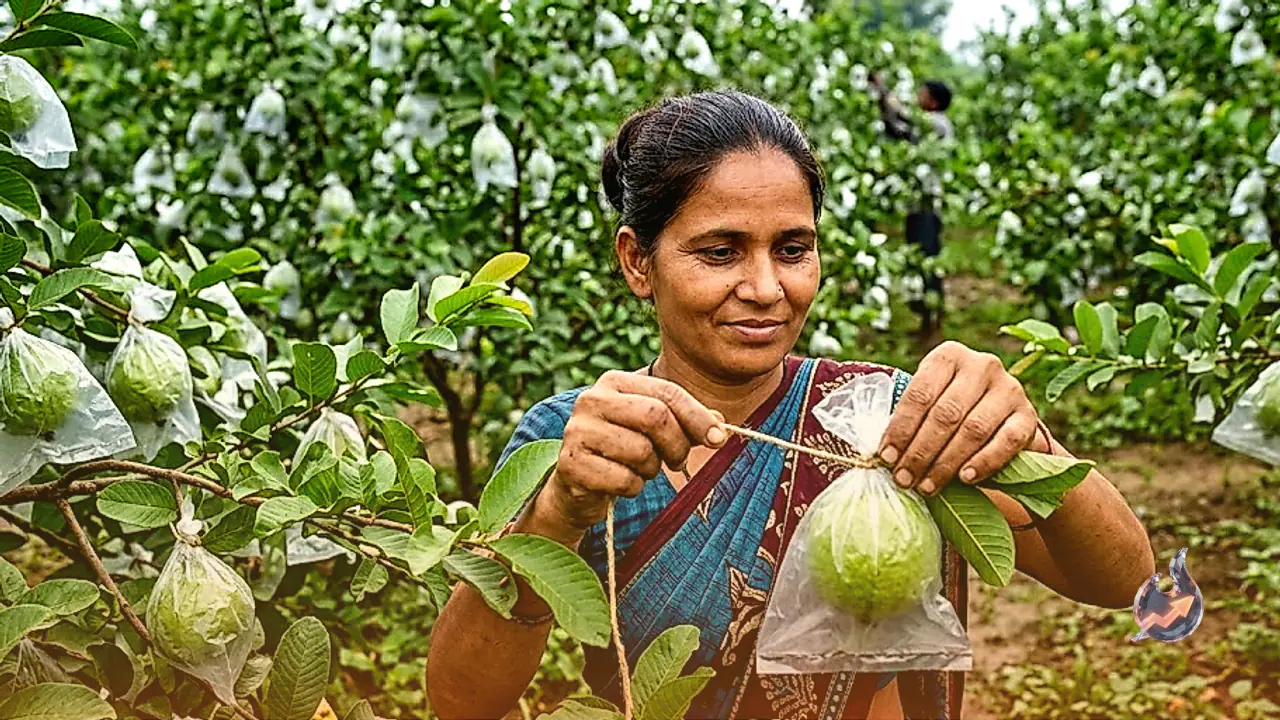
The method of wrapping polythene on guavas
Sushila states that she ties polythene bags around the guavas to protect the fruits from insects. Covering the fruit hanging on the tree helps shield it from pests. This task takes a considerable amount of time because individual attention must be given to every single fruit. By adopting this method during the rainy season, she tries to prevent damage to the crop. When the harvested fruit remains safe, the hard work does not go to waste.
Timely pruning and plant care
Sushila points out that timely pruning is essential in guava farming. She removes dry and overgrown branches herself. This creates adequate space on the tree for new fruit formation and keeps the yield proper. Every job in farming has its own designated time. Leaving the trees unattended does not work, which is why she cares for them by observing the weather and the needs of the plants.
Changing challenges with shifting weather
Guava farming requires immense physical effort. Sushila stays in the field even during the afternoon hours to check the condition of the trees. Sometimes she has to prune branches, and other times she needs to work on securing the fruits. As the weather changes, the challenges change too. Giving regular time to the field helps in understanding the needs of the plants and keeps a close watch on the crop.
Market rates and overall earnings
The current wholesale market rate for guava is reaching up to 50 to 60 rupees per kilo. Growing the Taiwanese pink variety helps her earn a decent monthly income. Getting the right price in the market can bring good earnings for a farmer. However, this farming involves cultivation costs along with hard work. Therefore, she also pays attention to the security of the fruit after it matures to minimize losses as much as possible.
Balancing yield and protection
In guava farming, achieving a good harvest is not the only important thing; protecting the ready fruit is equally crucial. Sushila does all the work herself, from pruning the trees to covering the fruits. Pests remain a persistent issue during the rainy season, which is why she uses polythene. When the market yields a price of 50 to 60 rupees per kilo and the fruits remain undamaged, the earnings turn out to be rewarding.