























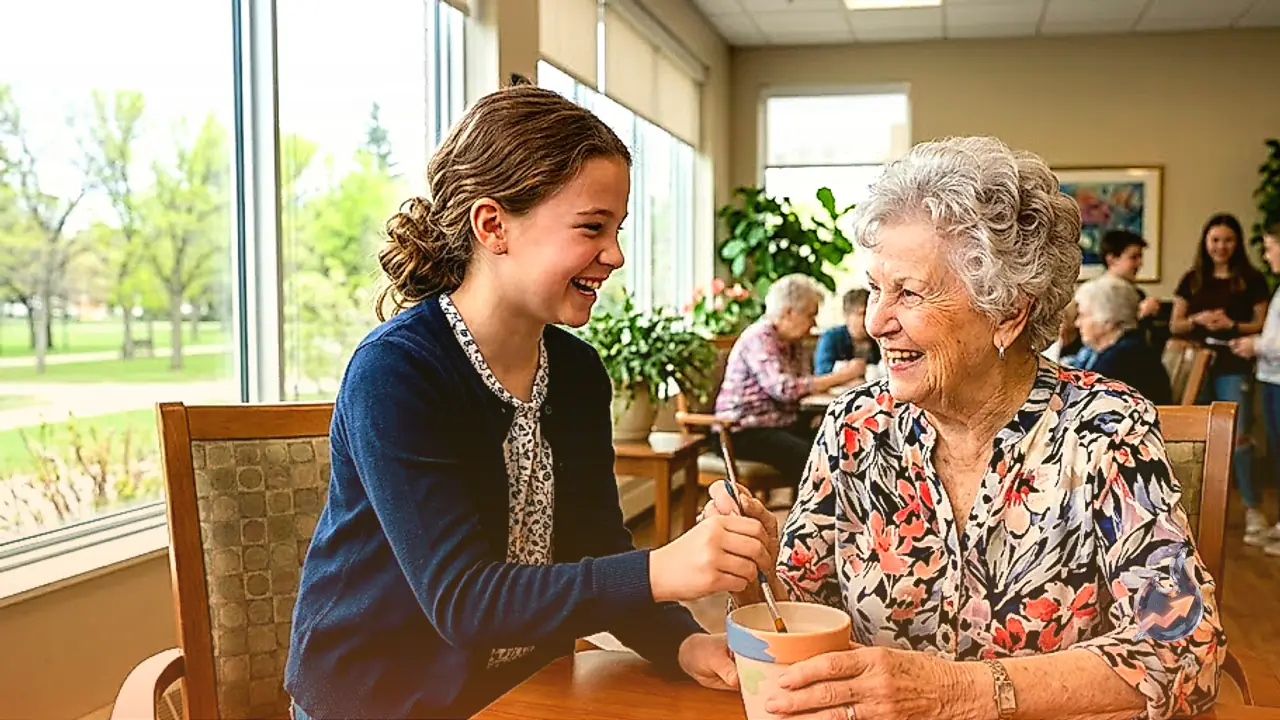

While traditional education isolates age groups within standardized classrooms, an innovative community program in Saskatoon, Canada, has demonstrated the profound benefits of mixing generations. Over the course of a full academic year, 25 sixth-grade students moved their learning environment entirely out of their regular school and into the Sherbrooke Community Centre, a long-term care facility. A new scientific study evaluating this 10-month intergenerational effort, known as the iGen program, reveals that daily structured interaction between youth and elderly residents can significantly enhance emotional well-being, health perception, and social connectedness across all ages.
A Classroom Embedded Within Care
Many residents at the Sherbrooke Community Centre live with dementia or other chronic health conditions. Under the iGen framework, students engaged with these elders in a wide spectrum of joint activities instead of isolated academic work. On any given day, students and residents could be found journaling together, exploring modern technology, or composing limericks. Beyond intellectual tasks, the children actively participated in gardening, assisted at the center's gift shop, and collaborated on creative art projects.
The impact on individual participants was immediate and profound. A participating student named Mya shared that working with the elders taught her rich stories, traditional games, and lessons on becoming a better person. For long-term care resident Jodi, the experience lifted a profound emotional burden, transforming a sense of daily dread into genuine joy and eager anticipation for each new day. Jodi noted that the sixth-grade children brought life back into focus, crediting the iGen initiative with giving her a renewed purpose.
What the 10-Month Scientific Evaluation Revealed
To quantify the social and psychological impact of the program, a research team led by Jason D. E. Proulx conducted rigorous evaluations. The study tracked 25 participating students, three elderly residents, and eight care facility staff members. Participants completed detailed daily surveys across two distinct 10-day tracking windows: the first in late September and early October, and the second near the conclusion of the school year in June. They rated the meaningfulness of their daily interactions, emotional state, physical health quality, helpful actions performed, and overall sense of community belonging.
The collected data indicated that on days when individuals experienced highly meaningful interactions, they reported feeling significantly better connected, healthier, and more compassionate. While overall baseline health metrics did not change drastically across the entire 10 months, daily fluctuations were clearly linked to positive engagement. Crucially, the psychological benefits derived from intergenerational connection were noticeably stronger than those stemming from interactions with age peers.
Deepening Bonds and Broader Educational Implications
The research highlighted that the positive influence of intergenerational bonding grew stronger over time. By June, meaningful interactions delivered an even greater boost to well-being than during the initial autumn assessment. The researchers attributed this trend to the progressive deepening of relationships between students and seniors over the full 10-month duration, allowing participants to savor their final weeks together.
Reflecting on the long-term impact, Mya’s mother Tanya observed that her daughter built enduring friendships with the residents while developing a deep appreciation for life. Although the researchers acknowledged that the study focused on a single program with a specific demographic composition, the findings offer compelling evidence for scaling such models. Structuring regular, meaningful contact between children and older adults represents a viable educational strategy to reduce societal isolation, foster empathy, and create more inclusive communities.