


















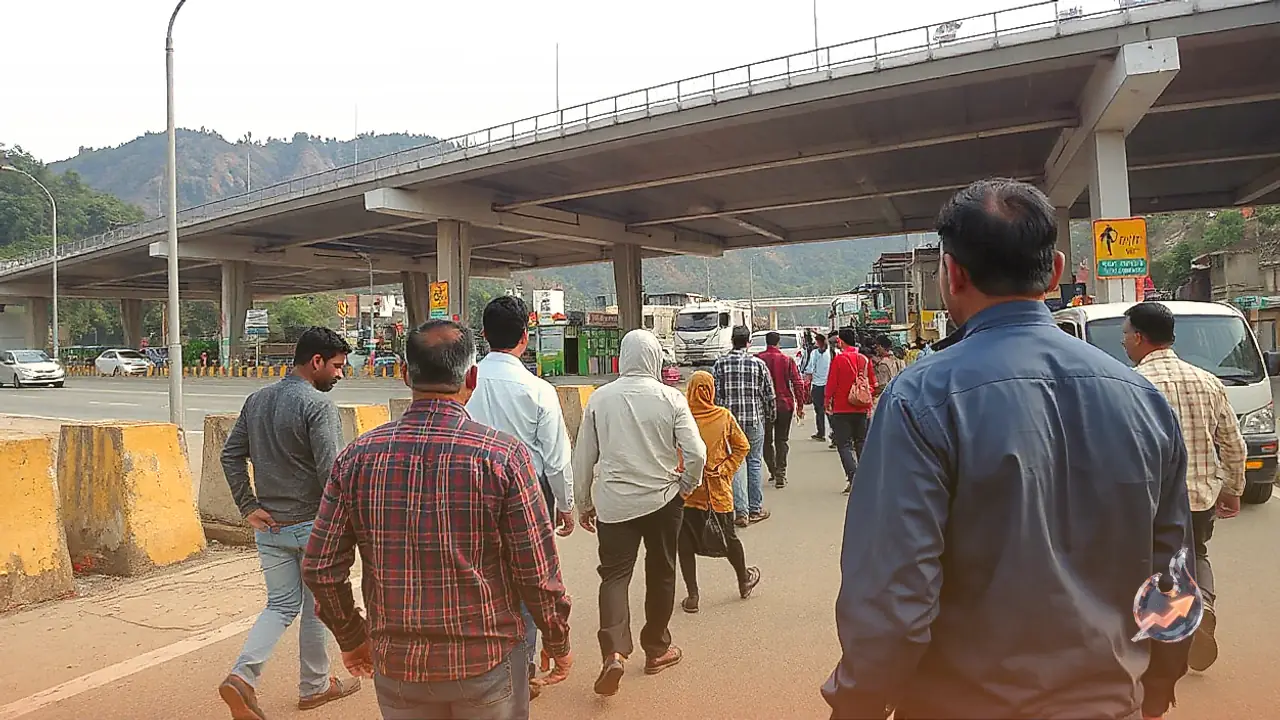

Residents living along major highway networks across Himachal Pradesh will now be able to cross nearby toll gates without paying regular commercial rates. The National Highways Authority of India, known as NHAI, has made a provision allowing vehicle owners residing within a 20-kilometer boundary of toll booths to purchase subsidized travel passes. The move is designed to ease the financial pressure on local commuters who travel short distances multiple times each day for farming, education, medical needs, or regular family errands.
Tiered Price Structure for Rural and Municipal Locations
Under the revised arrangement, eligible village households located within the 20-kilometer buffer zone can secure a full-year toll pass for 1,500 rupees. In areas where the toll booth falls under municipal limits, qualifying residents will be charged 3,000 rupees for an annual permit. Vehicle owners who prefer not to make a yearly payment upfront also have the option to buy a monthly pass priced at 360 rupees. These reduced tariffs apply exclusively to private, non-commercial passenger vehicles and cannot be claimed by vehicles operated for commercial logistics or hire.
Six Operational Toll Points Covered Across the State
NHAI currently oversees six active toll plazas on four-lane corridors and highways running through Himachal Pradesh. One of these is the Ghatta toll gate, situated on NH-503 along the Shimla-Mataur stretch. Another critical point is Sanwara on the Parwanoo-Shimla route. Along the Kiratpur-Manali highway corridor, four separate toll booths are functional: Moura, Baloh, Takoli, and Dohlu Nala. Eligible vehicle owners living within 20 kilometers of any of these six booths can apply for the respective pass.
Relief Follows Commuter Discontent in Kangra
The revised pass announcement arrives shortly after public protests took place in Kangra regarding operations at the Ghatta toll gate. Local drivers had voiced strong objections, emphasizing that four-lane construction work on the route remained incomplete even as toll collection began. Commuters also pointed out that individuals driving just a few kilometers between nearby hamlets were being compelled to pay full transit charges. The newly clarified pass system aims to defuse this discontent by protecting neighborhood motorists from multiple daily toll debits.
Essential Eligibility Checks and Active FASTag Requirements
To take advantage of these discounted passes, motorists must satisfy specific conditions set by highway authorities. Foremost among them is that the vehicle must be registered as a private, non-commercial unit carrying a valid, active FASTag sticker. Motorists are free to select either the 360-rupee monthly option or the yearly pass based on their personal travel habits. Crucially, the local pass operates only at the specific plaza for which it is issued; passing through any other gate requires paying regular toll tariffs.
Alternative Nationwide Annual Pass Covering Up to 200 Crossings
Alongside the local resident concessions, NHAI continues to run an independent nationwide annual FASTag pass program. Under this broader facility, private vehicle owners pay 3,075 rupees to receive permission for up to 200 plaza crossings across national highways within a twelve-month window. This works out to an average transit expense of roughly 15.38 rupees per trip, and over one crore drivers throughout India currently use this national package. Commuters should recognize that this 200-trip nationwide package and the local 20-kilometer discounted permit are two entirely separate products, allowing each motorist to choose according to their actual travel radius and routine.