
















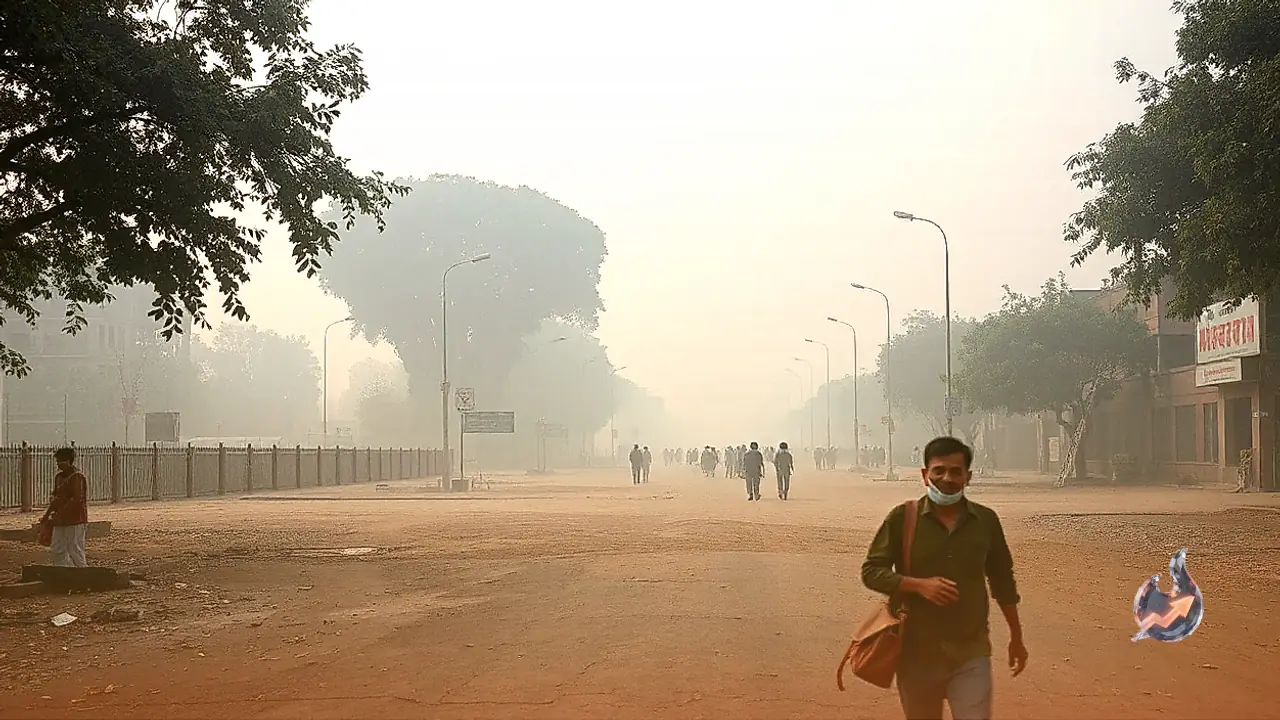

With the festive season underway, the atmosphere across the National Capital Region has deteriorated into an unbreathable haze. Thick, toxic smog is blanketing the territory, imposing an acute physical toll on grown-ups while placing small children in immediate jeopardy. Every morning, school students standing beside roads waiting for buses or lined up in outdoor school assemblies inhale hazardous particulate matter at concentrations vastly higher than their bodies can tolerate. Watching these alarming conditions unfold, parents across the metropolitan zone are exhausting their patience.
As air pollution levels breach dangerous categories, a growing movement is demanding the mandatory implementation of a dedicated smog break in educational institutions across the capital and neighboring satellite cities. A comprehensive public poll conducted among more than 38,000 citizens across Delhi, Noida, Ghaziabad, Gurugram, and Faridabad highlights a deep sense of public urgency. A definitive 53 percent of responding parents insisted that a smog break must be formally scheduled between November 10 and November 15. Furthermore, 47 percent of participants stated that whenever air quality plunges into the severe bracket, closing schools should be an automatic, non-negotiable rule.
Complete Parental Consensus Against Routine Class Schedules
Perhaps the single most revealing outcome of the public survey was that not a single parent advocated for keeping schools running normally during this severe phase. Families have expressed deep frustration with the administrative habit of reacting only after an emergency peaks, which often results in frantic midnight closure notices. Instead of waiting for public health conditions to hit crisis proportions, parents are calling on statutory bodies and state administrations to establish robust advance plans that safeguard young learners before exposure takes place.
Alarming PM 1 Concentrations Threaten Developing Respiratory Organs
On November 4, the average Air Quality Index across Delhi NCR climbed to a punishing 555, placing it squarely in the severe category. Atmospheric concentrations of fine particulate matter, including PM 2.5 and the ultra-fine PM 1 particles, have surged dozens of times past safe limits. Health professionals note that PM 1 particles are so small that they penetrate deeply beyond the lungs, entering directly into the human bloodstream. Because children breathe at a substantially faster rate than adults, their developing pulmonary systems face permanent and disproportionately severe harm.
Survey Preferences Split Between Virtual Classrooms And Complete Holidays
When questioned on how school authorities should structure learning during an enforced smog break, 49 percent of surveyed parents favored halting in-person attendance while shifting to remote online teaching. Another 25 percent expressed a preference for declaring total school holidays. Taken together, 74 percent of parents are firmly convinced that children must not commute to physical campuses under any circumstances while outdoor air remains dangerously polluted.
Questions Over Work From Home Allowances For Adults While Classrooms Stay Open
To curb exposure and reduce traffic emissions, government agencies along with the Commission for Air Quality Management, or CAQM, advised offices to permit 50 percent of their workforce to work from home. Parents are questioning the logic of a policy framework that permits adults to stay safely indoors while requiring vulnerable school children to head outdoors every morning into identical toxic air. Historical records spanning eight consecutive years clearly establish that pollution consistently peaks during the second week of November, prompting families to ask why preventative decisions for schools are still being deferred.
Long-Term Health Studies Reveal Persistent Lung Damage In Capital Youths
Citing established historical evaluations jointly conducted by the Central Pollution Control Board, or CPCB, and the Chittaranjan National Cancer Institute, survey findings pointed out that 43.5 percent of school children in Delhi suffer from diminished lung capacity. When compared to peers raised in rural environments, children in Delhi show vastly higher rates of chronic respiratory ailments and symptoms associated with Attention Deficit Hyperactivity Disorder, or ADHD. Medical data demonstrates that pulmonary harm sustained during early childhood development can never be fully reversed in later life.
Demand For Uniform Inter-State Protocols And Advance Schedules
A major flaw in the current regulatory setup is the lack of coordination among neighboring jurisdictions, as independent district magistrates across Delhi, Noida, Gurugram, and Ghaziabad issue fragmented orders on disparate dates. Parents want the CAQM along with all regional NCR state governments to coordinate and enact a single harmonized policy. With farm fire smoke and seasonal post-festival smog anticipated to reach absolute peaks between November 10 and November 15, families argue that pre-emptive smog breaks should be locked into the regional academic calendar beforehand.