




















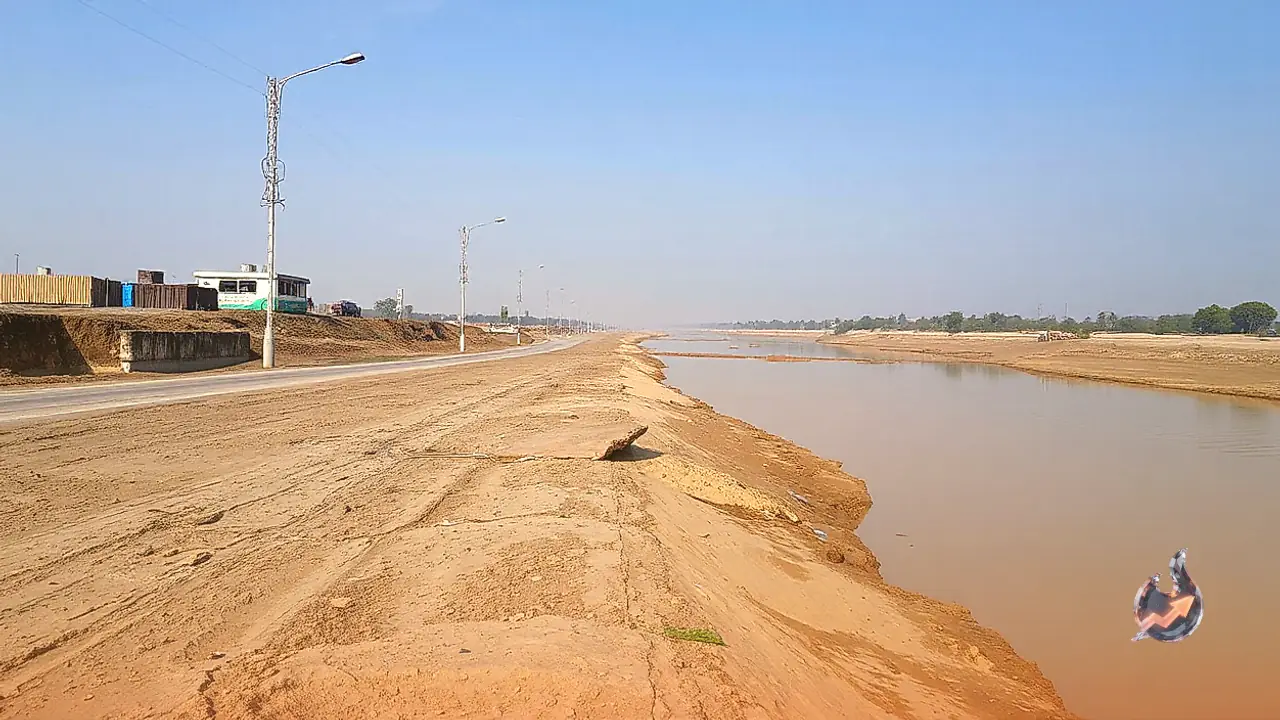

A major policy measure has been enacted to address the recurring flood menace and heavy siltation clogging riverbeds across Bihar. During a formal meeting in New Delhi, the Union Ministry of Road Transport and Highways signed an agreement with the Bihar government under the framework of the Bihar Water Resources Restoration and Silt Management Policy 2026. The pact was concluded in the presence of Union Minister Nitin Gadkari and Bihar Chief Minister Samrat Choudhary. Under this framework, sediment scientifically excavated from rivers and water reservoirs will now be utilized for filling and base construction in national highway projects. With this development, Bihar has emerged as the first state in the country to implement an institutional silt management policy.
A Working Model for the Entire Nation
Excessive silt accumulation has persistently restricted natural water drainage across river systems in Bihar. To convert this severe recurring challenge into an infrastructure resource, central and state authorities have established a cooperative framework. Under the state silt policy notified on September 17, 2026, highway works undertaken by NHAI will replace fertile topsoil drawn from farmland with riverbed sediment. Commending the initiative, Union Minister Nitin Gadkari stated that this initiative serves as an exemplary model for the entire country to follow.
Highlighting the milestone, Chief Minister Samrat Choudhary detailed the development in a message shared on X.
Dual Advantages for Agricultural Land and Flood Control
From an engineering and environmental perspective, the policy delivers two distinct functional gains. First, it directly curtails infrastructure reliance on fertile agricultural fields for earth filling, putting an end to the destruction of arable topsoil. Second, excavating deep sediment blocks from narrow river stretches, confluences, and barrage zones will restore normal discharge and streamline local water flow. Addressing the gathering, Chief Minister Samrat Choudhary pointed out that seven rivers entering from Nepal cause severe destruction across Bihar. This regular seasonal havoc inflicts an annual loss of 10,000 crore rupees on the state, and this agreement will deliver substantial relief to the region.
Ground Execution and Quality Control Remain Key Challenges
For a state continually burdened by devastating deluges and clogged river courses, utilizing excavated river silt as a core building block of transport infrastructure is an ambitious strategy. On paper, the framework establishes an integrated solution uniting ecological conservation, agricultural soil protection, and cost-effective road construction. However, the true measure of success will depend on rigorous execution on the ground. Only strict adherence to scientific extraction protocols, thorough material testing, and compliance with project budgets will ensure that rivers drain effectively while delivering durable, robust highways.