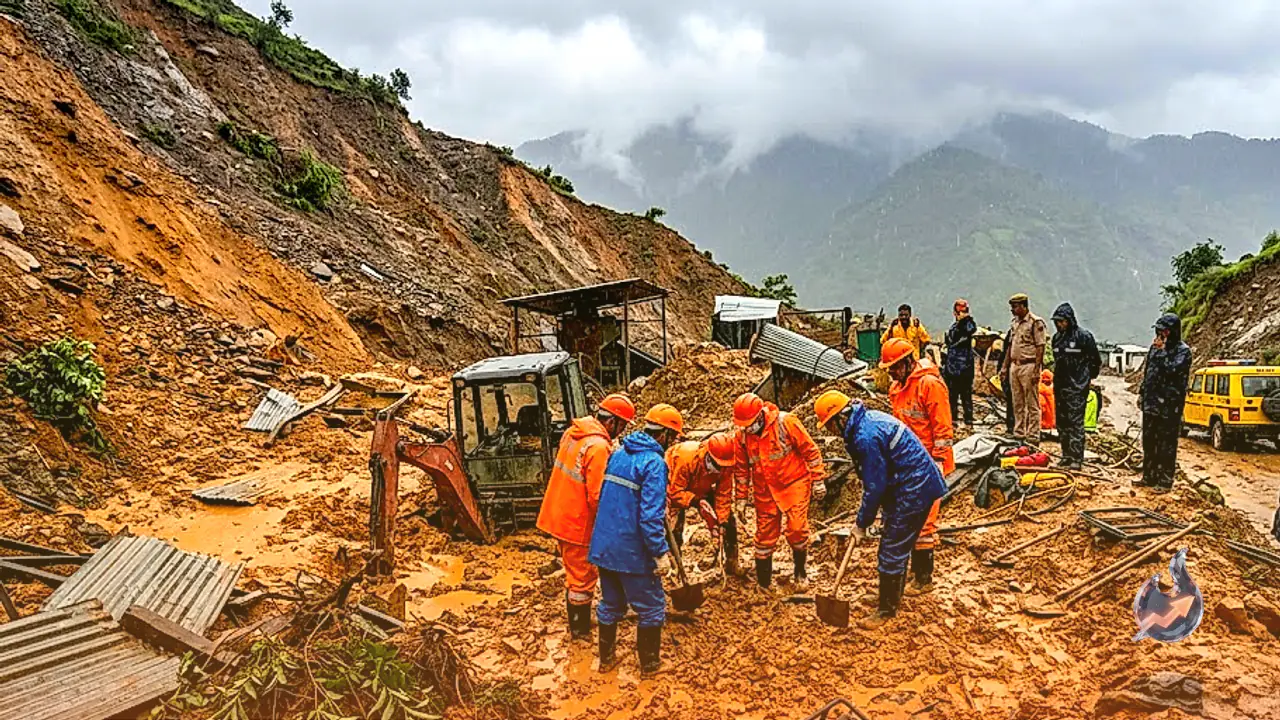
























Residents across Himachal Pradesh experienced brief respite as sunshine broke through overcast skies following two consecutive days of torrential downpours. However, atmospheric conditions remain volatile as the regional weather office issued a fresh yellow alert predicting light to moderate rainfall interspersed with isolated heavy spells over the next few days. The relentless rainfall triggered severe landslides and flash floods, severely crippling transport networks and utility services across the state. In Sirmaur district's Kafota region, rescue teams successfully retrieved the bodies of three individuals from under massive landslide debris following an arduous 24-hour operation. Furthermore, rolling mudslides led to the closure of 167 roads, including a major national highway, by Wednesday evening.
Three-Day Weather Forecast and Rainfall Warnings
Meteorological experts indicated that no major high-intensity rainfall alerts are active for the state past 20 August, with monsoon activity anticipated to abate significantly after 23 August. Nevertheless, cloud cover and localized precipitation will continue in multiple districts during this transitional phase. Authorities warned of light to moderate precipitation accompanied by isolated heavy showers across various parts of the state through 22 August, with intermittent light to moderate rainfall lingering on 23 August.
The district-wise daily forecast highlights rainfall likelihood in Una, Chamba, and Kangra on Thursday. A specific heavy rainfall alert has been issued for Kangra district on 21 August. Weather severity is expected to escalate on 22 August, with heavy precipitation forecast across Kangra, Mandi, Shimla, Solan, and Sirmaur districts. Shimla city and its surrounding areas are projected to receive heavy localized showers on 22 August, alongside moderate to heavy downpours in parts of Mandi, Solan, and Sirmaur. High-altitude mountain belts will continue to experience intermittent rain. Wind speeds reaching 30 to 40 kilometers per hour are expected in Kinnaur and Lahaul-Spiti through 22 August, while plain and mid-hill zones face thunderstorms, lightning, and gusty winds ranging between 30 to 40 kilometers per hour.
Widespread Road Blockages and Highway Disruptions
Operational data released by the State Emergency Operation Centre highlights extensive infrastructure impairment caused by debris accumulation and landslips. Out of the 167 blocked roadways statewide, Mandi district remains the worst affected with 84 closed roads. Traffic movement along National Highway-3 near Dharampur in Mandi came to a total standstill due to massive rocks and soil blocking the carriageway. Meanwhile, 35 roads in Kullu district and 12 routes in Sirmaur remain completely impassable.
In other regions, Shimla, Kangra, Hamirpur, and Una districts reported six blocked roads each. Debris accumulation disrupted four transport routes in Chamba district and three roads in Lahaul-Spiti. Solan and Bilaspur districts reported two closed roads each. Although clearing weather brought sunshine to Mandap village in Mandi's Dharampur area, ongoing slope instability and continuous rockfall continue to hamper highway clearance operations.
Emergency Incidents in Hamirpur and Parwanoo
Heavy rainfall led to severe local emergencies across Hamirpur district. In Hathol village, overflowing floodwaters from a neighboring seasonal stream inundated a government school campus, causing its boundary wall to collapse under hydrostatic pressure. Administrative officials responded promptly by evacuating all students to a safe alternate location. Hamirpur Additional Deputy Commissioner Abhishek Garg confirmed the structural collapse, noting that swift administrative intervention prevented casualties.
In another critical incident in Hamirpur, floodwaters washed away sections of the road connecting Shukkar Khadd to Pehlu, severing connectivity to dozens of rural hamlets. Extensive landslides along the corridor trapped multiple vehicles under heavy mud. In Kashmir village of Hamirpur, rescue teams carried out a successful emergency operation to evacuate residents from four houses trapped beneath landslide debris, relocating them to safer quarters. Additional Deputy Commissioner Abhishek Garg advised the public to strictly avoid venturing near rivers, streams, and swelling water channels during the monsoon season. In Parwanoo, an industrial hub in Solan district, inadequate drainage infrastructure coupled with heavy downpours resulted in widespread street flooding, submerging vehicles and stalling traffic for hours.
Power Grid Disruptions and Water Supply Damage
The torrential weather battered essential public infrastructure statewide, leaving approximately 130 electricity distribution transformers out of service and causing widespread power outages. The tribal district of Lahaul-Spiti suffered the heaviest electrical grid damage, recording 68 non-functional transformers. Electrical distribution was also disrupted in Hamirpur with 42 affected transformers, Solan with 12, and two transformers each in Kullu and Kangra districts.
Drinking water distribution infrastructure suffered parallel disruptions, with the State Emergency Operation Centre reporting 222 non-operational public water schemes due to pipe fractures and silt accumulation. Hamirpur district experienced the most severe impact, accounting for 107 crippled water schemes. Additional disruptions included 55 water supply schemes in Sirmaur, 28 in Bilaspur, 26 in Kangra, 5 in Shimla, and 1 scheme in Solan. Maintenance crews and technical teams are working continuously to repair damaged pipelines and restore electrical transformers.
24-Hour Rainfall Statistics and Monsoon Deficit Data
Precipitation measurements recorded over the past 24 hours reflect widespread light to moderate rainfall with heavy localized downpours. Sujanpur Tira in Hamirpur district recorded the highest rainfall at 156.4 millimeters. Other high rainfall figures include 138.6 mm in Naina Devi, 130.4 mm in Dharamshala, 128.4 mm in Nadaun, 119.5 mm in Kangra town, 118 mm in Bharwain, 111 mm in Palampur, 90.8 mm in Nagrota Surian, and 83.5 mm in Hamirpur. Additionally, Nalagarh received 5 centimeters of rainfall, Naina Devi recorded 4 cm, while Pandoh and Malraon logged 3 cm each. Intermittent rain was also recorded across Mandi, Khadrala, Sundernagar, Paonta, and Dhaulakuan. Meteorologists anticipate stable minimum and maximum temperatures over the next 4 to 5 days.
Cumulative rainfall data for August reveals a deficit compared to seasonal averages. Shobhit Katiyar, Director of the Meteorological Centre Shimla, stated that Himachal Pradesh typically receives 178 millimeters of rainfall between 1 and 18 August, whereas actual precipitation recorded during this period reached only 164 millimeters, marking an 8 percent rainfall deficit. Over the entire monsoon season to date, the state has received approximately 500 millimeters of rainfall against the normal benchmark of 535 millimeters, leaving the overall seasonal rainfall roughly 7 percent below normal. Rain spells are expected to persist across Kangra, Kullu, Mandi, Sirmaur, and Hamirpur on 20 August.