





















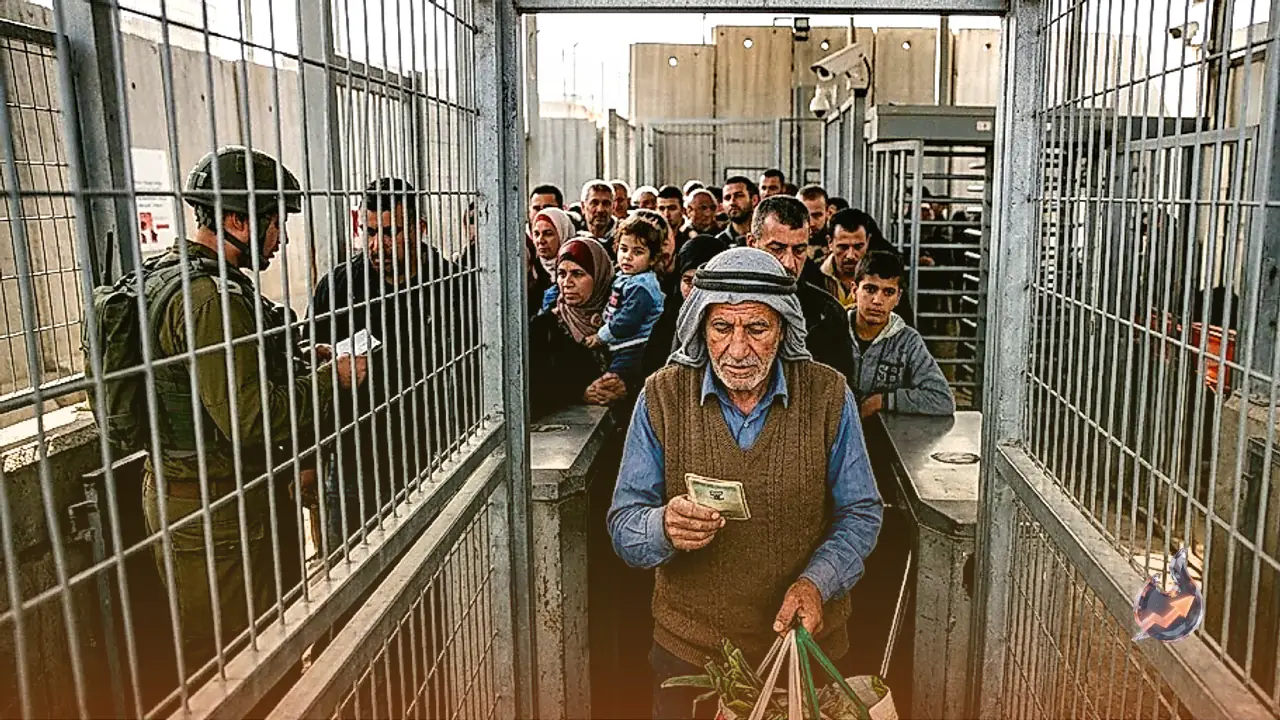

Aref Jaber, 51, finds himself navigating his neighbors' rooftops and perimeter walls simply to reach his own front door in the city of Hebron. The stone alleyways and side passages surrounding his home have been obstructed with concrete slabs and coils of barbed wire, leaving a solitary military installation, Checkpoint 160, as the only ingress and egress for the 140 families residing in the quarter. Whenever the installation shuts down without warning, whether due to an individual soldier's choice, a technical malfunction in scanning hardware, or regional news developments, Jaber is forced to phone nearby residents, ensure no soldiers are watching from street corners, and scale ladders over rooftops. Returning home after such an ordeal, he observes, feels like completing a monumental trial.
This localized confinement reflects the broader transformation taking place across the occupied West Bank for its 3.5 million Palestinian inhabitants. Alongside deadly settler violence and expanding settlement outposts, military control mechanisms have grown rapidly. The West Bank has effectively ceased to function as a unified territorial space. United Nations records compiled in December 2025 identified at least 925 permanent and temporary checkpoints, iron gates, roadblocks, and earthen mounds dividing the area, while a Palestinian governmental commission recently placed the count at 942. This physical fragmentation has disrupted family ties, stalled commerce, and severely impaired access to basic institutions such as schools and hospitals.
Mapping Commutes and Analyzing 2.6 Billion Location Pings
Standard navigation software often proves ineffective for Palestinian commuters because it does not account for temporary roadblocks and frequently directs traffic toward thoroughfares restricted to Israeli-plated vehicles. In response, residents have established mutual-aid networks on Telegram to monitor route conditions in real time. Drivers post frequent updates regarding gridlock at Awarta, closures at Huwwara, or whether the Al-Muraba’ah crossing is passable. Extensive investigations analyzing 2.6 billion driver GPS pings alongside tens of thousands of real-time communication logs demonstrate that physical barriers increased at a faster pace over the past three years than during the preceding eighteen.
The typical commuter across the West Bank loses approximately an hour and a half each week simply seeking alternative paths to bypass closures, adding up to roughly 77 hours squandered annually. Traveling the 27 kilometers between Ramallah and Al-Eizariya, on the outskirts of Jerusalem, which normally takes 48 minutes, now stretches across 45 kilometers and requires 100 minutes. Commuters making four round trips a week between Ramallah and Hebron lose upwards of 12 additional hours. Similarly, the 8-kilometer transit between the towns of Anabta and Beit Lid, once a 10-minute drive, now routinely demands 50 minutes. Overall, delays at these barriers escalated by more than 50 percent following October 2023, causing the Palestinian population to collectively lose an estimated 30 years of time every single day.
The Burden on Education and Forced Relocation
The daily disruption is clearly visible in the experience of Amal and her family, who relocated from the United States more than a decade ago to settle in the village of Al-Janiya. The village's main eastern artery had already been sealed off in 2003 to provide exclusive access for the nearby settlement of Talmon. This forced residents to rely entirely on a western detour through Ras Karkar. Her daughter Lina, studying software engineering, saw a routine 12-kilometer, 20-minute drive transform into a 32-kilometer detour requiring 47 minutes. Her older daughter Dana, pursuing a degree in dentistry, saw her 35.5-kilometer journey stretch into a grueling 90-minute commute.
Between checkpoint congestion and roundabout routes, each daughter lost roughly an hour per trip, amounting to approximately three full days lost over an academic year. A survey conducted by the Institute for Social and Economic Progress (ISEP) revealed that 30 percent of West Bank respondents have been prevented from starting or finishing university education because of checkpoint obstacles. Outside central cities, most university students must cross at least one checkpoint to reach class. The mounting exhaustion eventually compelled Amal's family to abandon their village home and move closer to Ramallah, joining more than 10 percent of West Bank residents who have relocated due to movement restrictions, while an additional 31 percent report considering a similar move.
Decades of Layered Enclosure and Shrinking Geographies
The infrastructure restricting movement was constructed incrementally over generations. During the British colonial era, authorities utilized road closures, searches, and motor vehicle permits to govern travel. Following the 1948 Nakba, in which more than 750,000 Palestinians were expelled and hundreds of villages depopulated, those who remained lived under military rule for 18 years, requiring explicit military permits for employment, medical care, or commerce. After the 1967 war, military authorities revived this framework across newly captured lands, establishing categorized identification cards that dictated where individuals could travel.
Although the 1988 United Nations Special Committee reports characterized such travel restrictions as collective punishment, the administrative divisions formalizing the West Bank into disconnected enclaves continued under the 1995 Oslo Accords. In 2002, construction commenced on the 713-kilometer separation barrier, with 85 percent of its length cutting through the West Bank itself, followed in 2007 by the land and naval blockade of Gaza. Consequently, successive generations have seen their accessible geography shrink: where older relatives in Jenin remember driving to Beirut or Jerusalem for lunch, today over 40 percent of polled West Bank residents have never visited the sea despite living within view of the coast, and nearly a third of young adults under 25 have never traveled beyond their home governorate.
Medical Delays and Humanitarian Consequences
Route 60, the primary spine connecting Ramallah to Nablus, formed the daily commute for Reem Yassin during her medical residency in anesthesiology at An-Najah National University Hospital. The 45-kilometer trip took roughly 40 minutes in 2020. However, after October 2023, three additional checkpoints were placed along the road, while existing gates closed with greater frequency. When Yassin dropped her infant daughter off with family in 'Asirah al-Qibliyah, she was forced through the Al-Muraba’ah crossing, where lines routinely lasted 20 to 30 minutes and regularly stretched into multi-hour gridlock, leaving her with barely an hour each night to spend with her child.
These obstructions carry life-threatening consequences. In July 2024, a wounded villager receiving emergency transport suffered severe hemorrhagic shock after soldiers detained his ambulance at a barrier for nearly an hour before Yassin treated him at Rafidia Surgical Hospital. Documentation from the Palestine Red Crescent Society indicates that between October 2023 and August 2026, medical workers experienced 237 access refusals and 240 transit delays by military forces, with 25 fatalities directly linked to emergency obstructions since 2023. In July 2026, an infant named Ahmad Zaid passed away when the vehicle conveying him was held at a checkpoint for over an hour. To mitigate these risks, medical organizations such as Doctors Without Borders (MSF) and the Red Crescent have had to set up localized first-aid outposts inside isolated communities.
Workplace Disruption and the Beit Furik Chokepoint
Industrial operations have also suffered severe disruption. At Sama Pharmaceuticals east of Nablus, maintenance supervisor Ali Haj Ali often faces a three-and-a-half-hour commute to cover just 16 kilometers after his shift ends at 4:30 pm. On nights when military gates close entirely, workers sleep in temporary office bunks set up at the facility. Meanwhile, the company's quality assurance manager, Ohood Khatatbeh, must pass through the lone iron gate guarding Beit Furik, home to 16,000 people. While the trip can take 15 minutes under open conditions, daily transits regularly lasted five hours, and once extended to ten hours when she and her teenage son were stuck in a queue until 3:00 am following his school exams.
The chronic unreliability has forced commercial firms to restrict hiring, with Sama Pharmaceuticals requiring applicants to reside strictly within Nablus city to avoid checkpoint absences. Nearly half of surveyed residents report that movement barriers directly impaired their or their partner's ability to secure employment. Personal safety is equally fraught: when Khatatbeh and her husband sought treatment for their jaundiced newborn son, Aws, in late 2025, an armed soldier at the Beit Furik gate barred their return under threat of gunfire, forcing them to wait an hour and a half in the cold before the barrier was lifted.
Internal Legal Warnings and the Vision of Unfettered Transit
While military representatives state that roadblock installations and operating hours are governed strictly by operational assessments and security requirements, internal legal documentation paints a more complicated picture. Colonel Cobi Marcus, legal adviser to the military, issued a formal warning to Central Command officials in June indicating that movement restrictions imposed without authorization since October 2023 have exceeded legal justification and may breach international law. Anthropologists studying the West Bank note that the density and structural permanence of this checkpoint grid remain unmatched by historic containment systems elsewhere in the world.
A brief glimpse of life without such barriers emerged on January 6, 2026, when travelers approaching the critical Wadi an-Nar crossing found the gates unattended and completely open around 3:00 pm. Word traveled rapidly across social channels as drivers posted video confirmation, sparking widespread astonishment before soldiers returned and shut the barriers at 6:12 pm. Though lasting only three hours, the momentary lapse highlighted what unrestricted movement could mean: driving the entire 130-kilometer span of the West Bank in under two hours, ensuring emergency medical access without armed confrontation, and allowing families to return home without climbing rooftops.