





















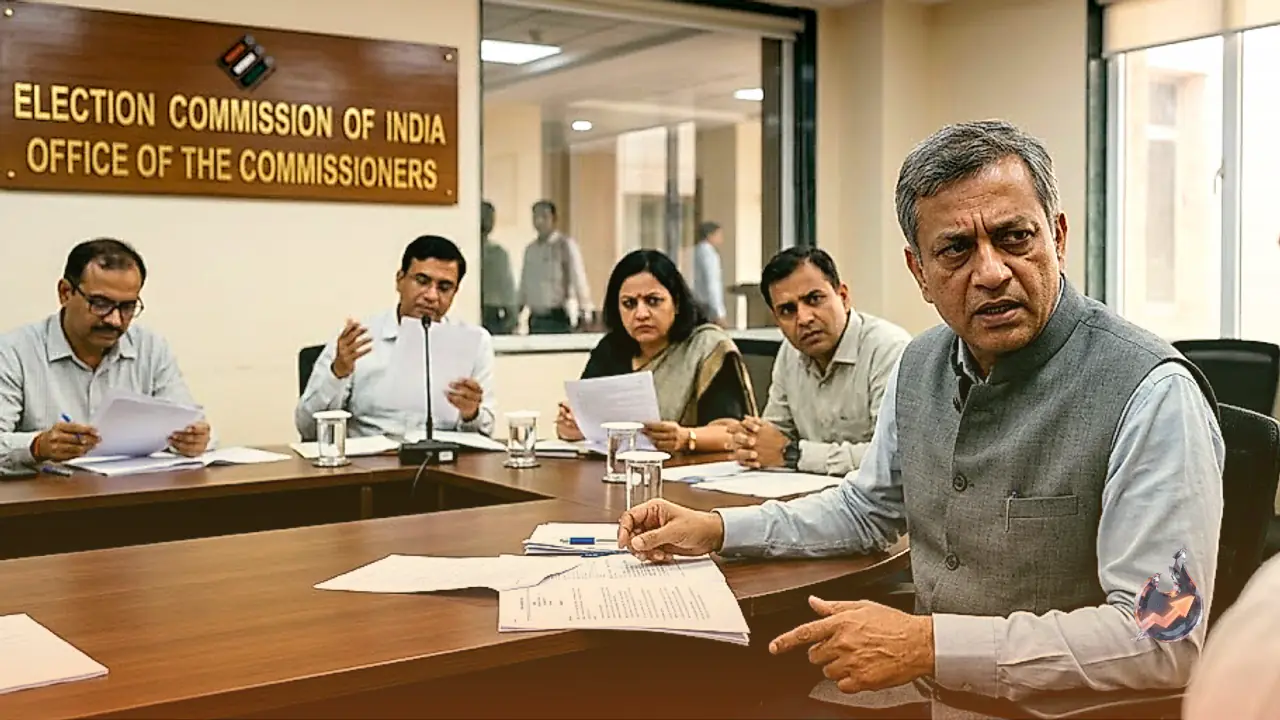

A deep institutional rift within the Election Commission has spilled into public view, triggering an intense political and legal confrontation. The controversy erupted following nationwide revisions under the Special Intensive Revision initiative, known as SIR, which was rolled out in June 2025 to update voter lists across India. When the initial draft of the revised electoral rolls expunged over 13 crore voters nationwide, opposition parties alleged widespread disenfranchisement intended to aid the BJP. However, internal documentation has now exposed that the resistance began inside the constitutional body itself. Two sitting Election Commissioners, Sukhbir Singh Sandhu and Vivek Joshi, formally raised official objections at least 14 times over a ten-month span, warning that established legal procedures were being compromised.
Official records indicate that on multiple critical occasions, significant decisions were authorized under the institutional authority of the Commission without the prior knowledge or concurrence of the two Commissioners. Sandhu formally declared that the administrative machinery was functioning unlawfully by disregarding the written counsel submitted by him and Joshi. The escalating discord centers on administrative overreach, questionable technology management, and unauthorized modifications to voter enrollment protocols.
Five Key Procedural Irregularities Behind the Discord
The administrative dispute rests on five specific irregularities that occurred during the execution of the SIR drive across several states. The primary grievance relates to the unauthorized modification of Form 6, the statutory application through which any eligible citizen aged 18 or above registers as an elector. An unapproved question was incorporated into the form, asking whether the applicant's parents or grandparents had been recorded in any previous SIR roll. The online system made an answer to this query strictly mandatory. In May, Joshi recorded that Form 6 could not be amended through internal administrative discretion because statutory rules required formal governmental action. Sandhu concurred with Joshi and explicitly demanded on 13 August that the illegally inserted question be purged at once, yet the portal continued to display it as late as 21 September.
A second major institutional dispute involves administrative curbs imposed on regional registration authorities. Electoral Registration Officers, typically local Sub-Divisional Magistrates, are legally mandated by Parliament to compile, review, and finalize electoral rolls within their territorial jurisdictions. Field officers perform these duties through the Election Commission's specialized management system, ECINet, earlier designated as ERONet. In August, Sandhu pointed out that several state election bodies reported their ground personnel were being blocked from full operational access to the platform. Sandhu emphasized that the Commission's Director General of Information Technology, Seema Khanna, lacked any legal sanction to restrict the statutory autonomy and system privileges granted to field officers by law.
The third contentious issue emerged from West Bengal, where the revision exercise flagged logical discrepancies in the demographic details of approximately 60 lakh registered voters. Under judicial oversight, the Commission struck out 27 lakh names from the roll. To ensure due process, the Supreme Court mandated that tribunals headed by retired High Court judges hear individual challenges. The Commission recently reported to the court that 38 lakh appeals were pending before these judicial panels. While 22.21 lakh claims were lodged by citizens fighting for their rightful inclusion, 16.10 lakh counter-appeals had been submitted seeking the removal of voters whom judicial magistrates had already verified and approved. Sandhu noted that the Commission actively opposed the inclusion of electors validated by judicial authorities, while remaining conspicuously silent about the identity of the entities filing those counter-appeals.
The mystery deepening around these tribunal challenges represents the fourth major irregularity. The court was never told which specific authority authorized the filing of these counter-appeals. Sandhu affirmed that neither he, nor Joshi, nor the incumbent Chief Electoral Officer of West Bengal had been briefed about the appeal strategy. This development followed administrative turbulence on 25 May 2026, when West Bengal CEO Manoj Agarwal was abruptly reassigned as the state's Chief Secretary, paving the way for Neelam Meena's appointment as the new CEO. Sandhu sent formal written inquiries to internal secretariats demanding to know who held the delegated authority to submit these appeals on behalf of the Commission and who granted the final clearance.
The fifth irregularity involved technological failures in Goa that prevented legally verified electors from entering the final rolls. The Supreme Court had ruled on 29 January that any citizen facing data mismatch flags must receive an opportunity to present supporting documents before electoral rolls are published. Goa's registration officers conducted formal verifications, examined physical records, and officially ruled that 97 applicants were fully eligible for enrollment. However, the operational software completely lacked any rollback mechanism to re-insert cleared individuals. Between 11 and 17 February, the office of Goa's Chief Election Commissioner dispatched eight separate letters to Senior Deputy Election Commissioner and state in-charge Gyanesh Bharti, urging that a rollback tool be enabled in the software. Despite copy-marking each urgent plea to Seema Khanna, no software update was provided, resulting in the permanent omission of all 97 qualified citizens when the rolls were finalized.
Former Chief Election Commissioner S.Y. Quraishi addressed the unfolding institutional breakdown, emphasizing that the Election Commission is fundamentally a three-member statutory body rather than a platform for unilateral decisions by the Chief Election Commissioner. Quraishi remarked that the Commission must clarify how minority decisions were enacted without full institutional concurrence, calling for an immediate redrafting of Form 6 in compliance with statutory rules and an independent security audit of ECINet to restore the lawful authority granted to regional officers by Parliament.
The Five Central Figures at the Heart of the Crisis
The controversy revolves around five high-ranking administrative officials whose executive actions and internal communiques define the ongoing turmoil. Leading the storm is Chief Election Commissioner Gyanesh Kumar, who stands accused by dissenting colleagues of steering institutional actions without collegial consensus. Hailing from Agra, Kumar is a 1988-batch IAS officer of the Kerala cadre. After securing a BTech degree from IIT Kanpur, he pursued studies in environmental economics at Harvard. He served as Secretary in the Ministry of Cooperation between May 2022 and 31 January 2024. Both Kumar and Sandhu joined the Commission on 15 March 2024, with Kumar elevating to the post of CEC on 19 February 2025 upon the retirement of Rajiv Kumar.
Kumar previously generated intense political debate on 17 August 2025 while responding to Rahul Gandhi's allegations of vote theft, asserting that the opposition leader had to submit an affidavit or offer an apology to the nation. Across his career, Kumar served as Secretary in the Ministry of Parliamentary Affairs and held the post of Additional Secretary in the Ministry of Home Affairs during the abrogation of Article 370 in Jammu and Kashmir in 2019, where he coordinated administrative restructuring. Following the Supreme Court ruling on the Ram Janmabhoomi dispute, he headed a three-member administrative team tasked with setting up the construction trust and allocating 5 acres of alternative land to the Sunni Waqf Board, subsequently serving as the Centre's representative on the trust. During the UPA administration from 2007 to 2012, he worked as Joint Secretary in the Ministry of Defence. His current tenure is slated to continue until 26 January 2029.
Standing in sharp opposition is Election Commissioner Sukhbir Singh Sandhu, who has documented the internal dissent. Hailing from Punjab, Sandhu is a 1988-batch IAS officer from the Uttarakhand cadre. He completed an MBBS from Government Medical College in Amritsar, followed by a master's degree in history and subsequent studies in law. Before entering the Commission in March 2024, he served briefly as Secretary to the Lokpal and acted as Chief Secretary of Uttarakhand from July 2021 to January 2024. He chaired the National Highways Authority of India between 2019 and 2021 and held the role of Additional Secretary in Higher Education. From 2007 to 2014, Sandhu worked as Principal Secretary across administrations led by four different chief ministers representing three political parties, after earlier administrative stints as District Magistrate of Haridwar and Noida. He received the President's Medal for his work on the 2001 Census and frequently lectures at LBSNAA in Mussoorie. Sandhu alone authored seven of the 14 formal objections filed within the Commission, joining Joshi on two additional submissions.
The third key official is Election Commissioner Vivek Joshi, who partnered in challenging the procedural lapses. A 1989-batch IAS officer of the Haryana cadre, Joshi earned a mechanical engineering degree from IIT Roorkee in 1987, followed by a doctorate in international economics from the Graduate Institute in Geneva. Appointed as Election Commissioner on 19 February 2025, he previously served as Haryana's Chief Secretary and held Union Secretary appointments in the Ministry of Textiles, the Ministry of Women and Child Development, and the Department of Financial Services. Joshi accumulated extensive district experience as Deputy Commissioner and Divisional Commissioner across four Haryana administrative zones, in addition to holding board seats at both the Reserve Bank of India and the State Bank of India.
Occupying a crucial operational position is Seema Khanna, the Director General of Information Technology at the Commission, whose centralized digital systems sit at the epicenter of the operational grievances. Appointed on deputation in 2025, Khanna completed a master's in engineering before earning a doctorate in Information Security from IIT Delhi. Between April 2020 and 2025, she functioned as Deputy Director General at the National Informatics Centre. On 22 January 2026, she oversaw the rollout of the unified ECINet platform, consolidating over 40 distinct election-related applications under a single interface, which she stated would enhance institutional transparency. With roughly 25 years of IT experience, Khanna faced heavy criticism in February when former West Bengal Chief Minister Mamata Banerjee alleged that the IT operations were compromising voter rolls. Subsequent attempts by former TMC MP Saket Gokhale to access ECINet documentation via an RTI filed on 17 April were rejected under trade secret exemptions.
The fifth pivotal figure drawn into the unfolding dispute is Cabinet Secretary T.V. Somanathan, recipient of high-level correspondence regarding the internal conduct of the Commission. Serving as the 33rd Cabinet Secretary since 30 August 2024, Somanathan is a 1987-batch Tamil Nadu cadre IAS officer who holds both qualified chartered accountant credentials and a PhD in economics. He held the key portfolio of Union Finance Secretary from April 2021 to August 2024, after serving as Expenditure Secretary from December 2019, playing a central role in guiding the GST implementation in July 2017. Between 2011 and 2015, Somanathan served as a Director at the World Bank in Washington, having earlier established Chennai Metro as its founding Managing Director and served as Secretary to Tamil Nadu Chief Minister M. Karunanidhi. Though his initial term was scheduled to conclude on 30 August 2026, the government granted him a one-year service extension.
Constitutional Recourse and Emerging Scenarios
Navigating the legal fallout from this administrative crisis is complicated by statutory protections enacted by Parliament in 2023. Under the revised framework, sitting Election Commissioners enjoy complete legal immunity against criminal prosecution for actions executed or words spoken while discharging their official responsibilities. Consequently, any attempt to unseat the Chief Election Commissioner must strictly follow the constitutional mechanism of parliamentary impeachment. Parliamentary sources suggest that opposition factions are drafting a formal impeachment motion. However, securing a successful impeachment involves an intricate, multi-stage procedure, as witnessed in April when a similar notice failed to clear the presiding scrutiny of the Lok Sabha Speaker and the Rajya Sabha Chairman.
Parallel to legislative efforts, legal challenges are moving before the judicial bench. Advocate Brajesh Singh has approached the Supreme Court seeking the initiation of criminal contempt proceedings against Gyanesh Kumar. Analyzing the matter, Supreme Court advocate Virag Gupta observed that if executive adjustments to Form 6 violated established statutory frameworks, the apex court retains the authority to take suo motu cognizance, though conclusive public proof that the form can be modified solely by Parliament remains subject to judicial determination.
Defending its administrative conduct, the Election Commission maintained that its operational choices remain grounded in statutory guidelines and longstanding institutional practices, asserting that all formal policies were approved through full commissioner concurrence. Emphasizing this stance, BJP national spokesperson Sambit Patra stated at a press conference that open debate among commissioners is a natural marker of democracy, preventing accusations of subservience to the government.