




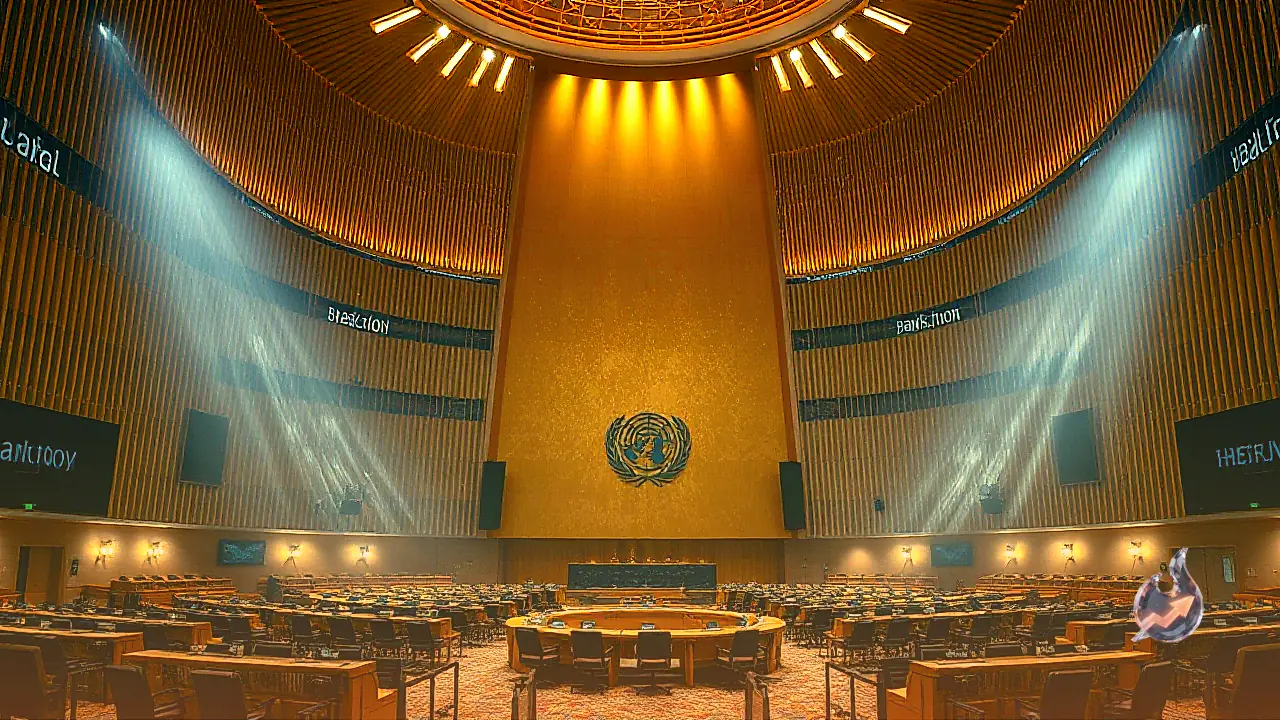

















Ahead of Prime Minister Shehbaz Sharif's scheduled speech at the United Nations General Assembly on 25 September, Pakistan has once again escalated its diplomatic outreach against India across multilateral forums. Islamabad has circulated a fresh formal communication to the UN Security Council regarding the Indus Waters Treaty, while persistently keeping Jammu and Kashmir at the forefront of its international public messaging. Since April 2025, when India placed the historic water-sharing framework in abeyance, Pakistan has repeatedly turned to international institutions, though institutional realities and binding treaty mechanics show severe limits to what such appeals can physically accomplish.
The Security Council Letter and Arbitration Ruling
Pakistan's latest diplomatic communication to the UN Security Council directly references the 31 August 2026 pronouncement by the Court of Arbitration regarding the Indus Waters Treaty. The tribunal observed that the 1960 pact remains legally in force. Pakistan welcomed this position and continues to maintain internationally that India cannot unilaterally withhold or suspend the agreement. Through its latest correspondence, Islamabad sought to formally place its legal stance on the official records of the Security Council.
This move is part of an ongoing diplomatic push rather than an isolated initiative. Pakistan had previously dispatched similar formal communications over the water treaty to the Security Council in April 2025, June 2025, and once again in April 2026. The tactical objective of these submissions is direct: Islamabad wants the United Nations to formally register its strong grievance regarding India's decision to freeze the operational execution of the pact. However, lodging formal diplomatic paperwork with the UN and securing enforceable international intervention represent two entirely different geopolitical realities.
Roots of the Current Water Agreement Impasse
The Indus Waters Treaty, originally signed in 1960, managed to survive decades of wars and severe bilateral hostilities between India and Pakistan. The operational status quo changed fundamentally following the Pahalgam terror attack, after which India announced that it was placing the treaty in abeyance, effectively suspending its application for a specified timeframe. India firmly established that this measure would remain active until Pakistan convincingly, credibly, and irrevocably stopped its backing of cross-border terrorism.
Pakistan rejected New Delhi's stance, arguing that bilateral treaty obligations cannot be paused unilaterally by one signatory. The legal confrontation deepened considerably in September 2026, when the Permanent Court of Arbitration at The Hague determined that the treaty remains active and found that India's suspension was impermissible under the treaty terms and applicable international legal standards. India, however, rejected those proceedings entirely and continues not to recognize the court's jurisdiction over the matter, while Pakistan continues leveraging the topic for diplomatic visibility.
Limits on UN Authority Regarding River Flows
Pakistan's recurring strategy of raising the river dispute at the UN General Assembly faces stark jurisdictional barriers. The Indus Waters Treaty contains its own dedicated, self-contained dispute-resolution mechanism designed specifically to address bilateral disagreements. Depending on the gravity and technical nature of the problem, the treaty explicitly establishes procedures for direct negotiations, the appointment of a Neutral Expert, or the constitution of a Court of Arbitration, with designated functional responsibilities assigned to the World Bank.
Given this autonomous framework, the UN General Assembly lacks the legal power to pass an enforceable resolution directing India to release specific river volumes to Pakistan. Multilateral diplomatic debate cannot override the explicit dispute clauses established under the 1960 pact, rendering Islamabad's broad institutional appeals largely symbolic.
Historical Context Behind the Kashmir Debate
Alongside the water treaty, Pakistan routinely attempts to highlight the Kashmir territorial issue at international gatherings. Following independence in August 1947, armed conflict erupted over Jammu and Kashmir later that year. India approached the UN Security Council in January 1948, leading to several resolutions, including Resolution 47 in April 1948, which outlined steps for restoring peace and proposed mechanisms related to a plebiscite.
India's long-standing diplomatic position remains firm: all outstanding bilateral issues with Pakistan must be resolved strictly between the two sovereign nations under the framework of the 1972 Simla Agreement, without third-party intervention or multilateral mediation. In contrast, Pakistan consistently cites the UN's historical engagement and earlier resolutions to invite outside mediation during international conferences.
Contrasting Territorial Disputes and River Governance
Understanding the current geopolitical exchange requires separating these two bilateral matters. The Kashmir dispute centers on sovereign territory, borders, and administrative control, whereas the Indus Waters Treaty governs the engineering, allocation, and technical utilization of shared river systems. While the United Nations provides an open forum where member states can hold debates and call for peaceful dialogue, it possesses no mandate to issue binding verdicts changing territorial sovereignty or compelling river management practices.
Evaluating the diplomatic impact of the upcoming speech, international affairs expert Shreesh K Pathak observed that Shehbaz Sharif's remarks will change nothing on the ground and reveal everything about the speaker. Pathak noted that Sharif speaks of Kashmir out of routine habit, whereas on the Indus Waters Treaty, his arguments stem from desperation, borrowing phrasing from an external court because his own administration lacks domestic leverage. A forum created for peace cannot negotiate around actions that a country refuses to halt against its neighbor; while Islamabad describes the situation as obstruction, New Delhi views it as consequence.