




















The opening weeks of June 1984 marked one of the most volatile and traumatic chapters in the history of the Indian Armed Forces. In the heart of Amritsar, Operation Blue Star was launched to flush out Khalistani extremist leader Jarnail Singh Bhindranwale and hundreds of his armed fighters from the Golden Temple complex. Bhindranwale had established his operational base inside the Akal Takht, the supreme seat of temporal and spiritual authority for Sikhs, effectively running a parallel administration. He had openly proclaimed that his forces would seize total control of Punjab by 10 June to carve out an independent nation called Khalistan. While military units cordoned off the holy shrine from every perimeter, Bhindranwale remained convinced that government forces would never cross into the sacred sanctum. At approximately 4:30 pm on 5 June, army commanders delivered an ultimatum over loudspeakers demanding an immediate surrender. When no one emerged, troops commenced their assault at around 10:30 pm. Heavy gunfire instantly met the entering soldiers. Armoured personnel carriers sent into the compound were targeted and destroyed by extremists using rocket-propelled grenades, inflicting fatal casualties on army ranks. The military leadership responded by deploying main battle tanks. At 5:00 am, tank cannons began targeting the upper structure of the Akal Takht, unleashing approximately 80 artillery shells in rapid succession. An hour of sustained bombardment silenced the retaliatory fire. By 10:00 am, troops swept through the rubble to discover Bhindranwale's body in the courtyard. Over 300 of his fighters and approximately 100 soldiers perished in the battle. The Akal Takht was heavily damaged, and the Golden Temple bore grave structural scars, setting off an overwhelming wave of grief and anger among Sikh communities across the country.
The Shockwave Reaches Ramgarh Regimental Centre
Far from the smoking ruins of Amritsar, approximately 1,663 kilometres away, the news triggered instant shockwaves at the Sikh Regimental Centre in Ramgarh, located in what was then Bihar and is now Jharkhand. On the morning of 8 June 1984, regular duties were initially underway across the cantonment, with officers attending files and soldiers on watch. Later that morning, Sepoy Gurnam Singh walked into the office of Deputy Commandant Colonel Jagdev Singh. Though his tone remained controlled, his expressions bore deep anger. He confronted the senior officer directly, stating that the assault on Amritsar was wrong and that he requested permission to leave for the holy city immediately. Colonel Jagdev Singh denied the request outright, reminding him that leaving the station was not permitted under military regulations. Gurnam Singh stood in silence for several seconds, turned on his heel, and walked out. That night, he refused his meals at the barracks, harboring an intense fury that mirrored the mood of hundreds of fellow Sikh jawans across the base.
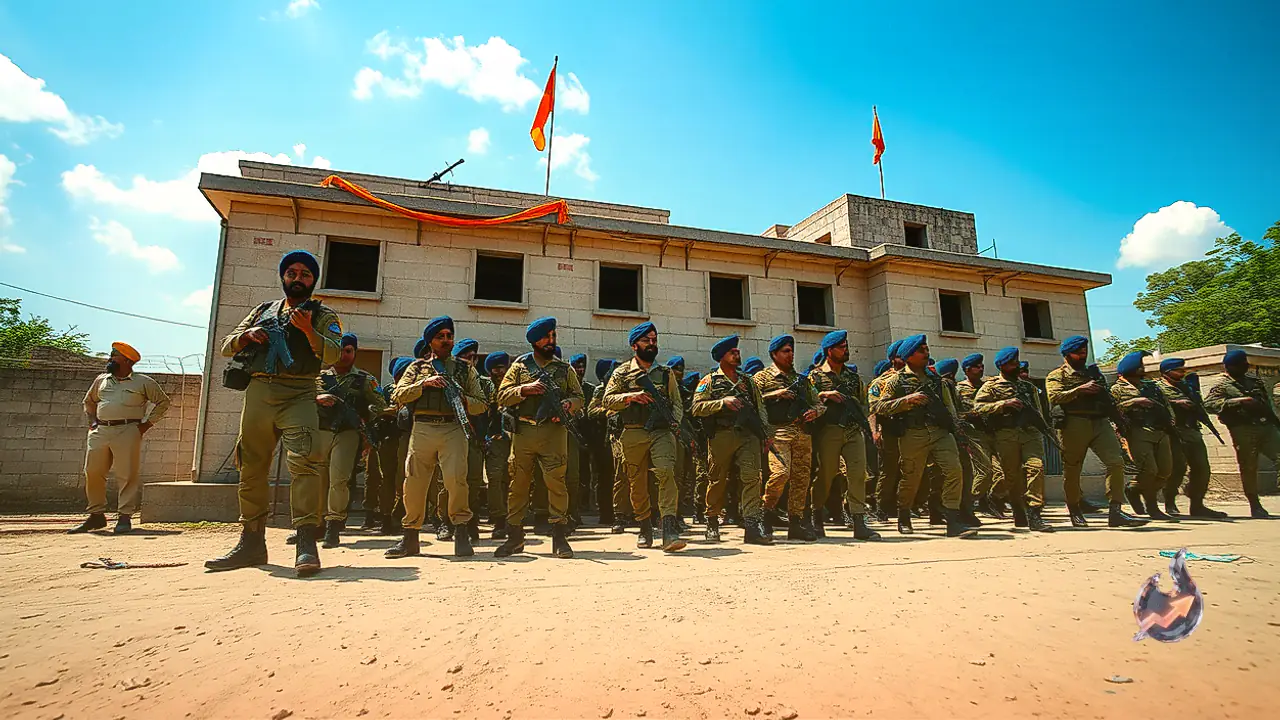
By the morning of 10 June 1984, the brewing resentment broke into the open. At 10:00 am, hundreds of Sikh soldiers assembled inside the cantonment gurdwara. Shabad kirtan was performed, followed by the congregation rising together for the solemn ardas prayer. After bowing their heads and receiving karah prasad, the soldiers filed outside. The moment they cleared the doors, discipline shattered completely. Instead of dispersing toward their living quarters, the men marched toward the armoury. Their pace intensified into a dead run, accompanied by thunderous battle cries of 'Jo bole so nihal, Sat Sri Akal.' The soldiers battered down the doors of the kote, seizing rifles, automatic weapons, and ammunition crates before boarding military transport trucks parked nearby.
The alarm reached command headquarters immediately. Brigadier SC Puri, the General Officer Commanding (GOC), drove straight to the armoury in his official vehicle in a bid to personally dissuade the mutineers. However, the situation had escalated beyond persuasion. As Brigadier Puri stepped forward to reason with them, gunfire erupted from the ranks. In the ensuing volley, a fatal round struck Brigadier Puri while another bullet killed his Sikh driver. Both succumbed to their wounds shortly after arriving at the military hospital. Colonel Jagdev Singh was also struck and sustained severe, life-threatening injuries during the chaos.
Convoys on the Highways and Mechanised Interceptions
Deeply shaken by the desecration of their supreme shrine, an estimated 1,400 armed mutineers took control of service trucks and commandeered several civilian vehicles in Ramgarh town before setting out on the long road to Amritsar. The initial effort to intercept the runaway column occurred roughly 450 kilometres down the route, near Sakteshgarh in the vicinity of Mirzapur railway station, but a large portion of the armed convoy smashed past the blockade. Upon entering Banaras, the soldiers recognized the risk of traveling as a single massive target and fractured into multiple smaller convoys.
As they attempted to clear the outskirts of Banaras, the Indian Army's 21st Mechanised Regiment threw a heavy perimeter across the arterial highways. Surrounded by heavy armour, a significant faction of the mutineers was forced into custody. Another splinter group that evaded the initial cordon pushed forward toward Allahabad, where elements of the Army's Mountain Division and infantry battalions had established interlocking defensive positions. A fierce firefight broke out between the regular units and the mutineers, ending with the surrender of the rebel soldiers. Subsequent military inquiries identified Sepoy Gurnam Singh as the central ringleader of the Ramgarh uprising. In his historical account, Turmoil in Punjab Before and After Blue Star, former Punjab Chief Information Commissioner Ramesh Inder Singh noted that base commanders should have summoned a general sainik sammelan or durbar to address the jawans directly and demystify events, but no such outreach took place.
A month prior to these events, on 1 May 1984, Prime Minister Indira Gandhi had personally visited the Ramgarh military facility. While reviewing the base, she turned to an accompanying general and asked what the travel distance was between Ranchi and Amritsar. Puzzled by the query, the general replied that a direct railway connection linked the two cities. Only after the tragic rebellion did the general understand the true gravity behind her inquiry, remarking to Bihar's then Home Secretary SH Dhanoa that had the political leadership dropped the slightest hint of upcoming military operations, commanders could have psychologically prepared their troops to avoid such catastrophic reactions.
The Uprising in Rajasthan's 9th Sikh Battalion
Concurrently, a separate and equally dangerous insurrection ignited in Sri Ganganagar, Rajasthan, within the 9th Battalion of the Sikh Regiment. This decorated combat unit had famously repulsed Pakistani forces in the Naogaon sector during the 1971 Indo-Pak war. As soldiers gathered around a radio set listening to BBC correspondent Mark Tully reporting that the Akal Takht had suffered massive structural damage and that Bhindranwale had died inside, tensions hit a boiling point.
Among the personnel in the unit was young rifleman Tarlochan Singh Manochahal, whose brother Gurbachan Singh Manochahal was known as a key lieutenant of Bhindranwale. Beside him stood Havildar Gyan Singh 'Runner', a widely respected athlete who had previously captured Asian championship titles in the 400-metre and 800-metre track events. Addressing the simmering anger, Gyan Singh made an impassioned remark in Punjabi, reminding everyone that having consumed the sacred karah prasad together, it was now time to take definitive action. His words galvanized the wavering men into immediate defiance.
During the night of 8 June, the soldiers raided their unit armoury, confiscating military rifles, heavy ammunition, and commandeering five military transport trucks. A total of 387 soldiers departed the cantonment under the cover of darkness. As the vehicles pulled away, rogue elements fired rounds into the official residence of Lieutenant Colonel Iqbal Singh Sabharwal. When Sepoy Satnam Singh and Havildar Major Karam Singh stepped into their path to urge restraint, the mutineers physically assaulted them before driving away toward the Punjab border.
Roadblocks, Ambush, and the Kot Sukhiya Standoff
The runaway convoy encountered its first major obstacle near Sri Ganganagar, where state police detachments had erected reinforced road barricades. Shouting the traditional battle cry of 'Jo bole so nihal, Sat Sri Akal', the mutineers unleashed automatic fire and breached the barricades, entering southwestern Punjab. They made their way onto the Abohar-Malout highway, unaware that the 94 Field Regiment had already deployed combat cordons along the road. Another intense firefight ensued. While the lead trucks managed to blast through the ambush, three trailing vehicles were cut off and immobilised, resulting in the deaths of 13 mutineers.
Realizing that mainstream routes were death traps, the remaining soldiers altered their course through Muktsar and diverted onto an unpaved canal road near the rural hamlet of Ashabuttar. They pressed forward toward Moga, but upon reaching the Kot Sukhiya crossing, they found their advance completely halted. Main battle tanks had sealed the road ahead, creating an impenetrable blockade backed by heavy infantry cordons. A Sikh general commanding the armoured detachment stepped forward and addressed the mutineers, declaring that the combat operation at the Golden Temple was already over and that driving to Amritsar would achieve nothing, ordering them to lay down their arms. Facing overwhelming firepower with nowhere to retreat, all 387 soldiers surrendered their weapons. They were moved under armed escort to Suratgarh for detention. In subsequent court-martial proceedings, Tarlochan Singh and three peers were handed 14-year prison sentences, though the VP Singh government granted them an executive pardon six years later. The 9th Sikh Battalion was subsequently disbanded.
Incidents Across Uri, Miran Sahib, Assam, and the Aftermath
Unrest was not confined to central and western India. In the frontier sector of Uri in Jammu and Kashmir, news of the Golden Temple operation caused deep agitation among Sikh personnel. Upon learning of the tension, Corps Commander Lieutenant General PN Hoon boarded a helicopter and landed directly on the sports ground where the soldiers had assembled. Addressing them frankly, General Hoon stated that reports broadcast by Radio Pakistan were fabricated propaganda aimed at inciting unrest, urging them to travel to Amritsar in due time and verify facts for themselves. He then challenged the assembly by pointing out that the Pakistani border was barely two miles away, asking anyone who wished to defect to cross over immediately. A profound silence fell over the ground, and not a single soldier raised a hand, defusing the revolt without a shot being fired. Author Rajesh Bhat documented in Radio Kashmir in Times of Peace and War how Radio Pakistan and Radio Trarkhal had persistently disseminated distorted narratives to inflame regional passions from 1947 to 1989.
Similar stirrings were recorded elsewhere. At Miran Sahib in Jammu, 80 troops belonging to the 18th Sikh Battalion abandoned their posts and drove toward Amritsar, but fellow Indian Army troops intercepted and persuaded them to stand down upon reaching Gurdaspur, leading to their peaceful disarming. Another contingent of 127 men from the 14th Sikh Battalion was apprehended in Maharashtra while heading north. On 11 June, over 200 soldiers attached to the 3rd Sikh Regiment in Assam deserted with their weaponry in small groups; despite Colonel JS Kahlo pleading with folded hands for them to halt their dishonourable action, they pressed on before being captured shortly after. Reports of unrest also emerged from Thane, Pune, and Alwar. A rare exception was Dafadar Gurjant Singh of the 4th Horse Regiment, who drove an army jeep all the way to Amritsar unarmed, only to be arrested inside the Golden Temple complex on 4 September 1984.
The institutional response from the military was swift and unsparing. Approximately 365 mutinous soldiers were dismissed from service, and 277 received prison terms through general court-martials. Lieutenant General KS Brar later recorded that even prior to the operation, audio cassettes containing Bhindranwale's inflammatory speeches demanding a separate homeland had circulated through cantonments and gurdwaras. When communications were clamped down during the raid, unchecked rumours filled the void. Historical compilations by Ramesh Inder Singh indicate that roughly 2,900 Sikh soldiers mutinied nationwide in the aftermath of Operation Blue Star, with 47 soldiers losing their lives in the mutiny and the rest taken into custody. The broader national tragedy deepened four months later on 31 October 1984, when Prime Minister Indira Gandhi was assassinated by two of her Sikh bodyguards, setting off horrific anti-Sikh violence across Delhi and other regions and pushing Punjab into a decade-long spiral of militancy. Although the 24 July 1985 accord between Rajiv Gandhi and Sant Harchand Singh Longowal addressed key issues such as Chandigarh, river waters, and compensation, healing took generations. On 11 August 2005, Prime Minister Manmohan Singh stood in the Rajya Sabha and expressed an apology to the nation, stating that what occurred was contrary to the national sentiment and caused his head to hang in shame. The Sikh Regiment remains one of India's most decorated formations, carrying a legacy of two Param Vir Chakras awarded to Karam Singh in 1948 and Joginder Singh in 1962, alongside 24 Maha Vir Chakras and 67 Vir Chakras, underpinned by a heritage where soldiers traditionally swear their supreme oath upon the Guru Granth Sahib.