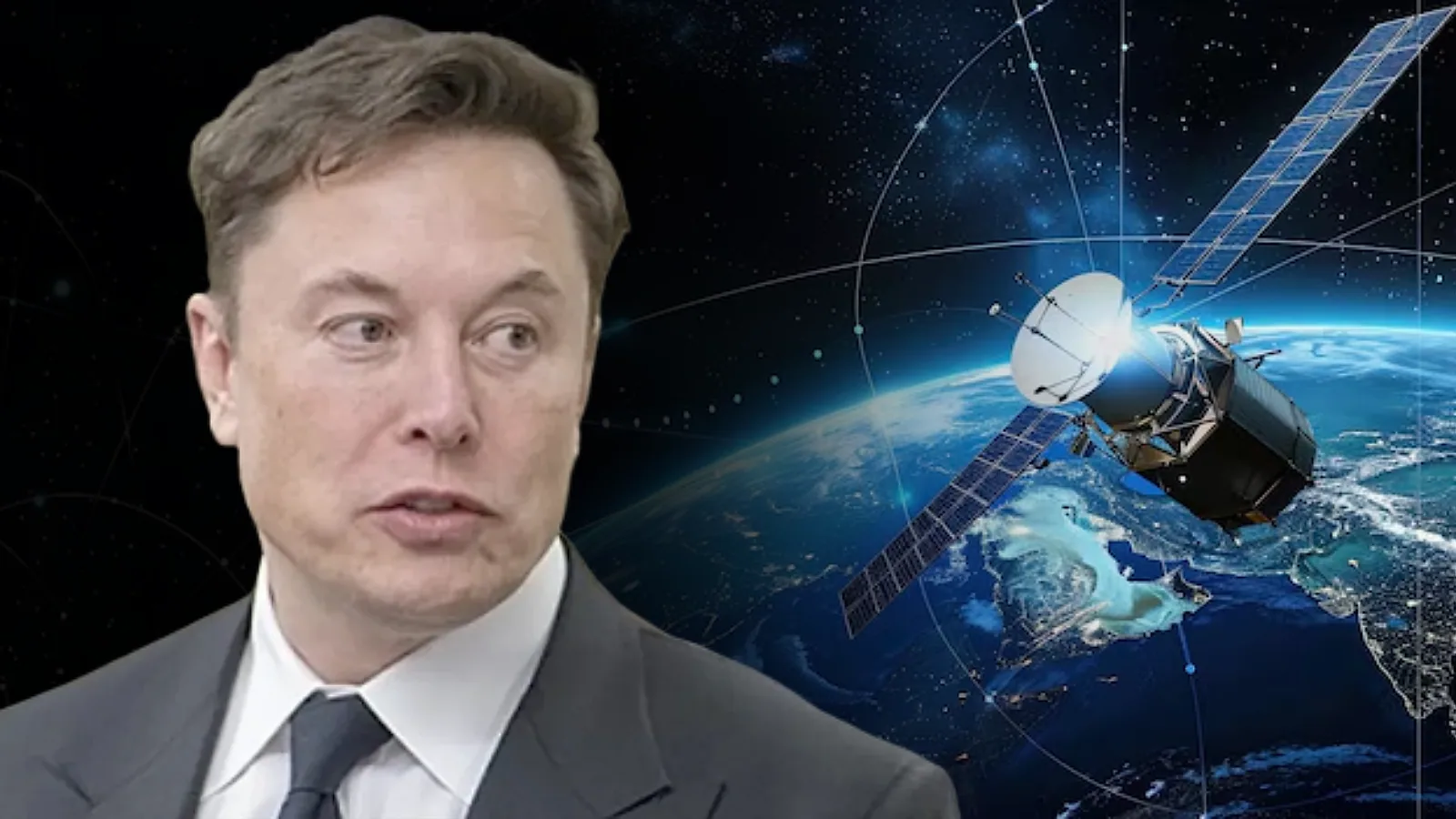

There are currently 16,928 active satellites operating in space, but Elon Musk's company SpaceX is planning to deploy roughly 60 times that number by launching 1 million satellites. Official approval for this massive undertaking was granted on 25 November, setting the stage for a dramatic transformation of Earth's orbital environment.
Why does Elon Musk need so many satellites in orbit?
The primary driver behind this monumental endeavor is Musk's ambition to construct solar-powered artificial intelligence data centres directly in space. Whenever a user submits a query to an AI tool such as ChatGPT, a data centre performs the heavy lifting required to generate the response. Operating terrestrial data centres demands vast amounts of physical land, massive quantities of electricity, and tens of millions of litres of water every single day solely for cooling purposes.
Under Musk's proposed architecture, satellites would process data directly in space and beam the results back down to Earth. This approach is intended to alleviate mounting concerns over the excessive consumption of land, electrical power, and water resources domestically, while simultaneously reducing overall data-centre operational expenses. The US Federal Communications Commission has authorized this so-called Starmind project, stipulating that the inaugural satellite must be launched by 2033. Ten percent of the constellation is mandated for launch by 2035, half by 2038, and the entire fleet by 2040.
What are the primary dangers associated with launching so many satellites?
Independent scientists and researchers have raised four distinct categories of concern regarding the environmental and orbital fallout of such a colossal constellation. The first major issue is that satellite light emissions will severely disrupt astronomical observations. The night sky observed today bears little resemblance to the celestial canopy viewed by past generations, with a satellite now streaking past every one to two minutes. The illumination reflected from these objects creates bright streaks across wide swaths of astronomical imaging data, frequently outnumbering the visible stars.
The second major hazard is Kessler Syndrome, which describes a catastrophic chain reaction of collisions in space. The underlying concept was originally formulated by NASA scientist Donald Kessler back in 1978, warning that debris from an initial impact strikes other orbiting bodies, generating cascading destruction. According to the University of Birmingham, if SpaceX's proposed satellites collide with existing orbital hardware, the resulting debris field would quickly spiral out of control. The sheer scale of the constellation means one million satellites would need to alter their trajectories approximately one billion times every year simply to avoid catastrophic impacts. More than 230 million pieces of debris measuring between 1 millimeter and 1 centimeter, alongside roughly 1.5 million larger fragments, are already circling the planet. A major collision event could generate enough shrapnel to render specific orbital bands completely unusable, crippling vital terrestrial services such as GPS navigation, weather forecasting, and global communications.
The third pressing danger involves a massive escalation in space pollution, which researchers estimate could surge 70 to 150-fold. Satellites typically possess an operational lifespan of 5 to 7 years before decaying and burning up during atmospheric re-entry. This combustion process generates aluminium oxide, a compound that activates chlorine and actively destroys the ozone layer, which shields Earth from harmful solar radiation. Research conducted by the University of Southern California indicates that a single 250-kilogram satellite produces roughly 30 kilograms of aluminium oxide nanoparticles upon incineration, particles that can persist in the upper atmosphere for decades. University College London estimates that pollution stemming from the launch and subsequent re-entry of one million satellites could multiply baseline pollution levels by 70 to 150 times.
The fourth concern centers on how satellite radio signals and electronic noise interfere with scientific research. The American Astronomical Society points out that radio emissions and operational noise generated by massive satellite constellations can severely impair the sensitivity of radio telescopes. Detecting extremely faint signals originating from deep space will become vastly more difficult, ultimately impeding our ability to study complex astronomical phenomena.
Could damaged or dead satellites eventually fall to the ground?
The physical threat of orbital debris surviving re-entry and impacting Earth is a proven reality rather than mere theory. In 2024, a 2.5-kilogram fragment originating from a Starlink satellite was discovered on a farm in Canada, having landed safely during the night without causing injuries. Historical precedents include a 1997 incident where a six-inch piece of a spent rocket struck a woman in the United States, and a 1969 event where debris from a Soviet spacecraft hit a Japanese merchant ship near the coast of Siberia, injuring five crew members. As satellites disintegrate in the atmosphere, unburnt fragments frequently survive the descent.
During 2026 alone, Starlink has averaged 1.5 satellites burning up in the atmosphere every single day. Scientists project that even if SpaceX's million satellites maintain an average lifespan of five years, approximately 200,000 units would re-enter the atmosphere annually, translating to roughly 550 objects every single day. This exponential increase naturally elevates the probability of ground impacts. The US Federal Aviation Administration cautioned in October 2023 that if satellite deployments continue at this pace and unburnt Starlink fragments survive re-entry, roughly 28,000 dangerous pieces could reach the Earth's surface every year by 2035. Statistical models suggest that worldwide, one person could be injured or killed by falling debris every two years. By 2035, Starlink alone would account for over 85 percent of the total cumulative risk posed to human populations and airborne aircraft. Although this regulatory assessment was compiled prior to the approval of the one-million-satellite proposal, subsequent risk levels could prove significantly higher. SpaceX previously dismissed the government findings as absurd. Because 70 percent of the Earth's surface is covered by water, falling debris is statistically more likely to land in remote ocean basins, which reduces the immediate danger to human populations but simultaneously prevents scientists from recovering and studying re-entry samples.
Why did regulators grant approval for one million satellites despite the risks?
To understand why the project received a green light, it is necessary to examine the core arguments presented by SpaceX. The company maintains that its success rate in actively deorbiting inactive satellites exceeds the performance benchmarks set by NASA and the FCC. Furthermore, SpaceX notes that the orbital volume spanning between 500 and 2,000 kilometers above Earth equals approximately 110 trillion cubic kilometers, meaning one million satellites would occupy a mere 0.005 percent of that available space. Additionally, the corporation aims to engineer its satellites to maintain a brightness magnitude below 7, ensuring they remain virtually invisible to the naked eye even under pristine dark skies.
Meanwhile, the Federal Communications Commission asserted that environmental and astronomical objections fall strictly outside its statutory jurisdiction. As the federal agency tasked with licensing radio communication frequencies within the United States, the FCC maintained that evaluating the environmental impact of rocket launches is the explicit responsibility of the FAA, while dismissing atmospheric destruction claims as speculative and lacking evidentiary support. Furthermore, major federal decisions in the United States are typically subject to rigorous environmental impact reviews under the National Environmental Policy Act. However, on 1 October, the FCC amended its regulatory framework, stipulating that space operations licensed by the agency occur outside domestic territory and therefore exempt them from standard environmental reviews. FCC Chairman Brendan Carr praised SpaceX's initiative as a decisive step that will shepherd global infrastructure into the era of superintelligence.