


















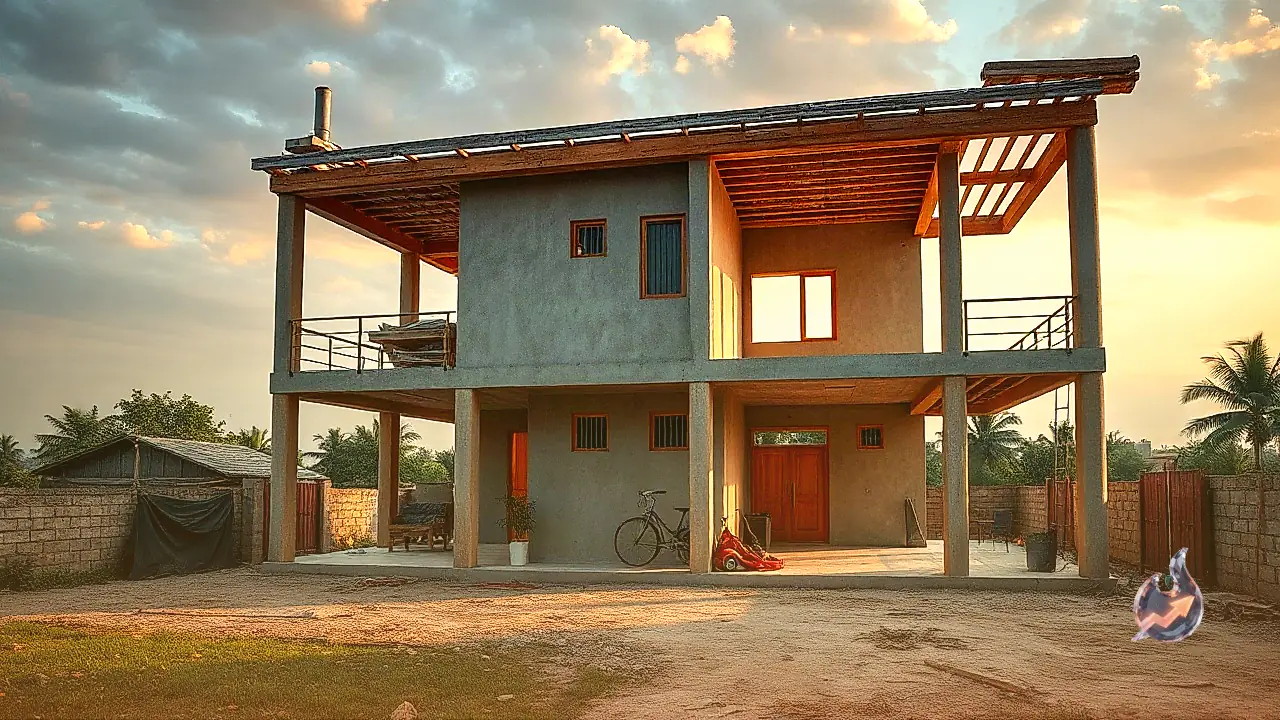

For homeowners planning to build a house in Koderma, establishing an accurate financial projection before breaking ground is vital. Erecting a three-bedroom, hall, kitchen, bathroom, and stair-accessible terrace layout across a 1000-square-foot plot demands an estimated basic expenditure between 5.85 lakh and 6 lakh rupees. This realistic estimate accounts for raw structural supplies and essential workforce expenses required to bring the bare structural shell to completion.
Steel and Cement Requirements with Cost Estimates
Drawing from 12 years of hands-on construction experience, contractor Kailash Ravidas outlined the essential materials required for building on a 1000-square-foot footprint. Various sizes and gauges of steel rebars are needed right from the foundation trenches up through the tie beams, plinth beams, and terrace roof casting. Approximately 15 quintals of steel will be consumed during the process. At prevailing market rates of 65 rupees per kilogram, procuring the required steel alone will cost around 97,500 rupees.
Cement represents the cornerstone of structural durability throughout the project. According to Kailash Ravidas, erecting the foundation base, vertical pillars, plinth beams, and brick masonry walls will consume roughly 160 bags of cement. Subsequently, casting the concrete terrace slab requires approximately 90 bags. In total, nearly 250 bags of cement will be necessary. At an average price of 360 rupees per bag, homeowners should budget around 90,000 rupees strictly for cement purchases.
Expenses for Sand, Stone Chips, Structural Rings, and Nails
Sourcing quality sand and stone aggregate forms another critical expenditure in the baseline construction budget. Kailash Ravidas stated that a 1000-square-foot residential layout typically requires around 15 tractor trolleys of sand. Based on current freight rates of 2,500 rupees per tractor trolley, sand procurement totals approximately 37,500 rupees. In addition, around 10 tractor trolleys of stone aggregate are needed for the concrete mix. Priced at 8,500 rupees per trolley, stone aggregate adds roughly 85,000 rupees to the material tally.
To assemble structural reinforcement cages across columns, plinth courses, and overhead roof beams, masons require approximately 1,000 prefabricated steel rings. At 15 rupees per unit, these rings cost around 15,000 rupees. Furthermore, securing shuttering formwork and temporary wooden supports calls for nearly 25 kilograms of construction nails. Sourced at 80 rupees per kilogram, this hardware requirement stands at roughly 2,000 rupees.
Bricks, Binding Wire, Chemicals, and Ancillary Items
Securing the reinforcement mesh along tie beams, plinth beams, and the roof slab necessitates roughly 20 kilograms of binding wire. Priced at 80 rupees per kilogram, binding wire accounts for an outlay of approximately 1,600 rupees. Meanwhile, constructing all exterior load-bearing and interior partition walls across the 1000-square-foot 3BHK footprint requires an estimated 12,000 bricks. Procuring grade-two bricks at prevailing local rates of 8,500 rupees per thousand bricks amounts to roughly 1.02 lakh rupees.
During the casting of the roof slab and support pillars, roughly 10 kilograms of plastic sheets are utilized to line shuttering and prevent slurry loss, requiring an outlay of approximately 1,500 rupees. Additionally, integrating chemical liquid admixtures into the concrete batch to enhance structural waterproofing and strength will cost around 3,000 rupees.
Labour Costs, Total Expenditure, and Project Timeline
Beyond raw building inventory, paying skilled masons and daily-wage labourers constitutes a significant portion of the construction outlay. Kailash Ravidas estimates workforce expenses at approximately 1.50 lakh rupees for the structural phase. Combining 4.35 lakh rupees for structural materials with 1.50 lakh rupees for labour yields a foundational expenditure of 5.85 lakh rupees. Depending on market rate fluctuations and minor site variations, the overall expenditure can reach up to 6 lakh rupees.
Assuming an uninterrupted supply of raw materials and standard working conditions, erecting the primary structural shell takes about one and a half months to finish. It is important to emphasize that this calculation excludes land acquisition costs. Expenses associated with municipal map approvals, electrical and water utility connections, doors, windows, floor tiling, wall painting, bathroom sanitary ware, and other finishing installations remain outside this baseline estimate. Final expenditures will vary based on material grades, current local rates, and customized architectural floor plans.