




















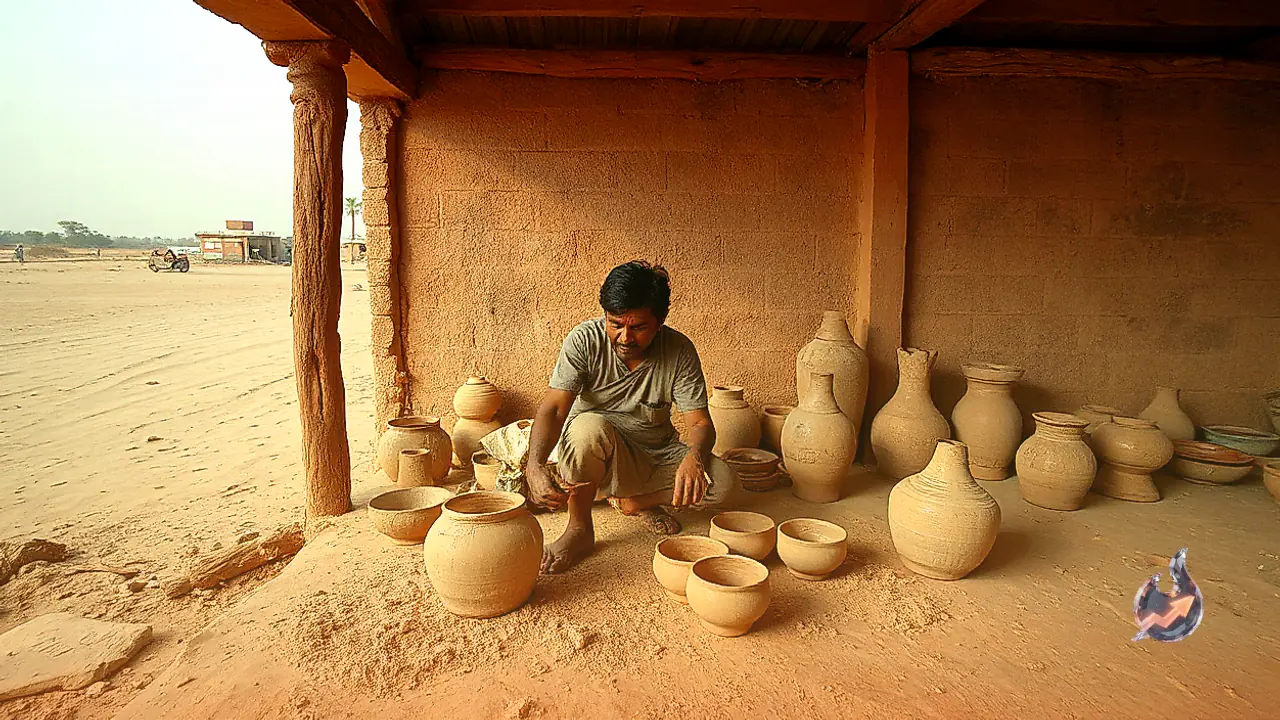

In Jharkhand's Palamu district, blending traditional earthen crafts with modern machinery has paved the way for a viable rural enterprise. Arjun Prajapati, a resident of the Nilambar-Pitambarpur block, has turned traditional clay cup manufacturing into an expansive commercial venture by tapping into government support provided by the Mati Kala Board. Replacing slow and physically demanding manual craftsmanship with electric pressing machines has reduced labor hours while multiplying daily output. With consumer demand for earthen tea cups continuing to grow across roadside stalls and markets, Prajapati now runs a profitable home-based enterprise that supports his family and creates regular employment for several villagers.
Mati Kala Board Subsidy and Mechanization
Crafting earthenware on manual potter wheels inherently limited the volume of pieces a craftsman could produce in a day. To scale beyond these bottlenecks, Arjun Prajapati sourced an automated pressing machine from outside the district, carrying a market cost of approximately Rs 75,000. Under the welfare initiative of the Mati Kala Board, he secured a 90 percent government subsidy, dramatically lowering the financial barrier to entry. This funding enabled him to install two pressing units at his workshop. Prajapati credits Arvind Sir for introducing him to the details of the government grant, which provided the initial push to set up the mechanized operation.
Clay Preparation Using Pug Mills and Slicing Machines
The manufacturing sequence begins with preparing soil to a precise consistency, as press molds require loose, evenly blended, and pliable clay. To achieve this, the workshop uses a pug mill that thoroughly churns and blends the raw mud into a uniform mass. After this mixing phase, an electric slicing machine refines the soil, rendering it loose, crumbly, and free of dense lumps. Once processed, the conditioned clay is placed directly into the molds of the pressing machines, where it is shaped into cups of varying sizes and designs. The tooling and calibration of these machines are straightforward, removing the technical hurdles that once slowed down batch production.
Surging Production: From 40 Units to Hundreds per Hour
Prior to mechanization, working entirely by hand allowed an experienced artisan to finish around 40 to 50 clay cups in an hour. This heavy physical exertion left little room to expand output or take on larger wholesale consignments. The introduction of the pressing machines has driven hourly output into several hundreds. Prajapati notes that in addition to higher volumes, the equipment makes it seamless to introduce varied aesthetic patterns and precise cup dimensions. The resulting uniformity appeals directly to commercial buyers, allowing the business to reliably service local traders and neighboring markets.
Generating Rs 40,000 to Rs 50,000 in Monthly Earnings
The economic returns from this workshop have proven substantial for a rural setting. Arjun Prajapati reports that after clearing all raw material, power, and overhead costs, the business nets between Rs 40,000 and Rs 50,000 in monthly profits. Lowering unit production times through machinery has widened profit margins while ensuring steady product turnover. Prajapati emphasizes that aligning production closely with commercial market demands allows clay pottery to offer far greater income security than migrating to distant cities for informal manual labor. The enterprise currently provides direct livelihood to two to four other local workers.
Empowering Village Women Through Home-Based Employment
The mechanized setup has opened up viable earning avenues for local women living in the immediate vicinity. Sangeeta Devi, who works at the workshop, explains that she previously stayed confined to domestic household duties before the machines made flexible, neighborhood employment possible. With previous familiarity in clay handling, she adapted quickly to the new setup and now produces approximately 150 clay cups in a single hour using the press machine. The simplicity and ergonomic ease of the machinery enable female workers to participate actively without excessive physical strain, with their wages directly supporting household budgets and children's education.
Dual Production of Festive Lamps and Kulhads
During festive periods, the workshop broadens its operational focus. In the run-up to Diwali, production lines are adjusted to manufacture clay lamps alongside the regular volume of tea cups, capitalizing on seasonal market spikes. The combined dedication of Prajapati and his team demonstrates how targeted welfare subsidies, dependable machinery, and hard work can convert traditional artisan skills into self-sustaining, community-level industries.