














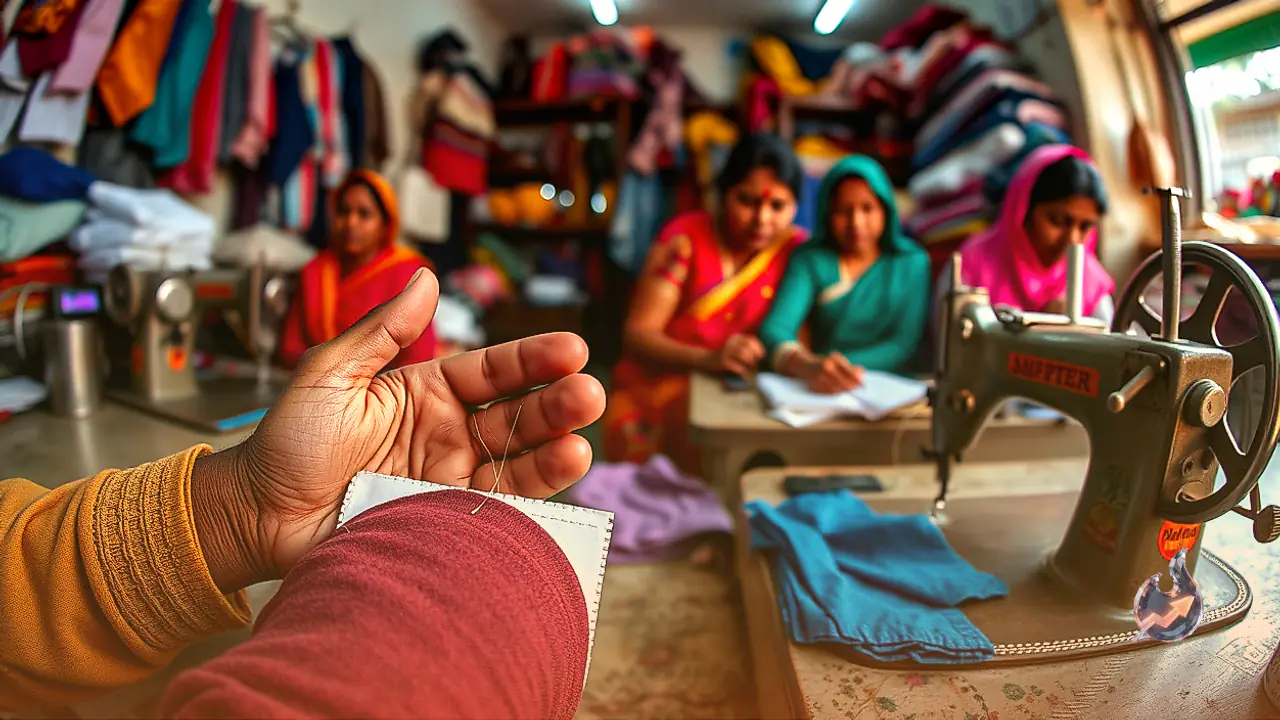

A tailoring establishment in Koderma, Jharkhand, has maintained an uninterrupted run of bespoke craftsmanship for more than a century, bridging the gap between historical hand-stitching techniques and contemporary styling. Operating continuously across five generations since its founding in 1919, the workshop has expanded its reputation well beyond local borders. Even amidst the dominance of mass-produced readymade garments, custom sizing and detailed tailoring remain in high demand among patrons seeking a personalized fit.
The Multi-Generational Transition Since 1919
The enterprise was founded in 1919 by Tafazzul Khalifa under the banner of Tafazzul Tailor. During that era, mechanical sewing machines were not accessible in the region, requiring him to assemble every garment entirely by hand with a simple needle and thread. The enterprise subsequently passed to his descendant, Wahid Khalifa, who took charge of daily operations and expanded the regional clientele. As sewing technology developed and machines entered common usage, the next generation under Abdul Rashid took over, renaming the enterprise Chola Tailor and incorporating mechanical stitching into the workflow.
In 2006, the stewardship of the family establishment transitioned to Parvez Alam. Adapting to the expectations of a changing market, Alam rebranded the business as Perfect Tailor. Under his leadership, the shop preserved the foundational precision developed by his predecessors while actively catering to modern cut and fit requirements.
Evolution of Tailoring Rates and Digital Influences
Pricing trends have shifted substantially over the last two decades. In 2006, the tailoring charge stood at 60 rupees for a shirt, 110 rupees for trousers, 275 rupees for a safari suit, and approximately 1500 rupees for a full suit. In contrast, current tailoring fees average around 1000 rupees for a shirt and trouser combination, while the charge for stitching a complete suit has risen to roughly 4500 rupees.
Modern customers frequently visit the workshop with digital references and fashion patterns saved directly from online platforms on their mobile phones, commissioning customized garments patterned after those concepts. A substantial segment of work also involves altering branded off-the-rack clothing. Because physical body dimensions vary widely across individuals in terms of height and build, standard factory sizes rarely offer an exact silhouette, prompting buyers to seek professional bespoke tailoring for alterations.
Clientele Extending to Bengaluru and Specialized Prep Work
Patronage for the establishment reaches well beyond Koderma to neighboring areas including Hazaribagh, Giridih, and Barkatha. The shop also handles long-distance orders through postal logistics; a native of Koderma currently residing in Bengaluru regularly dispatches unwoven fabric to Koderma via courier. Once the garments are cut, stitched, and verified for dimensions, they are returned to Bengaluru through the same courier channel.
Fabric care remains a central prerequisite of the tailoring process before scissors touch the material. Whenever cloth arrives at the facility, it is first thoroughly washed. Only after the material has dried completely does cutting and stitching commence, ensuring the finished garment retains its form without shrinking. While techniques and garment aesthetics have shifted across five generations, sustaining client confidence remains the central operational priority.